


Biography | Raoul Lufbery — He Fell on This Village in 1918, and the Legend Took Fifty Years to Correct
· 1918-5
Unreviewed contributionBy kevin · · Report an issue







































































Find memories left by people near you.
Distribute Bounty
This will distribute the bounty equally among all qualifying memories. This action cannot be undone.
Cancel Bounty
Are you sure you want to cancel this bounty? The remaining amount will be refunded to your account.
Success!
Operation completed successfully.
Error
Something went wrong.
Biography | Raoul Lufbery — He Fell on This Village in 1918, and the Legend Took Fifty Years to Correct
kevin
Eddie Rickenbacker told the version that stuck.
In his account the Nieuport 28 was burning, and Raoul Lufbery jumped from about two hundred feet rather than ride it down — a choice between two deaths, made in a second.
It is a good story.
The people of Maron, who were standing underneath it, told a different one.
Lufbery was born at Chamalières in the Puy-de-Dôme on 14 March 1885, to a French mother and an American father.
He grew up between two countries and worked his way around a third: a factory job in France, two years in the United States Army, then Asia as a travelling mechanic.
Flying reached him through Marc Pourpe, the French aviator he worked for as a mechanic before the war. When Pourpe was killed in a crash, Lufbery enlisted, and by 1916 he was flying with the Escadrille La Fayette, the squadron of American volunteers in French uniform.
He became its best-known pilot. Published tallies of his confirmed victories differ; the official figure is usually given as seventeen, and unofficial estimates run far higher.
In late 1917 he was commissioned a major in the United States Air Service, and in the spring of 1918 he joined the newly forming 94th Aero Squadron near Toul.
On 19 May 1918 he went up after a German two-seater and caught it over Maron, a few miles from the aerodrome.
He came out of the aircraft at low altitude and was killed. He was thirty-three.
Fifty years later, in the November–December 1968 issue of the Air University Review, Royal D. Frey set out what the witnesses on the ground had actually described.
The Nieuport was not on fire at all. Lufbery had unfastened his belt, reportedly to clear a jammed gun, and when the aircraft went inverted he fell from it.
Not a decision, then. An accident inside a fight.
He was buried at the aviators' cemetery at Sébastopol outside Nancy, and later moved to the crypt of the Escadrille La Fayette memorial at Marnes-la-Coquette, where he lies now.
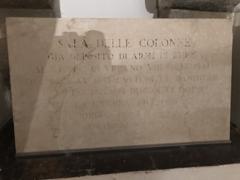
Two markers stay here. American airmen fixed the first at the crash site itself, on the house in whose garden he came down, about two hundred metres away.
The second was added on 18 May 2018, the eve of the centenary, to Maron's war memorial in front of the Église Saint-Gengoult, putting his name on the village's own list of its dead.
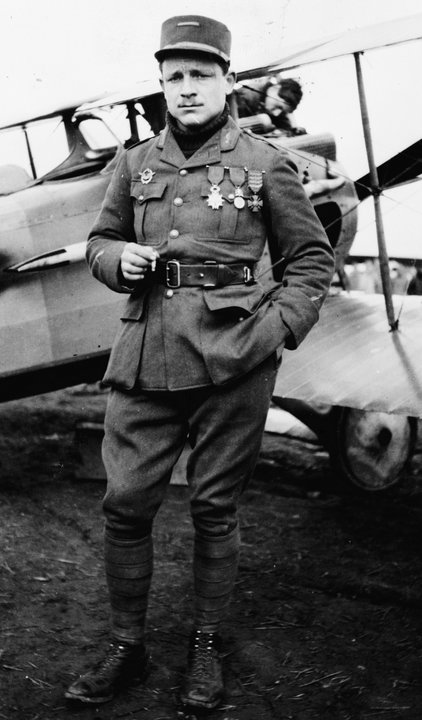
📸 Cover: Gervais Raoul Lufbery photographed between 1916 and 1918 in French uniform, wearing French decorations, in front of a Nieuport. Library of Congress Prints and Photographs Division, LC-USZ62-101970 (LCCN 90714838); credited "Copyright by R. Soubiran", public domain, via Wikimedia Commons.
changes?
delete this memory?
We detected that you have a Blox in your crypto wallet! We will import the Blox into your account.
Click on done below to complete the import.
Welcome Back!
Sign in to preserve cherished moments
Don't have an account?
Welcome!!
Sign up and start preserving cherished moments
?
?





Choose your payment method
Buy with Metablox Credit
Do you want to mint Blox with Metablox Credit?
Which Crypto would you like to use?
Purchase Confirmed!
Your Blox is being minted on-chain and will appear in your profile shortly.
Log in or sign up to claim your Blox.
How many credits do you want to buy?
$100 USD = 1 Metablox Credit = 1 Blox.
Use Metablox Credit to mint any Blox you want on the map.
 expand_more