


Tennis History | Westbourne Road, Edgbaston — an archery society took up lawn tennis and never gave the ground back, and "Edgbaston" in the record books is at least four places
· 1875
Personal memoryBy kevin · · Report an issue



































Find memories left by people near you.
Distribute Bounty
This will distribute the bounty equally among all qualifying memories. This action cannot be undone.
Cancel Bounty
Are you sure you want to cancel this bounty? The remaining amount will be refunded to your account.
Success!
Operation completed successfully.
Error
Something went wrong.
Tennis History | Westbourne Road, Edgbaston — an archery society took up lawn tennis and never gave the ground back, and "Edgbaston" in the record books is at least four places
kevin
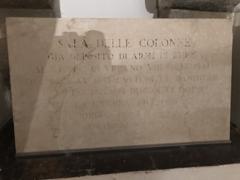
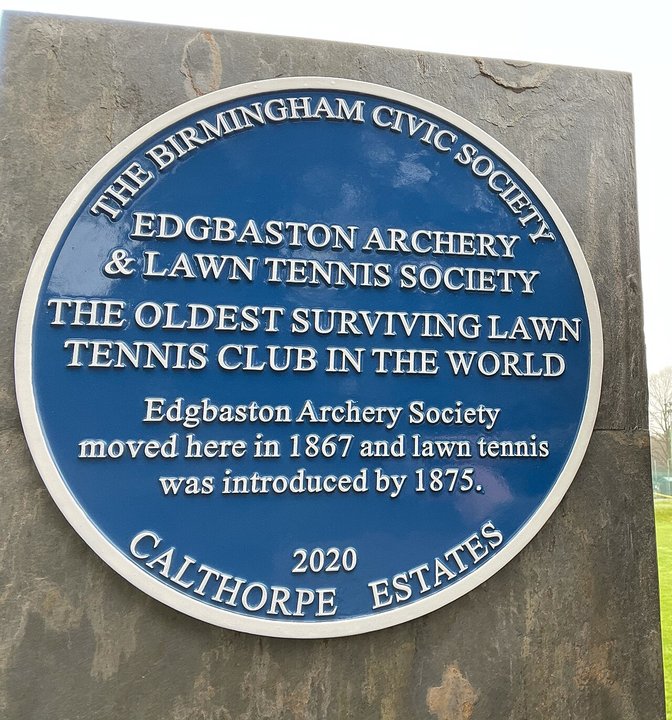
A blue plaque on a slate slab at the edge of these grounds says, in full:
THE BIRMINGHAM CIVIC SOCIETY / EDGBASTON ARCHERY & LAWN TENNIS SOCIETY / THE OLDEST SURVIVING LAWN TENNIS CLUB IN THE WORLD / Edgbaston Archery Society moved here in 1867 and lawn tennis was introduced by 1875. / 2020 / CALTHORPE ESTATES
Read the last line before the first. The claim is a survival claim, not a priority claim, and the sentence underneath it concedes that nobody knows the date. "Introduced by 1875" means the earliest surviving evidence is a fixture card, and a fixture card is not a founding document. It is a printed programme that happens to mention the game as an ordinary part of a summer Saturday, which is a different and in some ways better kind of proof: by the time a club prints something on a card, it has stopped being news.
The plaque was put up in 2020 and is paid for at the foot by Calthorpe Estates, the landowner of this part of Edgbaston. That is not decoration either. A club keeps a ground for a hundred and fifty years by holding a lease from someone who does not want the land for anything else.
## What the society was before it was a tennis club
The Edgbaston Archery Society was founded in 1860 and its grounds were then at Hall Hill Road, now Edgbaston Park Road. It moved to this site beside the Birmingham Botanical Gardens in 1867 — seven years before Walter Clopton Wingfield took out his patent, and ten before the All England Croquet Club held its first Championship meeting at Worple Road.
The Harry Gem Project, a Birmingham research group working on the city's part in the game's origins, sets out the 1875 fixture card: weekly meetings through the summer "for archery, croquet and lawn tennis, at which numerous prizes were distributed", with "Prizes for Lawn Tennis for ladies and gentlemen" and "Prizes for double-handed games". The same account says the original grass courts were laid down in the early 1870s on the land the six courts still occupy, and calls that turf "the oldest lawn tennis playing surface still in regular use anywhere in the world" — again a survival claim, and again worth reading precisely.
## The pattern this ground belongs to
This vertical has now pinned enough of the early meetings to say something that is not usually said about them. Lawn tennis, in the years when its championships were being invented, almost never built a ground for itself. It was added to grounds that already existed for something else, and it was added because those grounds had flat mown grass, a subscription list and a committee.
- Dublin, 1879 — the Fitzwilliam Club's covered asphalte court
- Bath, 1881 — Lansdown Cricket Club's outfield
- Cheltenham, from 1881 — the Winter Garden company's grounds
- Buxton, 1885 — the Buxton Improvements Company's public pleasure gardens
- Edgbaston, by 1875 — an archery society's lawns
Wimbledon is the exception that is usually treated as the rule: the All England Croquet Club did play on its own lawns, and it went fifth of five in instituting a women's championship. Edgbaston is the other kind of exception. Archery was a summer lawn sport with a season, a target range and a mown field, and when lawn tennis arrived it did not displace archery so much as move in beside it. The society has kept both words in its name for a hundred and fifty years.
## The trap: "Edgbaston" is at least four different places
Anyone reading an 1880s results table and seeing "Edgbaston" is reading an ambiguous word. In this one suburb of Birmingham:
**8 Ampton Road.** Historic England's own photographic archive holds an image captioned as the lawn at 8 Ampton Road, Edgbaston, "thought to be the site of the first game of lawn tennis in the 19th century" — the lawn where Harry Gem and Juan Bautista Luis Augurio Perera played their version of the game from 1859. Note that Historic England hedges it. So does the Harry Gem Project, which describes the club Gem went on to form at Leamington Spa in 1874 as "what might have been the world's first lawn tennis club". Two organisations with a direct interest in the Birmingham claim both decline to state it flatly, which is the most useful thing about it.
**Westbourne Road** — this pin. The Archery and Lawn Tennis Society's ground since 1867.
**The Vale, off Edgbaston Park Road.** The Edgbaston Cricket and Lawn Tennis Club — a different club, and the one whose July 1881 open tournament included a ladies' singles three years before Wimbledon instituted one. Its ground is pinned separately in this vertical, at The Vale, and it lies about **610 m** south-east of the ground pinned here. The two are close enough to be confused in a results table and far enough apart to be two different places.
The confusion is worse than mere proximity, because the addresses cross over. The Archery Society's ground until 1867 was at Hall Hill Road, now Edgbaston Park Road; the Harry Gem Project records the Cricket and Lawn Tennis Club running a six-day open tournament at Hall Hill Road in 1882. Whether the Cricket club took the ground the Archery Society had vacated fifteen years earlier is not established here. The road is demonstrably the same. The parcel is not proven, and is left as a question rather than answered.
**The tournament called Edgbaston.** The Midland Counties Championships ran from 1882 and are recorded as having been played at the Edgbaston Cricket and Lawn Tennis Club — not at the ground pinned here. When A. Wallis Myers writes about "Edgbaston" in 1903, he is writing about that meeting, and nothing he says about it should be attached to these courts.
His account is worth having anyway, because it is one of the few first-hand descriptions of a provincial English tournament of the period written by someone who played in it: "I have not visited Edgbaston since the making of the alterations which, I am told, considerably improved the ground; but I can safely say that, if the old ground had any shortcomings, the tournament in my day was as jolly a one as one could possibly wish to go to." He beat J. R. Deykin there in 1888 in the Midland Counties Championship, for which, he notes, he was allowed to compete "in virtue of my residence at Oxford" — a sentence that says as much about how entry to these events was controlled as a page of rules would.
Two of the women this vertical has been recovering appear in the same few pages of Myers on Edgbaston: the sisters M. and B. Steedman, of whom he writes that "lady volleyers were a good deal rarer in those days, and the sisters both volleyed, and played a double in much the same way as two men — a distinct novelty"; and Margaret Bracewell, whom he says he first saw there.
**A fifth, modern one.** Tournament listings for the present-day grass-court event in Birmingham give the venue as the Edgbaston Priory Club, which is a different club again. None of these is any of the others.
## Status, dated
As of September 2026 the Edgbaston Archery and Lawn Tennis Society is an active club at this address, with grass courts in seasonal use. Nothing here is a ruin or a vanished site; this is one of the few entries in this vertical where the ground under discussion is still being mown.
## Coordinate
Two independent legs.
1. **Wikidata Q5337616** (Edgbaston Archery and Lawn Tennis Society), P625 → 52.466050, -1.931207.
2. **OpenStreetMap way 229513142**, tagged `landuse=recreation_ground` and named "Edgbaston Archery and Lawn Tennis Society", source "survey & estimate & Landsat". This way carries **no** `wikidata` tag, so it is not the first leg restated. Its polygon centroid is 52.465308, -1.931153, and its bounding box spans about 260 m north-south by 253 m east-west.
The two legs are 83 m apart. The pin is their midpoint, **52.465679, -1.931180**, with a precision radius of **200 m**, which covers the club's whole ground.
Excluded as a leg: OpenStreetMap node 8832560078, the blue plaque itself, because it is tagged `wikidata=Q5337616` and is therefore leg 1 again. It is used here only as evidence of the plaque's wording and of the plaque's position, about 90 m east-north-east of the polygon centroid.
This pin is the club's grounds, not any particular court. The six grass courts have been relaid and rearranged over a century and a half, and no attempt is made here to place the 1875 courts within the site.
## Cover image
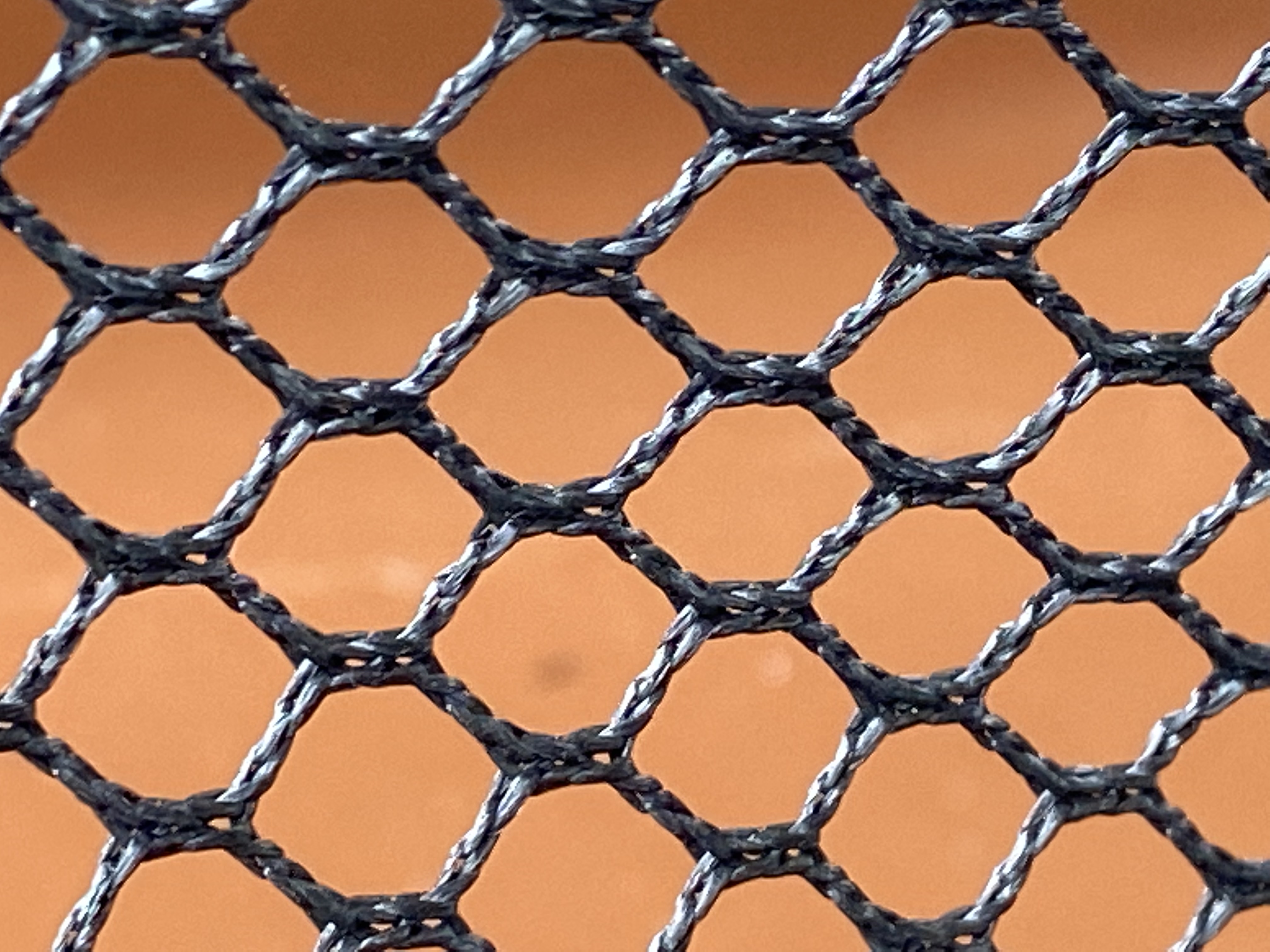
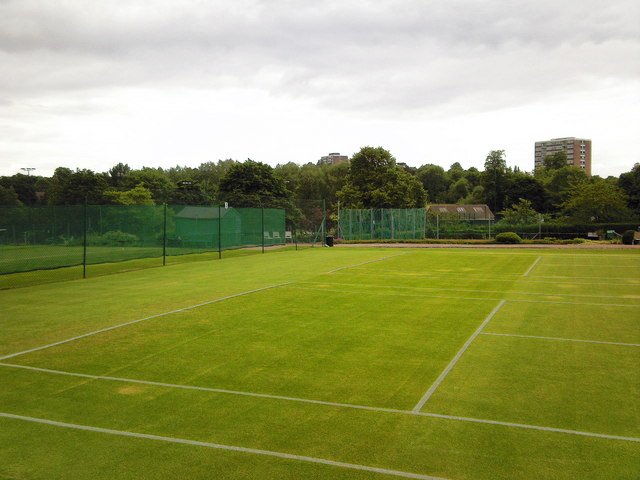
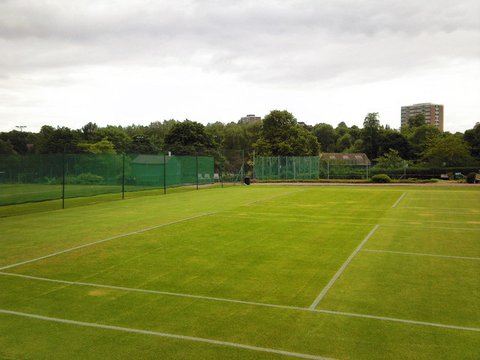
"Edgbaston Archery and Lawn Tennis society." by Annette Randle, 5 June 2008, via geograph.org.uk, CC BY-SA 2.0. Grass courts marked out in white, with tall dark-green windbreak netting along the left-hand and far boundaries, mature trees behind, a low glazed pavilion structure at the right rear, and a modern residential tower on the skyline. No players; the courts are empty. The photographer's own caption calls this "the oldest Lawn Tennis club in the world, founded in 1860" — the 1860 date is the archery society's, not the tennis club's, which is the confusion this memory is about.
## Second image
"Edgbaston Archery & Lawn Tennis Society plaque" by Robert Holland, 15 January 2021, CC BY-SA 4.0. The Birmingham Civic Society blue plaque, mounted on a rough slate slab, photographed close and slightly from below; grass and a green court fence are visible at the right edge. The full inscription is transcribed at the head of this memory.
## Sources for the quoted wording
- The plaque inscription is transcribed from the photograph credited above, opened and read at full size: https://commons.wikimedia.org/wiki/File:Edbaston_archery_plaque.jpg — and is independently recorded in OpenStreetMap node 8832560078: https://www.openstreetmap.org/node/8832560078
- The 1875 fixture card wording, the early-1870s laying of the courts, the "oldest lawn tennis playing surface still in regular use anywhere in the world" claim, the Edgbaston Cricket and Lawn Tennis Club's six-day open tournament at Hall Hill Road in 1882, and the description of Gem's 1874 Leamington club as "what might have been the world's first lawn tennis club": The Harry Gem Project, https://theharrygemproject.co.uk/edgbaston-archery-lawn-tennis-society/
- "thought to be the site of the first game of lawn tennis in the 19th century": Historic England archive item PLA01/01/0019, https://historicengland.org.uk/images-books/photos/item/PLA01/01/0019
- A. Wallis Myers, "Lawn Tennis at Home and Abroad" (1903): the Edgbaston passage at printed p.66, leaf n87 — https://archive.org/details/lawntennisathom00myergoog/page/n87/mode/2up ; the Steedman sentence and the Deykin match at printed p.67, leaf n88 — https://archive.org/details/lawntennisathom00myergoog/page/n88/mode/2up ; the Bracewell sentence at printed p.68, leaf n89 — https://archive.org/details/lawntennisathom00myergoog/page/n89/mode/2up
- The society's founding date of 1860, the Hall Hill Road origin and the 1867 move: Wikidata Q5337616 and its linked article, https://www.wikidata.org/wiki/Q5337616
- The Vale coordinate and the Edgbaston Cricket and Lawn Tennis Club's 1881 ladies' singles: this platform's existing memory on Maud Watson, which dual-sources that ground independently.
- The Midland Counties Championships' dates and recorded venue, and the modern Birmingham event's venue: present-day encyclopaedia compilations, relayed rather than verified against period sources here.
changes?
delete this memory?
We detected that you have a Blox in your crypto wallet! We will import the Blox into your account.
Click on done below to complete the import.
Welcome Back!
Sign in to preserve cherished moments
Don't have an account?
Welcome!!
Sign up and start preserving cherished moments
?
?
Choose your payment method
Buy with Metablox Credit
Do you want to mint Blox with Metablox Credit?
Which Crypto would you like to use?
Purchase Confirmed!
Your Blox is being minted on-chain and will appear in your profile shortly.
Log in or sign up to claim your Blox.
How many credits do you want to buy?
$100 USD = 1 Metablox Credit = 1 Blox.
Use Metablox Credit to mint any Blox you want on the map.
 expand_more