


Biography | Henry Kissinger — The Kremlin Hall Where Détente Reached the Signing Table
Kremlin, Global, Earth · 1972-5
Unreviewed contributionBy kevin · · updated · Report an issue





















Distribute Bounty
This will distribute the bounty equally among all qualifying memories. This action cannot be undone.
Cancel Bounty
Are you sure you want to cancel this bounty? The remaining amount will be refunded to your account.
Success!
Operation completed successfully.
Error
Something went wrong.

Biography | Henry Kissinger — The Kremlin Hall Where Détente Reached the Signing Table
kevin
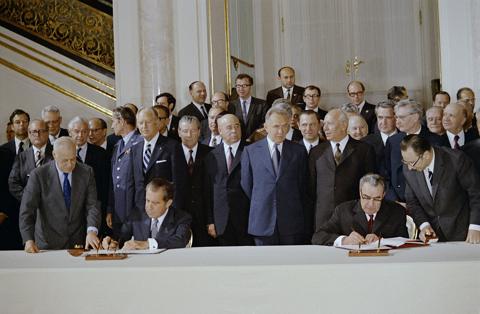
Late on 26 May 1972, a ceremony inside Moscow’s Grand Kremlin Palace turned years of strategic bargaining into the first formal restraints on the two largest nuclear arsenals.
Richard Nixon and Leonid Brezhnev sat at a long table in St. Vladimir Hall and signed the Anti-Ballistic Missile Treaty together with an Interim Agreement on offensive arms.
Henry Kissinger’s name was not on either signature line.
His role was the architecture around the signatures: as national security adviser, he helped make arms control part of the wider Nixon administration strategy of détente with the Soviet Union.
The U.S. State Department later called SALT I the crowning achievement of the Nixon–Kissinger approach.
A Nixon Presidential Library account also places Kissinger inside the hall during the ceremony, where White House chief of staff H. R. Haldeman spoke with him while the documents were being signed.
The agreements followed negotiations that had begun in November 1969 and survived sharp disputes over unlike American and Soviet forces.
Their achievement was real but narrower than later memory sometimes suggests.
The interim accord capped intercontinental-ballistic-missile silos and submarine-launched-ballistic-missile forces, while the ABM Treaty constrained nationwide missile defenses.
For the first time in the Cold War, Washington and Moscow had accepted negotiated limits on central elements of their strategic competition.
Yet SALT I did not cap nuclear warhead totals or strategic bombers, and multiple-warhead technology still allowed both sides to expand striking power.
Kissinger himself later argued that the Moscow discussions showed why heads of government should not try to settle highly technical arms questions without detailed preparation.
That observation fits the scene: the public ceremony looked controlled and conclusive, while the negotiating record behind it remained technical, contested and incomplete.
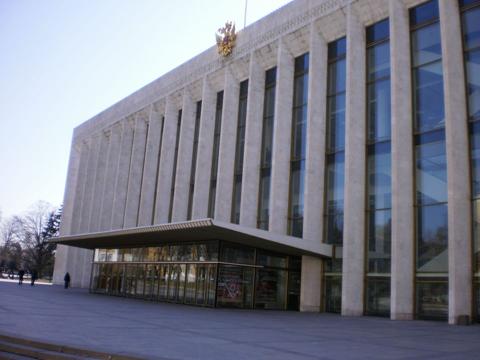
The map pin marks the Grand Kremlin Palace building at 55.750000, 37.615833, based on Wikimedia’s building coordinate; it does not pretend to identify a separate latitude and longitude for St. Vladimir Hall inside the palace.
This was therefore neither the end of the arms race nor a merely ceremonial photograph.
It was the place where Kissinger’s practice of linking summit diplomacy, strategic calculation and limited agreements acquired its clearest public form.
Photo: White House Photo Office / U.S. National Archives, public domain, showing Nixon and Brezhnev signing the ABM Treaty and Interim SALT Agreement in St. Vladimir Hall on 26 May 1972.



changes?
delete this memory?
We detected that you have a Blox in your crypto wallet! We will import the Blox into your account.
Click on done below to complete the import.
Welcome Back!
Sign in to preserve cherished moments
Don't have an account?
Welcome!!
Sign up and start preserving cherished moments
?
?

Choose your payment method
Buy with Metablox Credit
Do you want to mint Blox with Metablox Credit?
Which Crypto would you like to use?
Purchase Confirmed!
Your Blox is being minted on-chain and will appear in your profile shortly.
Log in or sign up to claim your Blox.
How many credits do you want to buy?
$100 USD = 1 Metablox Credit = 1 Blox.
Use Metablox Credit to mint any Blox you want on the map.
 expand_more