


NFL History | Three Rivers Stadium, Pittsburgh — An Exact Marker for an Unsettled Play
Global, Earth · 1972-12
Personal memoryBy kevin · · updated · Report an issue






















Distribute Bounty
This will distribute the bounty equally among all qualifying memories. This action cannot be undone.
Cancel Bounty
Are you sure you want to cancel this bounty? The remaining amount will be refunded to your account.
Success!
Operation completed successfully.
Error
Something went wrong.
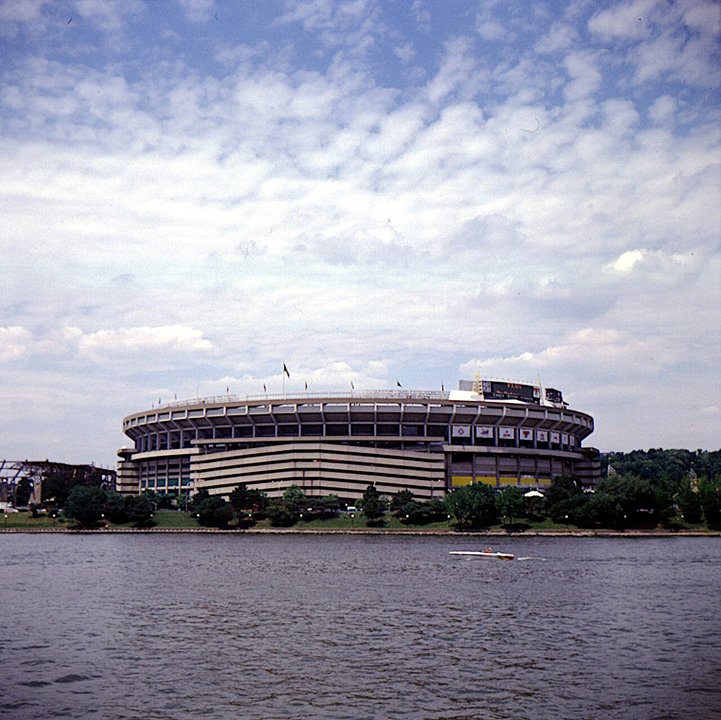
NFL History | Three Rivers Stadium, Pittsburgh — An Exact Marker for an Unsettled Play
kevin
Three markers stand for one play here, and one of them is on the exact spot where the ball was caught — a street that exists only because the building was destroyed.
On 23 December 1972 the Steelers played the Raiders here in an AFC divisional playoff, in front of 50,327 people, on NBC, with Fred Swearingen refereeing. Pittsburgh trailed 7–6 and faced fourth down and ten at its own 40 with twenty-two seconds left. Terry Bradshaw threw toward Frenchy Fuqua. Fuqua and Jack Tatum arrived together, the ball came back off the collision, and Franco Harris caught it close to the artificial turf and ran it into the end zone. Pittsburgh won 13–7, the first playoff victory in the franchise's history.
Whether it should have counted has never been settled, and the reason is a rule that no longer exists. The rules then did not permit two offensive players to touch a forward pass in succession. If the ball came off Fuqua alone, the play was dead and the Raiders had won. If it came off Tatum, a defender, the catch was good. The officials ruled a touchdown after a long delay. Fuqua, who is the one person who would know, has spent fifty years declining to say.
So the honest description is not that a great play was disputed. It is that the outcome of a playoff game turned on a question of fact that the only available witness has chosen not to answer, and that the rule which made the question matter has since been changed.
The broadcaster Myron Cope gave it the name. The NFL Network later ranked it the greatest play in the league's history, which is the league's own assessment of its own past and should be read as such.
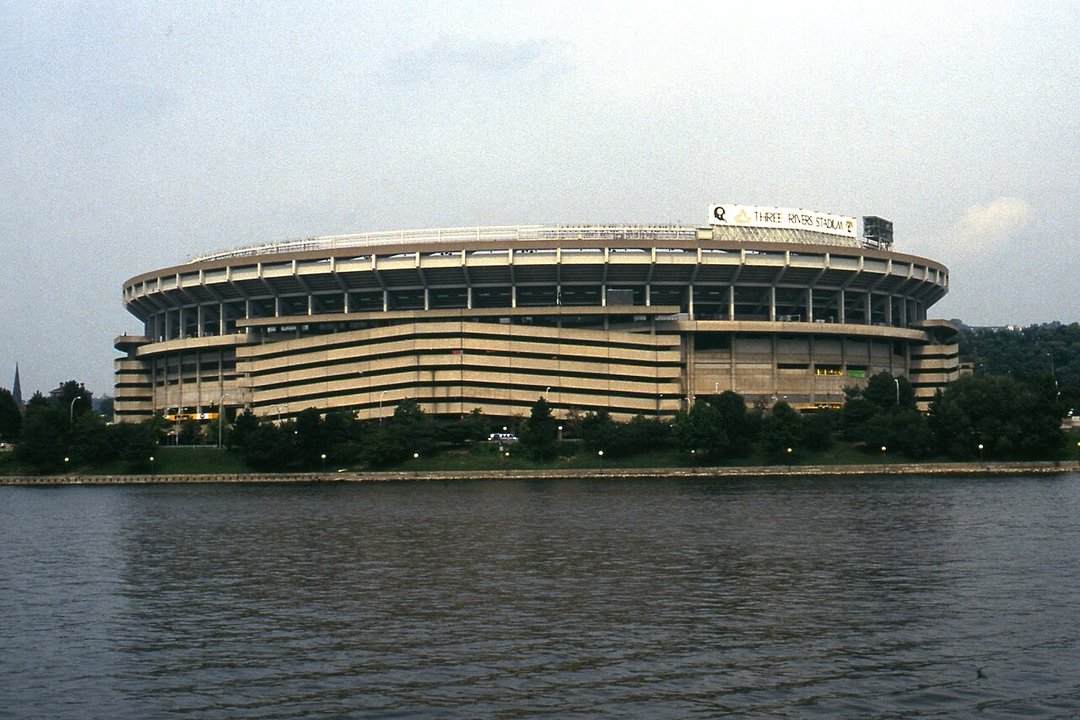
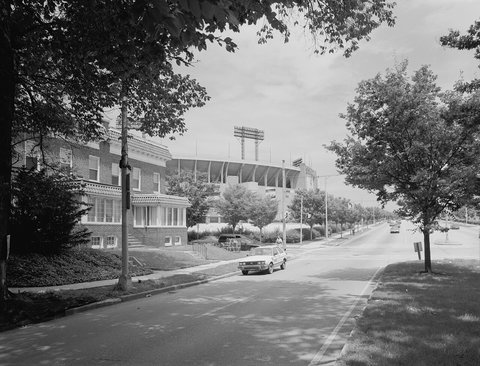
The stadium opened on 16 July 1970 and was imploded on the morning of 11 February 2001. What replaced it is roads, office buildings, parking and a concert venue. Nothing of the structure survives on the site.
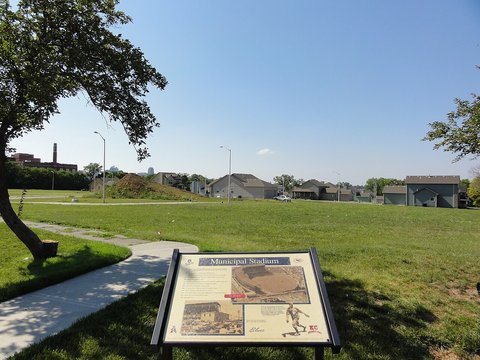
The commemoration, by contrast, is unusually exact. A Pennsylvania state marker went up on the North Shore in 2006. A gate pylon was moved to stand near the Steelers' current stadium. And in December 2012, on the eve of the fortieth anniversary, a monument was unveiled at the precise spot where Harris made the catch, on West General Robinson Street, a road laid across the cleared footprint after the rubble went. Harris stood on the spot at the unveiling. It was the third marker the Heinz History Center commissioned for the play; the others are statues at Pittsburgh's airport and at the Western Pennsylvania Sports Museum.
An earlier version of this memory opened by calling this the most precisely marked spot in professional football. Nothing was ever counted behind that, and no survey of markers exists to count. What can be counted is in the paragraph above: three markers commissioned by one institution for a single play, one of them set at the catch site itself. That is the claim this memory now makes, and it is narrow enough to check.
Three markers, a named street corner and an exact position, for a play nobody can prove was legal, in a building that no longer exists.
Coordinate: the stadium footprint, not the monument. The Wikidata point and the West General Robinson Street segment laid across the cleared site agree to within about 60 m, and the street running through the footprint is itself the corroboration. Precision ±150 m.
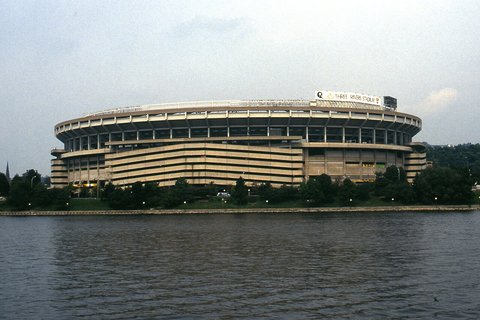
Cover: Three Rivers Stadium from across the Allegheny in September 1992, the name still on the roof board. Photo: Steve Tiesdell Legacy Collection, CC BY 2.0, via Wikimedia Commons.
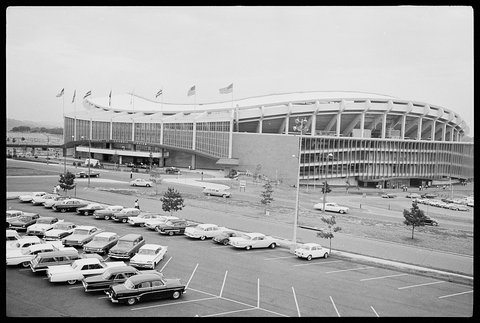
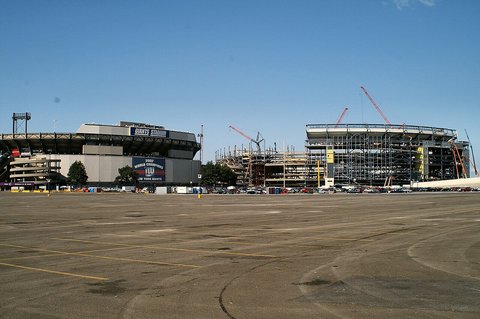
Second image: the stadium seen from Point State Park, photographer Cbaile19, CC0, via Wikimedia Commons. A caution on this file: Commons dates it 14 June 2001, which cannot be right, because the stadium was imploded on 11 February that year and the trees in the frame are in full leaf. The photograph shows the building standing; the year is not established.

changes?
delete this memory?
We detected that you have a Blox in your crypto wallet! We will import the Blox into your account.
Click on done below to complete the import.
Welcome Back!
Sign in to preserve cherished moments
Don't have an account?
Welcome!!
Sign up and start preserving cherished moments
?
?


Choose your payment method
Buy with Metablox Credit
Do you want to mint Blox with Metablox Credit?
Which Crypto would you like to use?
Purchase Confirmed!
Your Blox is being minted on-chain and will appear in your profile shortly.
Log in or sign up to claim your Blox.
How many credits do you want to buy?
$100 USD = 1 Metablox Credit = 1 Blox.
Use Metablox Credit to mint any Blox you want on the map.
 expand_more