


NFL History | Comiskey Park Site, Chicago — One Architect Drew Both Football Ballparks
· 1947-12
Personal memoryBy kevin · · updated · Report an issue













































Find memories left by people near you.
Distribute Bounty
This will distribute the bounty equally among all qualifying memories. This action cannot be undone.
Cancel Bounty
Are you sure you want to cancel this bounty? The remaining amount will be refunded to your account.
Success!
Operation completed successfully.
Error
Something went wrong.
NFL History | Comiskey Park Site, Chicago — One Architect Drew Both Football Ballparks
kevin
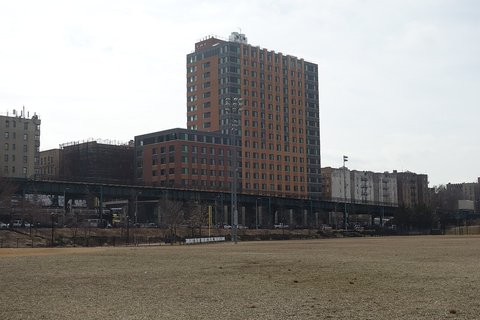
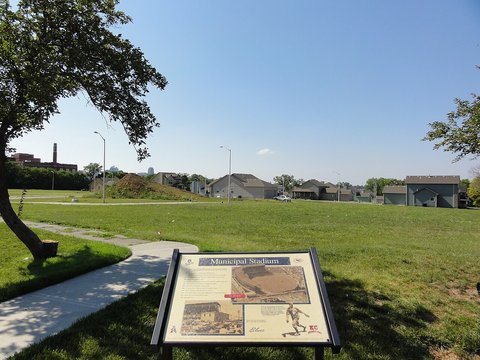
A marker in a parking lot on South Shields Avenue, east of West 35th Street, records where home plate used to be. The Historical Marker Database gives its text as nothing more than the name of the ballpark, the years 1910 and 1990, and the words identifying what the spot was. Its location description places the marker just south of a parking lot serving the ballpark built beside it. The ground the marker belongs to was demolished in 1991, on the account of the Chicago History Museum.
It was a professional football address as well as a baseball one, and the reason it was one is the argument of this entry.
The league had two clubs in this city at the same time. Pro-Football-Reference's schedule table for the 1947 Chicago Cardinals lists the Chicago Bears twice among their opponents that season. Neither club built anything of its own. The Bears rented a baseball park on the north side and the Cardinals rented this one on the south side, and Chicago's professional football was divided between two grounds neither club owned.
The detail that makes the division concrete is architectural. George W. Hilton, writing on this ballpark in the 1974 Baseball Research Journal for the Society for American Baseball Research, records that it was designed by the Chicago architect Zachary Taylor Davis, and that Davis went on to design Wrigley Field. Another entry in this series deals with the Bears at Wrigley Field. Both of the grounds that housed professional football in Chicago, then, came off the same drawing board, and both clubs paid rent to a baseball landlord to use them.
Hilton records that the lot, at 35th Street and Shields Avenue, was bought in February 1909 from the estate of Chicago's first mayor for one hundred thousand dollars, and that it measured six hundred feet square. Ground was broken around 15 February 1910. He gives the investment in the park as variously reported between five hundred thousand and seven hundred and fifty thousand dollars, and this entry prints his range rather than choosing inside it. He gives the original design capacity as thirty-five thousand, expanded to about forty-one thousand by the mid-1920s. Those are baseball figures. No source consulted here states what the ground held when it was laid out for football, so they are not applied to any football crowd below.
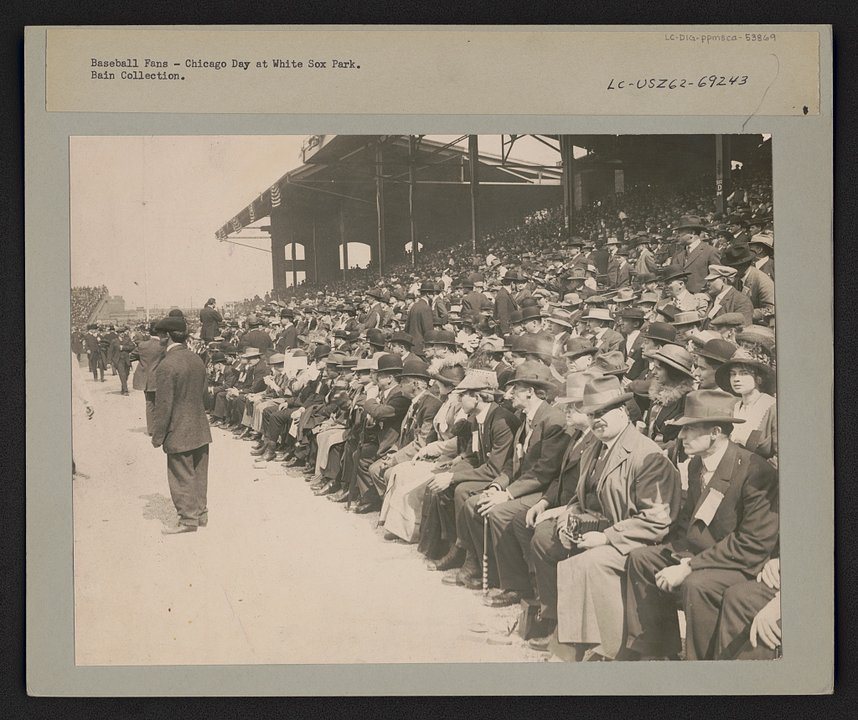
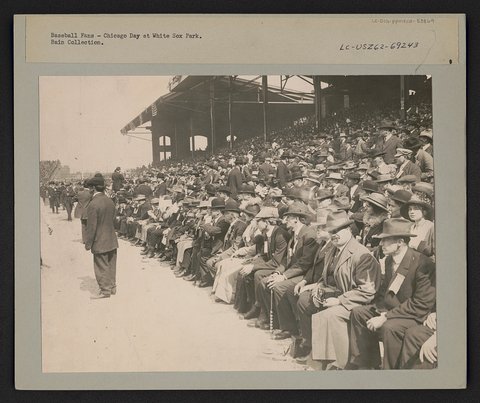
Heidi Samuelson, writing for the Chicago History Museum on 30 September 2020, records that the ballpark opened as White Sox Park and was renamed after the club's owner some years later. That earlier name is visible on this entry's cover image, which is discussed at the end.
Pro-Football-Reference's page for the ground gives the football tenancy in figures. The Chicago Cardinals played here from 1922 to 1958: one hundred and thirty-four games, a regular-season record of 62 wins, 65 losses and 6 ties, and a postseason record of 1 win and no losses. The first game is dated 22 October 1922, a Cardinals win over the Minneapolis Marines by 3 points to nil. The last is dated 30 November 1958, a Los Angeles Rams win by 20 points to 14. That single postseason win is the game this entry is dated to.
Before it, the ground produced an afternoon that is recorded in two places and described differently in each. Hilton records that Ernie Nevers scored forty points here against the Bears on Thanksgiving Day 1929. The Pro Football Hall of Fame gives the same performance the date 28 November 1929, a Cardinals win by 40 points to 6, with Nevers scoring all of his team's points on six touchdowns and four conversions, and describes the mark as the one among the league's records that has survived longest. The two accounts agree on the year and on what Nevers did; they describe the day differently, and this entry does not decide between them. Nor does it claim anything about whether the mark stands now.
The 1947 season is the one that ended here. Pro-Football-Reference records the Cardinals at 9 wins and 3 losses, first in the league's Western Division, under Jimmy Conzelman. The Pro Football Hall of Fame, in a piece published on 1 January 2005, records that the club's owner, Charles Bidwill, had signed the halfback Charley Trippi to what the Hall describes as the largest contract in professional football, at one hundred thousand dollars, and that Bidwill died in April, before the season was played.
The championship game was played on 28 December 1947. The Hall of Fame describes the turf as frozen. Pro-Football-Reference's box score gives the quarters as Philadelphia 0, 7, 7, 7 and Chicago 7, 7, 7, 7, for a final of 28 points to 21, and the attendance as 30,759. No halftime figure is given here; the quarters are printed as the box score prints them.
The Hall of Fame's account of the scoring is what the frozen ground produced. Trippi ran 44 yards in the first quarter and returned a punt 75 yards in the third. Elmer Angsman ran 70 yards in the second quarter and 70 yards again in the fourth. Pat Harder kicked the conversions. Steve Van Buren scored from one yard for Philadelphia. Four touchdowns, and not one of them short.
What followed is recorded in Pro-Football-Reference's franchise table rather than argued here. The franchise appears as the Chicago Cardinals, then St. Louis from 1960, Phoenix from 1988 and Arizona from 1994. The same table credits it with two league championships and no Super Bowl victories in one appearance, lost after the 2008 season. This entry establishes the 1947 title. It does not establish which year the other championship falls in, and it makes no claim about the franchise's championship record since.
One rule that runs through several entries in this series does not reach this address, and it is worth saying so rather than leaving it implied. The requirement that a home stadium seat more than fifty thousand belongs to the period after the 1970 merger. Pro-Football-Reference dates the last professional football game on this ground to 1958. No source consulted here connects the rule to this ballpark, and this entry does not.
Coordinate. The published position, 41.831545 north, 87.634327 west, is the field GPS reading the Historical Marker Database gives for the home-plate marker, a point physically inside the old footprint. A second and independent record was obtained: the United States Census Bureau's TIGER geocoder returns 41.830951 north, 87.635107 west for 324 West 35th Street, the street address Pro-Football-Reference gives for the ground, on a matched string read as 324 W 35TH ST, CHICAGO, IL, 60616. The two readings differ, and the difference is explicable rather than troubling. An interpolation test on the same street, 400 West 35th Street, returned a separate point at effectively the same latitude, which establishes that the TIGER result is a point on 35th Street, the block's northern boundary, while the marker sits inside the block to the south and east. No distance between the two readings is computed here. The precision radius of 150 metres is sized from the six-hundred-foot-square lot Hilton describes, not from the decimal places of either reading. The marker is a volunteer-compiled record and is one record.
Status note, September 2026. This entry describes the ballpark, its lot, its dimensions and its capacities as its sources record them, the most recent of those revised in 2020. Nothing in it establishes what stands on the block today beyond the parking lot the marker's own location description places it in, nor what use is made of the site now.
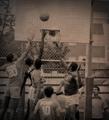
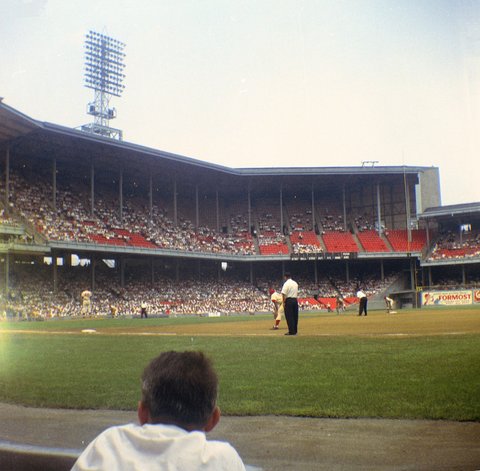
Cover image. Baseball Fans - Chicago Day at White Sox Park, Bain Collection, Library of Congress Prints and Photographs Division, LC-DIG-ppmsca-53869 and LC-USZ62-69243, dated 1910 by the Library, rights advisory: no known restrictions on publication. It is a photograph of a baseball crowd, not a football crowd, and the Library dates it to 1910 while the game this entry is dated to was played in 1947. It is used because it shows the ground itself: the steel grandstand and its roof columns, and spectators overflowing from the stands onto the playing surface along a foul line. The print is mounted on a card whose typed caption block names the ground as White Sox Park, the earlier name recorded above. No free photograph of professional football at this ballpark was found for this entry, and the four Library of Congress results returned for the ballpark are all baseball. There is no second image.


changes?
delete this memory?
We detected that you have a Blox in your crypto wallet! We will import the Blox into your account.
Click on done below to complete the import.
Welcome Back!
Sign in to preserve cherished moments
Don't have an account?
Welcome!!
Sign up and start preserving cherished moments
?
?




Choose your payment method
Buy with Metablox Credit
Do you want to mint Blox with Metablox Credit?
Which Crypto would you like to use?
Purchase Confirmed!
Your Blox is being minted on-chain and will appear in your profile shortly.
Log in or sign up to claim your Blox.
How many credits do you want to buy?
$100 USD = 1 Metablox Credit = 1 Blox.
Use Metablox Credit to mint any Blox you want on the map.
 expand_more