


Biography | Margaret Bracewell — champion of the North of England and of the South of England in the same two years, and first holder of the All England ladies' doubles at Buxton, 1885-1888
· 1885
Personal memoryBy kevin · · Report an issue








































Find memories left by people near you.
Distribute Bounty
This will distribute the bounty equally among all qualifying memories. This action cannot be undone.
Cancel Bounty
Are you sure you want to cancel this bounty? The remaining amount will be refunded to your account.
Success!
Operation completed successfully.
Error
Something went wrong.
Biography | Margaret Bracewell — champion of the North of England and of the South of England in the same two years, and first holder of the All England ladies' doubles at Buxton, 1885-1888
kevin
The Badminton Library's 1890 volume on lawn tennis never prints her first name. Its index has one line — "Bracewell, Miss, 168, 438, 442" — and the three pages behind those numbers contain, between them, the whole of what a contemporary reference work thought worth recording about a player who was holding two English regional championships at once.
She is worth a memory because of what the three pages say when they are read together, which is something none of them says alone.
## Buxton, 1885: the first holder of a title that had just been invented
The 1890 volume, at printed page 168, describes the season of 1885:
"Another new championship dates from this year. It was instituted by the managers of the Buxton Tournament under the title of 'Ladies' double championship,' and has been repeated annually at the same place. The winners on the first occasion were Mrs. Watts and Miss Bracewell."
The volume's own tabulated roll, at printed page 438, sets the same event under the heading ALL ENGLAND CHAMPIONSHIPS with the parenthesis "(Played at Buxton)", and gives 1885 to Mrs. Watts and Miss Bracewell, then three consecutive years to Miss L. Dod and Miss M. Langrishe, then 1889 to the sisters M. and B. Steedman. A. Wallis Myers, writing thirteen years later, corroborates it independently: "Buxton, the home of the All-England Ladies' Doubles Championship, instituted in 1885, and first won by Mrs. Watts and Miss Bracewell".
Two things follow. The first is that an All England championship was instituted in 1885 by "the managers" of a tournament in a Derbyshire spa town — a title was something a meeting's committee could name into existence, not something a governing body allocated. The second is that Bracewell's name stands at the head of that roll, and has stood there, unread, for a hundred and forty years.
Neither volume gives Mrs. Watts a forename. Present-day reference sites supply one; it was not corroborated in a period source for this memory and is therefore not printed here.
## 1886 and 1887: champion of the North and champion of the South at the same time
The same appendix, a few pages later, carries the winners' tables of the regional meetings. Two of them matter here.
**North of England Championships (played at Scarborough):** ladies' singles — 1886 Miss Bracewell, 1887 Miss Bracewell, 1888 Miss Bracewell. She also took the ladies' doubles there in 1886 with Miss Mardall.
**South of England Championships (played at Eastbourne):** ladies' singles — 1885 Miss Bingley, 1886 Miss Bracewell, 1887 Miss Bracewell, 1888 Mrs. Hillyard.
For two consecutive seasons the ladies' championship of the North of England and the ladies' championship of the South of England were held by the same woman. Devonshire Park at Eastbourne and the South Cliff ground at Scarborough are roughly 270 miles apart, and the two meetings had nothing to do with each other beyond both having decided, independently, to call their winner a champion.
This is the clearest demonstration available of how the word worked in the 1880s. A championship was a tournament's property. It described the meeting that awarded it, not a territory it was won over, and there was no authority whose business it was to say that "the North" and "the South" ought to be mutually exclusive — or, for that matter, that a Derbyshire tournament committee could not call its doubles event an All England championship. The Lawn Tennis Association, founded in 1888, is described in the 1890 volume's own account in terms of the laws it made, not of titles it allocated.
## The Midland Counties, and a caution about the word "Edgbaston"
Present-day compilations credit Bracewell with the Midland Counties Championships ladies' singles in 1885, 1887 and 1888 — beating Mary Steedman in the first of those finals and Florence Mardall in the other two. Those results are relayed from modern reference sites and were not confirmed here against a period source; they are recorded as claims, not as findings.
The venue, though, is the point. The Midland Counties Championships are recorded as having been played at the Edgbaston Cricket and Lawn Tennis Club — which is not the Edgbaston Archery and Lawn Tennis Society on Westbourne Road, the surviving club pinned separately in this vertical, and not the Edgbaston Priory Club of modern tournament listings, and not the lawn at 8 Ampton Road where Harry Gem and Augurio Perera played from 1859. Four places in one Birmingham suburb answer to "Edgbaston". A career summary that lists a player's Edgbaston titles without saying which club is not, on its own, telling the reader where she played.
The 1890 volume also records a Cheltenham ladies' doubles won by Miss Bracewell and Miss Bingley. The year column at that point in the scanned copy is garbled and illegible, so the year is left out rather than guessed.
## The only description of her playing that survives
Myers, who umpired in this period before he became the game's best-known correspondent, saw her at the Edgbaston meeting and wrote this:
"Here, too, I first saw Miss Bracewell, one of the pluckiest players going, but hampered to some extent by an extremely nervous temperament. I once umpired a terrific match in which she completely broke down under the strain and excitement, and had to stop playing. But after a brief interval she went on again and, though defeated ultimately, kept up her form to the bitter end."
That is one man's account of one match, written from the umpire's chair some fifteen years after the fact, and it is reported here as his words rather than as a description of her. He goes straight on to a comparison worth keeping: "The easy nonchalance and off-hand manner of the cracks (of both sexes) of to-day is admirable enough and, of course, eminently British; but there was something rather taking about the deadly keenness with which some of these old-time battles were fought out."
## What is not known
No forename appears for her in either of the two period volumes used here. The forename "Margaret" comes from present-day tabulations of the 1880s seasons and is relayed, not verified. No birth or death date was established. No portrait of her was found in either volume's plates or in a free-licensed collection, which is why this memory is illustrated with the place rather than the person.
## Why the pin is here
This is a career pin at the ground where she won the title that makes her worth recording — the All England Ladies' Doubles Championship, on its first occasion, in 1885 — following the same practice as the other biographies in this vertical. No residence, birthplace or grave is pinned, because none is known.
## Coordinate
The pin is the Pavilion Gardens at Buxton, established on two independent legs:
1. **Wikidata Q84178744** (Buxton Pavilion Gardens), P625 → 53.256, -1.919.
2. **Historic England register entry 1000675**, Pavilion Gardens, Buxton, a Registered Park or Garden at **Grade II***, first registered 4 August 1984, National Grid Reference **SK 05296 73313**, converted from OSGB36 to WGS84 → 53.256798, -1.922075.
The two legs are 223 m apart, and the divergence is not smoothed: the registered area extends further west than the modern park polygon, so its centre sits west of the polygon's centre. The pin is the midpoint, **53.256399, -1.920538**, with a precision radius of **300 m**.
This pin is the gardens, not a court. Historic England's own description notes that the head gardener Adam Hogg probably laid out the western extension of the park in 1880, "possibly to designs by R R Duke, who shows it on a map of 1887 with a tennis court alongside" — two years after the championship described here, and an inference from a map description rather than a located baseline. Where the 1885 courts stood within the grounds is not established.
## Cover image
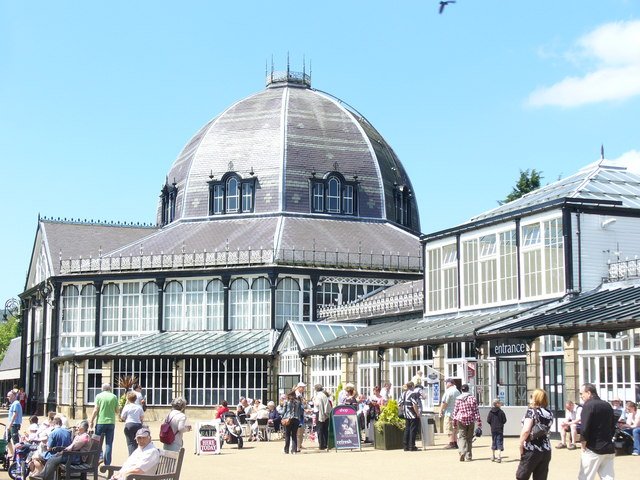
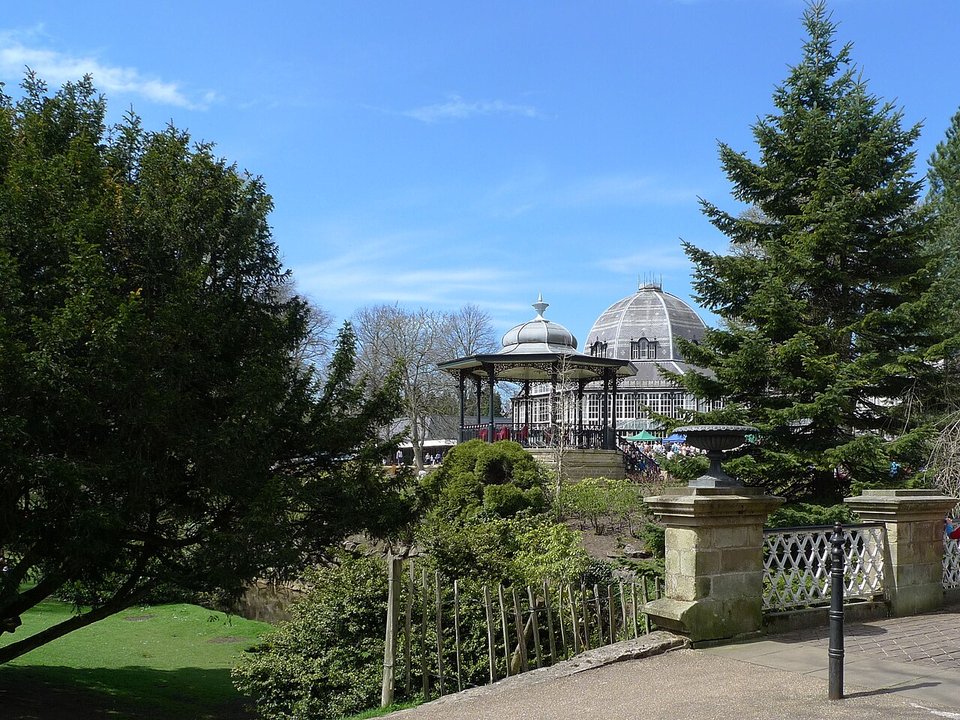
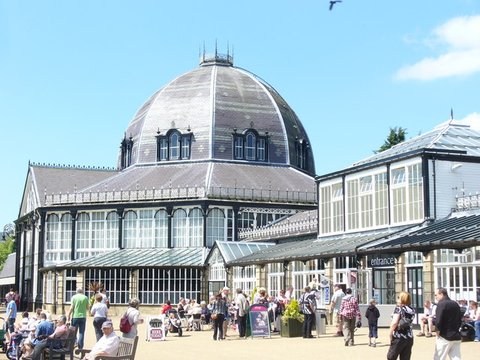
"Buxton Pavilion" by Colin Smith, 30 May 2009, via geograph.org.uk, CC BY-SA 2.0. The great domed octagonal hall on the west side of the Pavilion complex, seen from the paved forecourt: a broad lead-covered dome with gothic dormers and iron cresting, glazed arcades running off to either side, an "entrance" sign, and a crowd of present-day visitors on benches and among planters under a clear sky. Historic England's register entry dates this Octagon to 1875 and attributes it to R R Duke — the same architect named in its 1887 map reference — while Milner's Pavilion itself dates from 1870. The photographer's own caption dates the building to 1871; that discrepancy is left standing rather than resolved, because the caption and the register entry are describing adjoining structures of different dates. The people and the signage are modern.
## Second image
"Bandstand at Buxton Pavilion Gardens" by Geoff Royle, 6 May 2013, via geograph.org.uk, CC BY-SA 2.0. An ornate open bandstand with a domed roof, seen across the gardens with the Octagon's glazed dome rising behind it, conifers to either side, and a stone-piered balustrade with lattice panels in the foreground. Historic England records this bandstand as a late twentieth-century reproduction of the original, so it is a modern structure standing on a Victorian layout, not a survival from Bracewell's year.
## Sources for the quoted wording
- "Another new championship dates from this year..." — The Badminton Library, "Lawn Tennis" (1890), printed p.168, leaf n195: https://archive.org/details/india.history.resource.89303/page/n195/mode/2up
- The ALL ENGLAND CHAMPIONSHIPS rolls, including "Ladies' Doubles (Played at Buxton)" — printed p.438, leaf n479: https://archive.org/details/india.history.resource.89303/page/n479/mode/2up
- The North of England (Scarborough) and South of England (Eastbourne) winners' tables — printed p.442, leaf n483: https://archive.org/details/india.history.resource.89303/page/n483/mode/2up
- "Buxton, the home of the All-England Ladies' Doubles Championship..." — A. Wallis Myers, "Lawn Tennis at Home and Abroad" (1903), printed p.85, leaf n106: https://archive.org/details/lawntennisathom00myergoog/page/n106/mode/2up
- "Here, too, I first saw Miss Bracewell..." and "The easy nonchalance and off-hand manner..." — Myers, printed p.68, leaf n89: https://archive.org/details/lawntennisathom00myergoog/page/n89/mode/2up
- Historic England register entry 1000675, Pavilion Gardens, Buxton: https://historicengland.org.uk/listing/the-list/list-entry/1000675
- Wikidata Q84178744: https://www.wikidata.org/wiki/Q84178744
- The Midland Counties results, and the forename "Margaret", are relayed from present-day encyclopaedia compilations and are flagged as such in the body.
changes?
delete this memory?
We detected that you have a Blox in your crypto wallet! We will import the Blox into your account.
Click on done below to complete the import.
Welcome Back!
Sign in to preserve cherished moments
Don't have an account?
Welcome!!
Sign up and start preserving cherished moments
?
?

Choose your payment method
Buy with Metablox Credit
Do you want to mint Blox with Metablox Credit?
Which Crypto would you like to use?
Purchase Confirmed!
Your Blox is being minted on-chain and will appear in your profile shortly.
Log in or sign up to claim your Blox.
How many credits do you want to buy?
$100 USD = 1 Metablox Credit = 1 Blox.
Use Metablox Credit to mint any Blox you want on the map.
 expand_more