


Tennis History | Lansdown Cricket Club, Combe Park — a cricket ground hired out a tennis week from 1881, and the three photographs it left are all of women
· 1881
Personal memoryBy kevin · · Report an issue










































Find memories left by people near you.
Distribute Bounty
This will distribute the bounty equally among all qualifying memories. This action cannot be undone.
Cancel Bounty
Are you sure you want to cancel this bounty? The remaining amount will be refunded to your account.
Success!
Operation completed successfully.
Error
Something went wrong.
Tennis History | Lansdown Cricket Club, Combe Park — a cricket ground hired out a tennis week from 1881, and the three photographs it left are all of women
kevin
In 1890 the Badminton Library published its lawn tennis volume, and on printed page 308 it listed, in one sentence, the meetings that had admitted women to championship play. The list is short and the order matters.
"The example set by Dublin was followed at Bath in 1881, at the Northern Championship meeting in 1882, at Cheltenham in 1883, at Wimbledon in 1884."
Four of those five places are already pinned on this platform. Dublin is the covered asphalte court of the Fitzwilliam Club, off Fitzwilliam Square. The Northern is Aigburth, in Liverpool. Cheltenham is the Winter Garden. Wimbledon is Worple Road. Bath is the one that had not been pinned, and this is the ground the 1881 meeting is recorded as having used.
## A cricket club's field, hired out
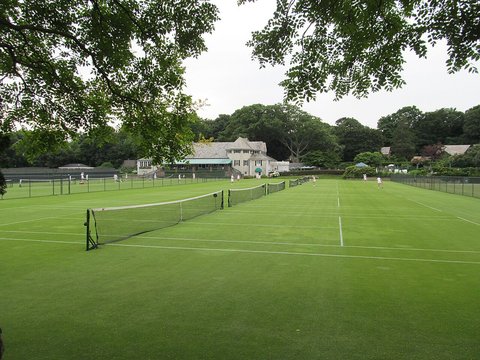
Lansdown Cricket Club was formed in 1825 and is recognised as the earliest organised cricket club in Somerset. It began on the hill north of the city — a ground known as Cricket Down, or the Racecourse ground — moved around 1850 to Captain Thornhill's Sydenham Field on the south bank of the Avon, and moved again in 1869 to Combe Park, where it still plays. The last of those moves was twelve years before the tennis started, which matters: the club that hired out its field in 1881 was already on this field and has not left it.
The West of England Championships were founded in 1881 and played at Bath until 1895. They moved to Bristol in 1896, stopped for a generation, were revived in Bristol in 1920, and ran there until 1989.
That a cricket club's outfield carried the tennis is not an inference from the tournament's name. R. E. M. Peach's *Bath, Old and New: A Handy Guide and a History*, published in 1891 — while the meeting was still running — lists the city's sporting institutions in a single column, and the entries are worth reading next to each other exactly as they are printed:
"Cricket. — Lansdown Club, Weston. Bath Association, near the North Parade Bridge."
"Lawn Tennis. — Bath Lawn Tennis Club, at Weston, on the Lansdown Cricket Club ground. Lansdown. Sydney. Grosvenor."
The punctuation is the guidebook's. A lawn tennis club with no ground of its own, playing on the cricket club's, in the year that is the midpoint of the tournament's fifteen Bath seasons.
This is not a peculiarity of Bath. The meeting immediately before it on the Badminton list, Dublin's, was played — the same page says so — in the covered asphalte court of the Fitzwilliam Club. The two that follow it are already pinned on this platform, at Aigburth, which is Liverpool Cricket Club's ground, and at the Winter Garden, Cheltenham, which was built for concerts. Four of the five places on that list were somebody else's premises. Wimbledon, in 1884, was the one on its own lawns, and it went last.
Whether the two facts are connected — that the meetings with no members' lawn to protect were the ones that let women in first — is an inference, and none of the sources read for this entry states it.
## What the tournament left behind, and who is in it
In 1903 A. Wallis Myers edited *Lawn Tennis at Home and Abroad*, the standard survey of the game as it then stood. It carries dozens of photographic plates from grounds across Britain, Ireland, Europe, America, Australasia and India.
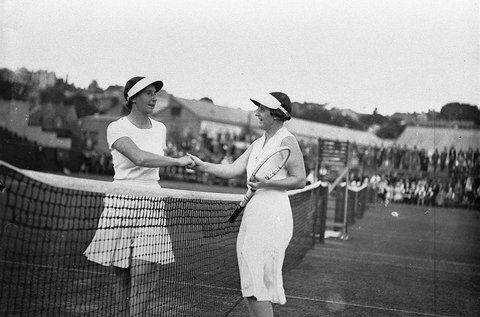
Three of those plates are captioned at Bath. All three are of women.
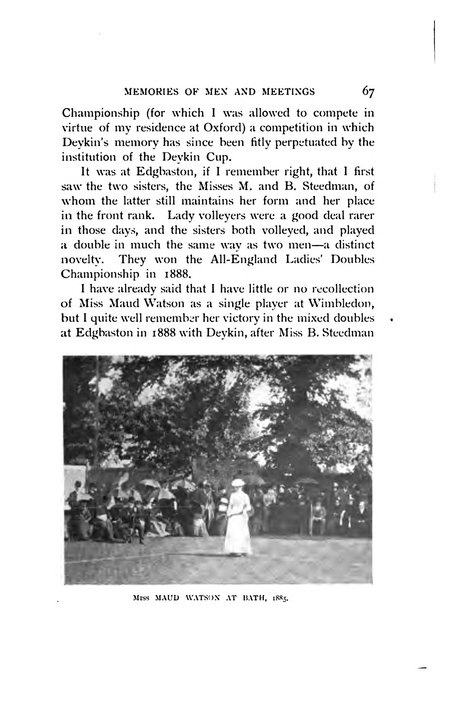
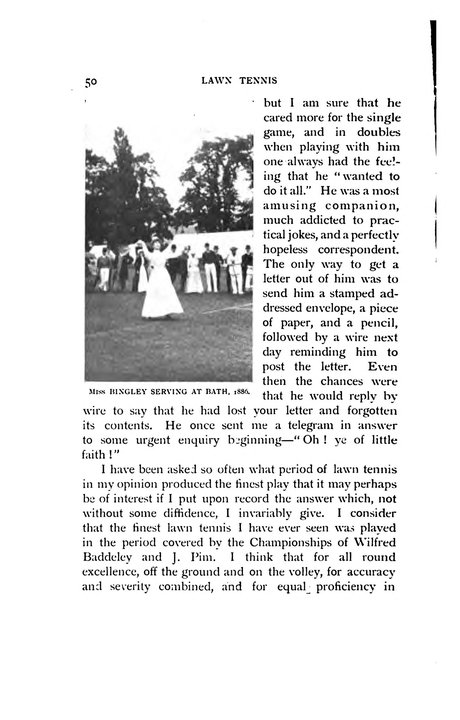
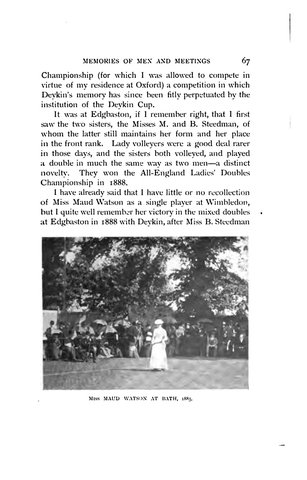
On printed page 50, "Miss Bingley Serving at Bath, 1886" — a woman in a long white dress at the top of her service action, arms fully extended overhead, a line of men in flannels and dark jackets watching from behind a low white screen, trees beyond. On page 55, "Miss L. Martin Playing at Bath, 1885" — a marked grass court running away from the camera, a player mid-stroke on the baseline, spectators standing at the edge of the turf with a large white marquee behind them. On page 67, "Miss Maud Watson at Bath, 1885" — a woman in white with a straw boater, racket down, a crowd two and three deep in the shade of heavy trees behind her.
The claim that these are the only three is a claim about a search, so here is the search: a whole-file text search of the volume's optical transcription for the word Bath returns three entries in the List of Illustrations, the three matching captions under the plates themselves, and one line of running text. An optical transcription can miss a word, and this one does have damaged pages elsewhere in the book. But on what can be read, every photograph the 1903 survey printed from this tournament is of a woman playing in it.
Maud Watson won the first ladies' singles ever held at the All England Club, in 1884, and won it again in 1885 — the year she was photographed here. Blanche Bingley won it in 1886, the year of her plate, and five more times afterwards under her married name. Louisa Martin, the third, is the subject of the companion entry at this pin.
## The cup and the tea service
The men's prize survives as an object. The Museum of Bath at Work, which mounted an exhibition on tennis in the city, describes the Bath Cup as a magnificent silver trophy presented to the men's singles champion, and put it on display.
For the women's prizes there is one account and no object. The Bath Magazine, writing about the same exhibition, states that while male champions received the ornate Bath Cup, women were typically awarded tea services. No contemporaneous source consulted for this entry confirms or contradicts that, and it is recorded here as that magazine's statement rather than as an established fact. It is worth the qualification, because the distinction it describes — a trophy for one draw and a household object for the other — is the same argument that the four majors were still having ninety-two years later, when the United States championship became the first of them to pay its two singles champions the same.
## What is not established
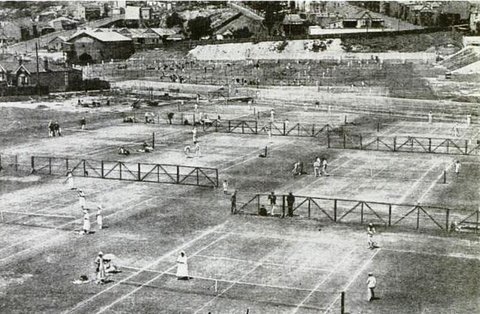
The plates say Bath. They do not say Lansdown. The identification of this ground as the one in the photographs rests on the West of England meeting being the Bath tournament of those years, and it should be held loosely: a separate championship of the Sydney Lawn Tennis Club was also played in Bath in 1881, and the city had several tennis grounds, as Peach's list shows.
Nor is it known where on this field the courts were laid. A cricket club that hires out a tennis week puts the courts somewhere on or beside the outfield, moves them when it needs the square, and leaves no plan. The Royal United Hospital was built alongside the ground in the twentieth century and now adjoins it; whether the ground's own footprint shifted in the process was not established here.
---
**Coordinate.** 51.389624, -2.390421, precision radius 200 m. Two independent readings. Wikidata Q6487351, Lansdown Cricket Club Ground, gives 51.3896, -2.3904. OpenStreetMap way 291431115, tagged `leisure=pitch` and `sport=cricket` and carrying no Wikidata identifier, has a centroid of 51.389647, -2.390442. They agree to about six metres and the pin is their midpoint. OpenStreetMap way 4269286, the named recreation-ground polygon over the same site, was **not** used as a second reading: it carries `wikidata=Q6487351` and is therefore the first source again. A third reading disagrees and is recorded rather than averaged in — the Office for National Statistics centroid for postcode BA1 3NE, the club's own postcode, is 51.387675, -2.389688, about 220 m to the south. That is a postcode centroid, not a ground footprint, and the gap is what that difference looks like. The radius is an envelope for the whole ground, which measures roughly 150 m across, because the position of the tennis courts within it is not recorded. The pin is the club, not the court.
**Cover image.** "Miss Maud Watson at Bath, 1885," a halftone plate on printed page 67 of A. Wallis Myers, ed., *Lawn Tennis at Home and Abroad* (London, 1903), reproduced from the Internet Archive's scan of the volume, public domain by age. The image published here is the whole page, not a crop, and the letterpress above the photograph is about Edgbaston and the Steedman sisters — **it is not about Bath and does not describe this photograph.** The caption underneath it is.
**Second image.** "Miss Bingley Serving at Bath, 1886," a halftone on printed page 50 of the same volume. The letterpress around it concerns a correspondent's habits and, again, has nothing to do with the picture.
**Sources.** Ladies' championship meetings and the order of them: *Tennis, Lawn Tennis, Rackets, Fives*, Badminton Library (London, 1890), printed p. 308, leaf 339 of the Internet Archive scan: https://archive.org/download/india.history.resource.89303/page/n339_w1280.jpg · The Bath lawn tennis clubs and their grounds: R. E. M. Peach, *Bath, Old and New* (London, 1891), printed p. 175: https://archive.org/details/cu31924028089914 · The three Bath plates: https://archive.org/details/lawntennisathom00myergoog · Lansdown Cricket Club's foundation and its three grounds: https://en.wikipedia.org/wiki/Lansdown_Cricket_Club · The Bath Cup and the city's tennis history: https://museumofbath.org/on-court-bath-and-tennis-from-indoor-to-outdoor-2/ · The tea services, single-sourced: https://thebathmagazine.co.uk/baths-love-affair-with-tennis/ · Tournament run and venues: https://en.wikipedia.org/wiki/Bristol_Open
**Status note.** Written 8 September 2026. This is this platform's first tennis-history pin in Somerset. Lansdown Cricket Club still plays at Combe Park.
changes?
delete this memory?
We detected that you have a Blox in your crypto wallet! We will import the Blox into your account.
Click on done below to complete the import.
Welcome Back!
Sign in to preserve cherished moments
Don't have an account?
Welcome!!
Sign up and start preserving cherished moments
?
?

Choose your payment method
Buy with Metablox Credit
Do you want to mint Blox with Metablox Credit?
Which Crypto would you like to use?
Purchase Confirmed!
Your Blox is being minted on-chain and will appear in your profile shortly.
Log in or sign up to claim your Blox.
How many credits do you want to buy?
$100 USD = 1 Metablox Credit = 1 Blox.
Use Metablox Credit to mint any Blox you want on the map.
 expand_more