


Tennis History | Buxton Pavilion Gardens — an All England championship played 145 miles from the All England Club, and the misprint that sends readers to the wrong town
· 1885
Personal memoryBy kevin · · Report an issue




















































Find memories left by people near you.
Distribute Bounty
This will distribute the bounty equally among all qualifying memories. This action cannot be undone.
Cancel Bounty
Are you sure you want to cancel this bounty? The remaining amount will be refunded to your account.
Success!
Operation completed successfully.
Error
Something went wrong.
Tennis History | Buxton Pavilion Gardens — an All England championship played 145 miles from the All England Club, and the misprint that sends readers to the wrong town
kevin
In 1885 the company that ran a Derbyshire spa town's pleasure gardens instituted a national championship for women and gave it the grandest name available. They called it the All-England Ladies' Doubles Championship. They held it at Buxton, about 145 miles (235 km) from the All England Club's ground at Worple Road, and they went on holding it there.
One of the game's first substantial reference books records this without appearing to notice how strange it is. "Tennis, Lawn Tennis, Rackets, Fives" — the Badminton Library volume of 1890 — opens its appendix with "THE WINNERS OF THE PRINCIPAL TOURNAMENTS", and the first heading is ALL ENGLAND CHAMPIONSHIPS. Beneath it the gentlemen's doubles roll is headed "(Played at Wimbledon)". Directly below, in the same type and under the same championship heading, stands "Ladies' Doubles (Played at Buxton)". Below that again: "Ladies' and Gentlemen's Doubles (Played at the Northern Association Tournament)". Three events of the All England Championships as the book tabulates them, and two of the three were not played at the All England Club at all.
The Buxton roll it prints runs: 1885, Mrs. Watts and Miss Bracewell; 1886, 1887 and 1888, Miss L. Dod and Miss M. Langrishe; 1889, Miss M. Steedman and Miss B. Steedman. That is the whole list as of publication — five years, four pairs, one ground.
The narrative chapters say the same thing in sentences. Reviewing the 1885 season, the volume records that "Another new championship dates from this year. It was instituted by the managers of the Buxton Tournament under the title of 'Ladies' double championship,' and has been repeated annually at the same place. The winners on the first occasion were Mrs. Watts and Miss Bracewell." Thirteen years later a second and independent survey agrees. A. Wallis Myers's "Lawn Tennis at Home and Abroad" (1903) lists, among the meetings its contributor knew only at second hand, "Buxton, the home of the All-England Ladies' Doubles Championship, instituted in 1885, and first won by Mrs. Watts and Miss Bracewell, and then (for three years running) by Miss M. Langrishe and Miss Dod."
A CONFLICTING YEAR, RECORDED RATHER THAN RESOLVED
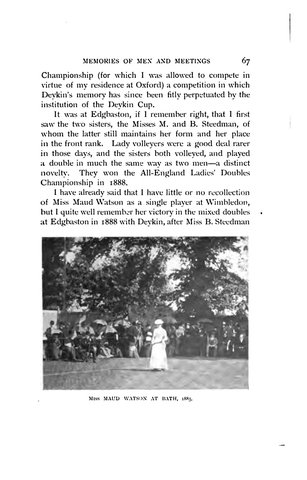
The 1903 volume contradicts itself about the end of the roll. Its chapter of recollections, at printed page 67, says of the sisters M. and B. Steedman: "They won the All-England Ladies' Doubles Championship in 1888." Its page 85 says the title went to Langrishe and Dod for three years running after 1885, which puts Dod and Langrishe in 1888 and the Steedmans in 1889. The 1890 roll, compiled five years nearer the events and set out as a table rather than as a memory, agrees with page 85. This entry follows the table and prints the page-67 sentence rather than dropping it.
WHAT "ALL-ENGLAND" MEANT, AND WHAT IT DID NOT
It is worth being exact about the word, because the modern reader will read a governing body into it and there was not one to read. In the 1880s a championship was a title a tournament's managers could institute, announce and defend. The Lawn Tennis Association was not founded until 1888, and even then the 1890 volume describes its authority in terms of laws rather than titles — "the laws of the Lawn Tennis Association are recognised and cheerfully obeyed by one sex as by the other". Nobody granted Buxton the right to call its ladies' doubles an All-England championship. Buxton called it that, the reference books printed it, and it stuck. Standard modern accounts date the All England Club's own ladies' doubles championship at Wimbledon to 1913; the 1890 volume, tabulating the All England Championships as they then stood, lists no ladies' doubles at Wimbledon whatever.
THE MISPRINT, AND WHY IT MATTERS
The same book contains, on printed page 308, the sentence this vertical has been working through all week — the list of meetings that admitted women, in order: Dublin 1879, Bath in 1881, the Northern Championship meeting in 1882, Cheltenham in 1883, Wimbledon in 1884. It then goes on: "A Ladies' Double Championship was instituted in 1885 at Burton, and one for mixed doubles at the Northern Meeting in 1888."
Burton. Not Buxton.
The page image was opened and read at the original scan rather than trusted to OCR, and the printed word on the page is Burton. This is a mistake in the book, not in the machine that read it. The index compounds it: the volume's own index carries the entry "Burton, 308", and no entry for Buxton at that page. So a reader who follows the index lands in Burton upon Trent, Staffordshire — a real tennis town, with a real open tournament founded in 1883 on a brewery's cricket ground — about 32 miles (52 km) south of the place where the championship was actually played. Two of the volume's own pages, its appendix, and the standard survey of 1903 all say Buxton. One sentence and one index line say Burton, and they are the two that a searcher is most likely to hit.
WHO RAN IT
The gardens were not a club's. Historic England's register entry for the site records that "The park was given by the seventh Duke of Devonshire to the Buxton Improvements Company in the C19, which subsequently passed it to Buxton Corporation." The Buxton Improvements Company was a spa-town development concern, and the tournament was its event. That places Buxton alongside the pattern this vertical has been finding at every early meeting that admitted women: the courts belonged to somebody else. Dublin's championship was played on the Fitzwilliam Club's covered asphalte court; Bath's was played on the Lansdown Cricket Club's outfield; Buxton's was played in a company's public pleasure gardens. Wimbledon, in 1884, was the one that ran its ladies' event on its own lawns — and it went fifth of the five.
The women's singles at Buxton, which the volume tabulates from 1884, reads as a roll of who was actually winning in that decade: Mrs. Watts, then Miss Bingley, then Miss Martin, then Miss M. Langrishe, then Mrs. Hillyard (Miss Bingley), then Miss B. Steedman. Two of those names already have entries on this platform — Blanche Bingley Hillyard, who appears twice under both her names, and Louisa Martin, whose 1886 Buxton win is the second of the two meetings the 1903 survey names as where she made her reputation. The other was Bath.
A DISPUTE, NAMED
The founding date is not agreed either. Both the nineteenth- and early twentieth-century sources above give 1885, and the printed winners' roll begins in 1885. A club history, relayed through a modern encyclopaedia article, dates the All-England Ladies' Doubles to 1884 instead, along with the men's and women's singles staged that year under the title Championship of Derbyshire. The 1890 volume's Buxton table does begin its ladies' singles in 1884, which is consistent with 1884 being the year the meeting acquired championship status generally. Whether the doubles title came with it, or a year later, is not settled here. The contemporaneous printed evidence available to this entry says 1885, and this entry does not resolve the other side away.
WHERE THE COURTS WERE
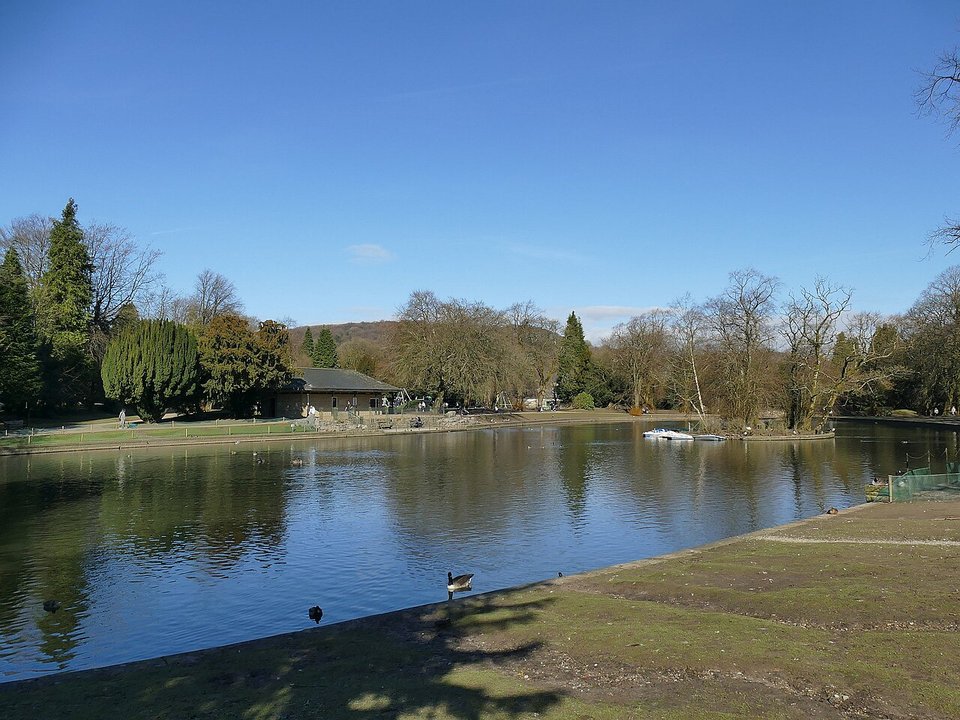
Not established to a court. Historic England's entry does, however, put tennis in the gardens within two years of the championship: "The extension to the park was probably laid out by head gardener Adam Hogg in 1880, possibly to designs by R R Duke, who shows it on a map of 1887 with a tennis court alongside." The extension is the western part of the gardens, the ground around the boating lake — an existing stretch of water, per the same entry, shown on the 1878 Ordnance Survey map before the area was taken into the park. So the likeliest court ground is the western end, roughly 200 m south-west of the Pavilion. That is an inference from a map description, not a located court, and the pin below is the registered park, not a baseline.
THE COORDINATE
Pinned at 53.256399, -1.920538, the midpoint of two independent readings of the registered park. First, Wikidata Q84178744 (Buxton Pavilion Gardens), 53.256, -1.919. Second, Historic England list entry 1000675, Registered Park or Garden, Grade II*, first registered 4 August 1984, National Grid Reference SK 05296 73313, which converts from OSGB36 to 53.256798, -1.922075. The two readings lie about 223 m apart. That divergence is not an error and has not been smoothed over: the registered area is the larger one, taking in ground to the west, so its centre sits west of the centre of the park polygon that carries the Wikidata identifier. The OpenStreetMap polygon for the gardens was excluded from the count, because it carries the Wikidata identifier and is therefore the first source again rather than a second.
Precision radius 300 m, which covers the gardens east to west. The pin is the park; it is not the court, and no source consulted places the 1885 court.
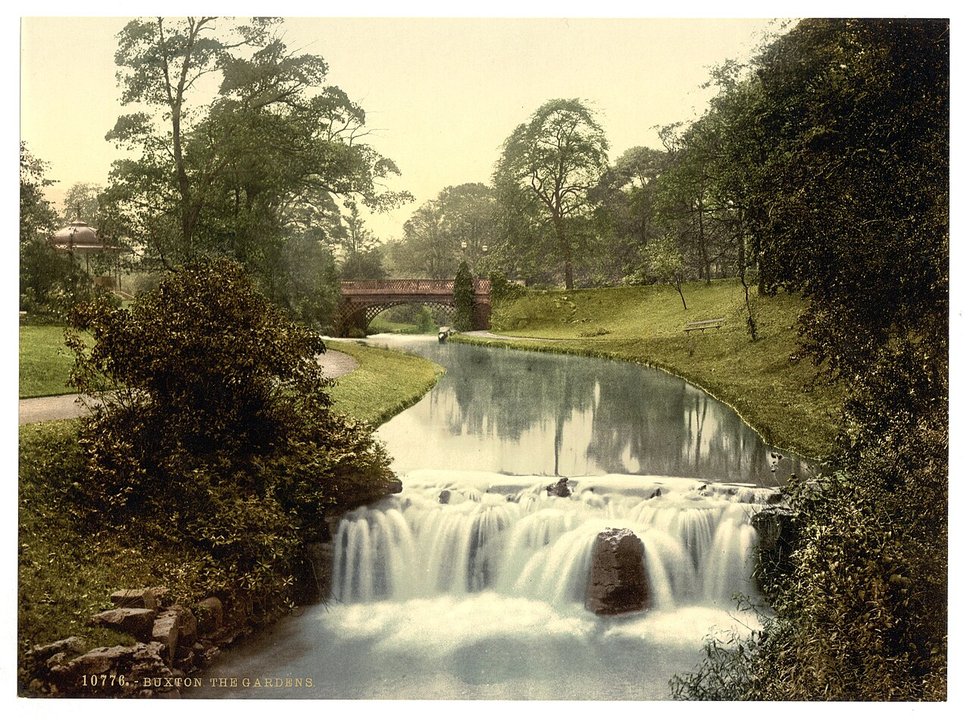
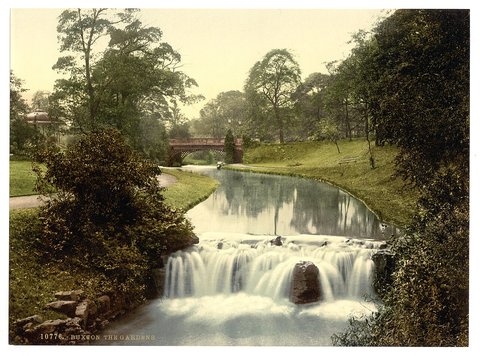
COVER IMAGE. "Buxton, the gardens, Derbyshire, England", a photochrom print made between 1890 and 1900, Detroit Publishing Company, Photochrom Print Collection, Library of Congress (LCCN 2002696663), public domain, via Wikimedia Commons. The plate's own printed caption reads "10776. — BUXTON THE GARDENS." It shows the River Wye running through the gardens over a rock cascade, an iron footbridge with lamp standards beyond it, a domed structure among the trees at left, and mown lawn slopes with a bench. It is the ground within five to fifteen years of the championship. It is not a photograph of the tennis, and no court is visible in it.
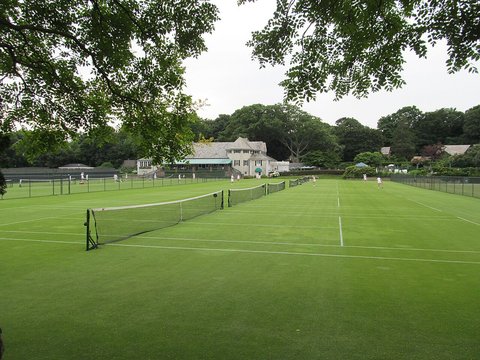
SECOND IMAGE. "Boating lake in Buxton Pavilion Gardens", photographed 2 March 2025 by Stephen Craven for Geograph Britain and Ireland, CC BY-SA 2.0, via Wikimedia Commons. A modern view across the boating lake in the western extension — the part of the gardens where the 1887 map is described as showing a tennis court alongside. The low building, the play equipment and the fencing on the far bank are modern; the lake and the ground behind it are the area in question. Nothing in this photograph is 1885.
SOURCES. Badminton Library, "Tennis, Lawn Tennis, Rackets, Fives" (London, 1890): printed pages 168-169 (the 1885 season), 308 (the misprint), 438 (the All England Championships appendix roll) and 444 (the Buxton winners' table). Public-domain scan at https://archive.org/details/india.history.resource.89303 — note that this item was formerly reachable under the bare identifier 89303, which no longer resolves; its files still carry the 89303_ prefix. Page images read directly at leaves n195-n196, n339, n479 and n485. A. Wallis Myers (ed.), "Lawn Tennis at Home and Abroad" (London, 1903), printed pages 67 and 85: https://archive.org/details/lawntennisathom00myergoog. Historic England, register entry 1000675, Pavilion Gardens, Buxton: https://historicengland.org.uk/listing/the-list/list-entry/1000675. Wikidata Q84178744: https://www.wikidata.org/wiki/Q84178744. The 1884-versus-1885 dating of the doubles championship is taken from the Wikipedia article "Derbyshire Championships", which relays a Buxton club history and cites Robert Lake, "A Social History of Tennis in Britain" (Routledge, 2015), p. 48; neither the club page nor page 48 was opened for this entry, and that is why the other side of the dispute is described rather than quoted.



changes?
delete this memory?
We detected that you have a Blox in your crypto wallet! We will import the Blox into your account.
Click on done below to complete the import.
Welcome Back!
Sign in to preserve cherished moments
Don't have an account?
Welcome!!
Sign up and start preserving cherished moments
?
?

Choose your payment method
Buy with Metablox Credit
Do you want to mint Blox with Metablox Credit?
Which Crypto would you like to use?
Purchase Confirmed!
Your Blox is being minted on-chain and will appear in your profile shortly.
Log in or sign up to claim your Blox.
How many credits do you want to buy?
$100 USD = 1 Metablox Credit = 1 Blox.
Use Metablox Credit to mint any Blox you want on the map.
 expand_more