


Dynastic History | Tomb of Cyrus at Pasargadae — The Grave That Carries No Name
· -530
Unreviewed contributionBy kevin · · updated · Report an issue
















































Find memories left by people near you.
Distribute Bounty
This will distribute the bounty equally among all qualifying memories. This action cannot be undone.
Cancel Bounty
Are you sure you want to cancel this bounty? The remaining amount will be refunded to your account.
Success!
Operation completed successfully.
Error
Something went wrong.
Dynastic History | Tomb of Cyrus at Pasargadae — The Grave That Carries No Name
kevin
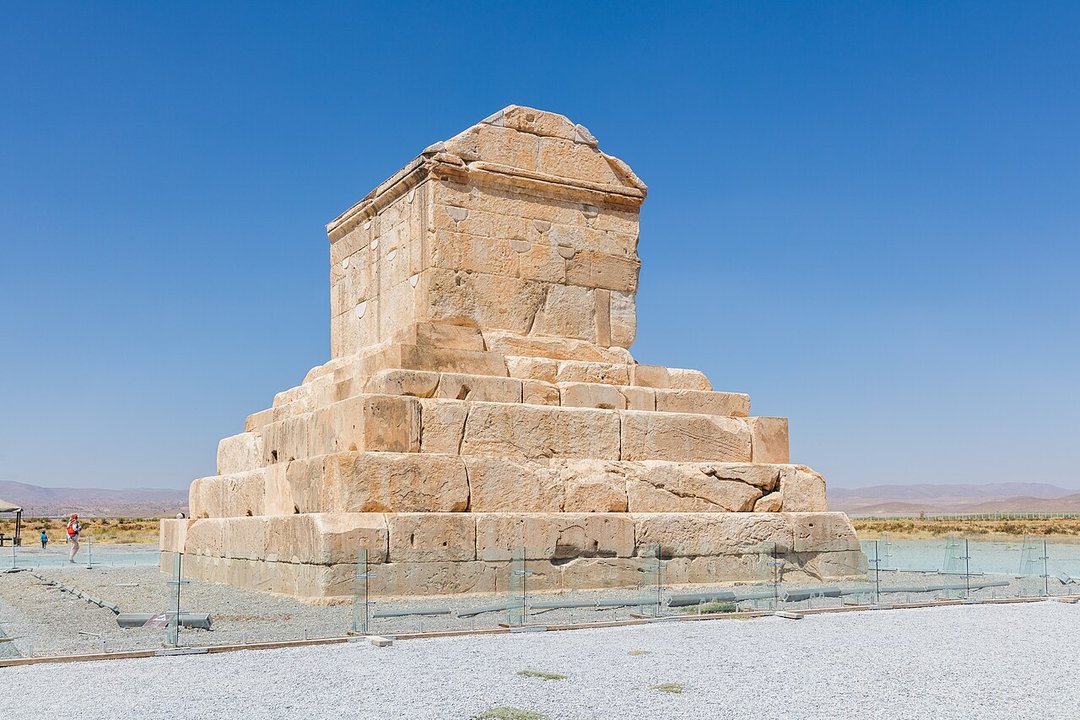
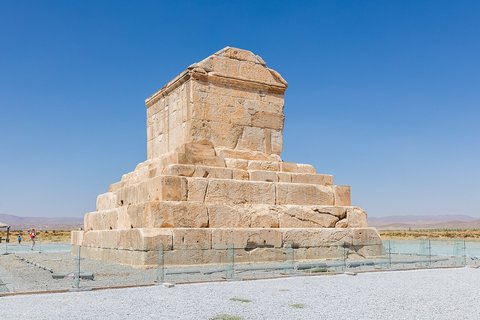
A block of yellowish limestone stands on six receding stone tiers in a plain in Fars, a little over eleven metres to the ridge of its gabled roof. The chamber inside is small — roughly 3.17 by 2.11 metres, and 2.11 high — and it is empty. Nothing on the building names Cyrus II, who founded Pasargadae as his royal centre; Encyclopædia Iranica places the main construction at about 540 to 530 BCE, the year Cyrus died.
The attribution comes from outside the stone. Aristobulus, an officer on Alexander's expedition, described the tomb and an inscription on it; his account survives only at second hand, in Arrian and Strabo, writing centuries afterwards. Aristobulus reported that when the party reached the chamber it had already been stripped — everything carried off but the coffin and the couch. The earliest surviving description of the tomb is therefore a description of a robbery, written up by the invading side.
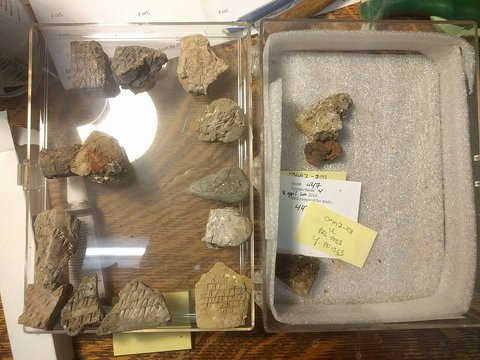
Who quarried and dressed these blocks is not recoverable here. At Persepolis, two generations later, the royal administration's own tablets record rations issued to its workforce. Pasargadae has produced no comparable archive, and the labour that raised this building is simply absent from the record.
The tomb survived because it was reused. After the Muslim conquest it was known as Mashhad-e Madar-e Sulaiman, the tomb of the mother of Solomon, and was maintained as a shrine; James Justinian Morier proposed the identification with Cyrus in 1812. Ernst Herzfeld excavated at Pasargadae in 1928, Ali Sami from 1949, and David Stronach for the British Institute of Persian Studies between 1961 and 1963.
It stands today inside a fenced World Heritage property, ringed at ground level by a low glass barrier and a gravel path.
📸 Cover: The tomb of Cyrus at Pasargadae, with the modern protective barrier at its base, Diego Delso, CC BY-SA 4.0 via Wikimedia Commons
changes?
delete this memory?
We detected that you have a Blox in your crypto wallet! We will import the Blox into your account.
Click on done below to complete the import.
Welcome Back!
Sign in to preserve cherished moments
Don't have an account?
Welcome!!
Sign up and start preserving cherished moments
?
?

Choose your payment method
Buy with Metablox Credit
Do you want to mint Blox with Metablox Credit?
Which Crypto would you like to use?
Purchase Confirmed!
Your Blox is being minted on-chain and will appear in your profile shortly.
Log in or sign up to claim your Blox.
How many credits do you want to buy?
$100 USD = 1 Metablox Credit = 1 Blox.
Use Metablox Credit to mint any Blox you want on the map.
 expand_more