


Dynastic History | The Conciergerie — The Capetian Palace That Became the Court
· 1793-3
Unreviewed contributionBy kevin · · updated · Report an issue





































































Find memories left by people near you.
Distribute Bounty
This will distribute the bounty equally among all qualifying memories. This action cannot be undone.
Cancel Bounty
Are you sure you want to cancel this bounty? The remaining amount will be refunded to your account.
Success!
Operation completed successfully.
Error
Something went wrong.
Dynastic History | The Conciergerie — The Capetian Palace That Became the Court
kevin
The hall was finished in 1302, under Philip IV, and it is still described as the largest surviving secular Gothic room in Europe: four naves of ribbed vaulting, low and cold, built to feed and quarter the household of a king — guards, clerks, cooks, the apparatus of a court that had outgrown the older palace on the Île de la Cité. The Centre des monuments nationaux, which runs the building now, puts the purpose in the administration's own terms: the rebuilt palace was to be a monarchical symbol.
Charles V moved out in the 1360s, to the Louvre and the Hôtel Saint-Pol, and left the Palais de la Cité to its officials. A concierge with judicial powers was installed; cells were fitted into the lower storeys; the rooms that had been a royal residence became a court and a prison and stayed one for the next five and a half centuries.
On 10 March 1793 the Convention created the Revolutionary Tribunal, and it sat upstairs in the Grand'Chambre — the room in which the Parlement of Paris had registered royal edicts. Prisoners were held below and brought up the stairs. Marie-Antoinette was moved here in August 1793 and tried in that chamber in mid-October; the sentence came back in the small hours of the 16th. Counts taken from the Tribunal's registers vary with the period they cover: more than 2,500 sent to the guillotine by the end of July 1794, and about 2,780 death sentences across the whole 780 days the court sat.
The prison closed in 1934. The soldiers' hall is now the ticketed entrance, and the Palais de Justice next door is still a working court.
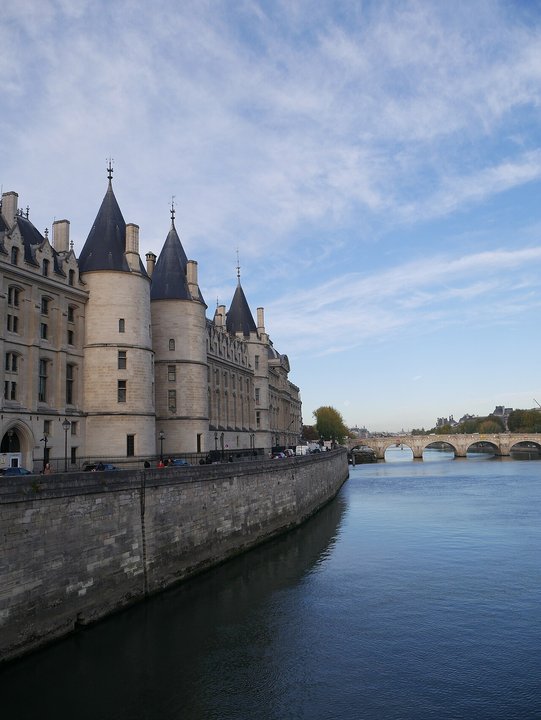
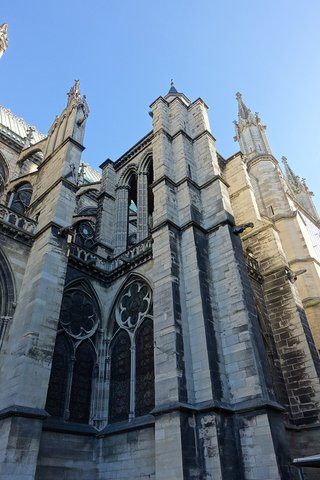
📸 Cover: The Conciergerie's towers from the Pont au Change, IlonaThoumazet, CC BY-SA 4.0 via Wikimedia Commons — exterior view from the river.


changes?
delete this memory?
We detected that you have a Blox in your crypto wallet! We will import the Blox into your account.
Click on done below to complete the import.
Welcome Back!
Sign in to preserve cherished moments
Don't have an account?
Welcome!!
Sign up and start preserving cherished moments
?
?






Choose your payment method
Buy with Metablox Credit
Do you want to mint Blox with Metablox Credit?
Which Crypto would you like to use?
Purchase Confirmed!
Your Blox is being minted on-chain and will appear in your profile shortly.
Log in or sign up to claim your Blox.
How many credits do you want to buy?
$100 USD = 1 Metablox Credit = 1 Blox.
Use Metablox Credit to mint any Blox you want on the map.
 expand_more