


Military History | Ossuaire de Douaumont — A Vault for Each Sector of the Field
· 1932-8
Personal memoryBy kevin · · Report an issue































Find memories left by people near you.
Distribute Bounty
This will distribute the bounty equally among all qualifying memories. This action cannot be undone.
Cancel Bounty
Are you sure you want to cancel this bounty? The remaining amount will be refunded to your account.
Success!
Operation completed successfully.
Error
Something went wrong.
Military History | Ossuaire de Douaumont — A Vault for Each Sector of the Field
kevin
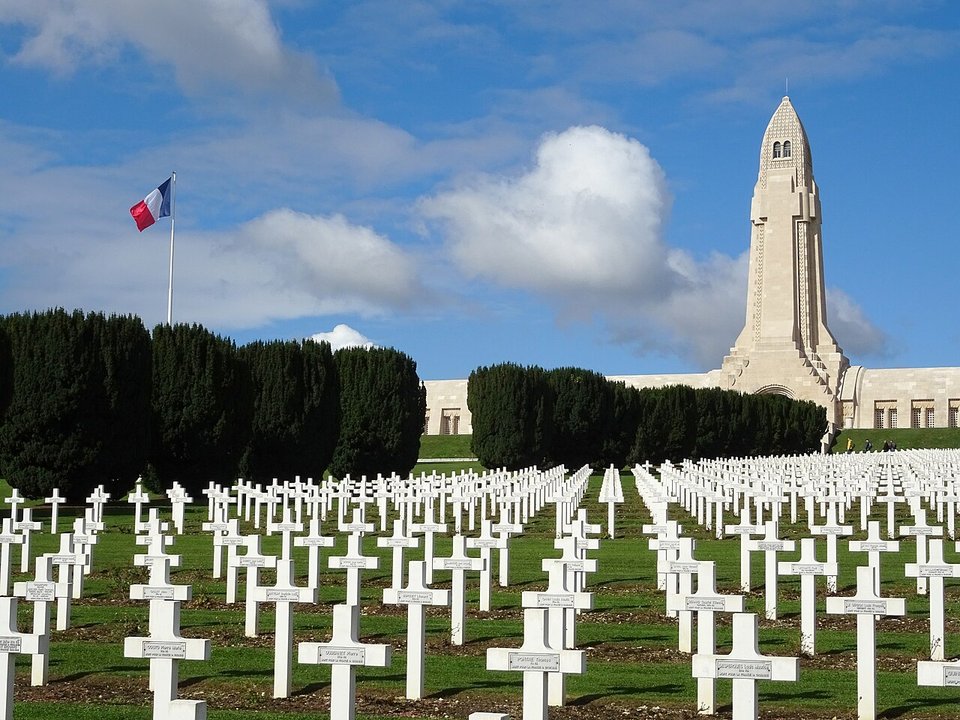
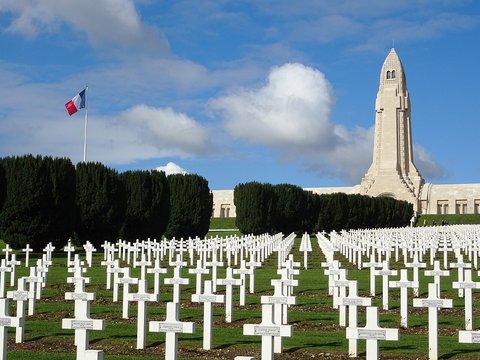
The battlefield was still giving up unidentified remains when Charles Ginisty, Bishop of Verdun, asked for a building to hold them. A provisional ossuary went up first, in 1919. The foundation stone of the permanent one was laid on 22 August 1920 by Ginisty and Marshal Philippe Pétain, honorary president of the building committee. Donations came from more than a hundred French towns and from cities abroad, Canada and the United States among them, along with private subscriptions and a million francs from the French state.
Léon Azéma, Max Edrei and Jacques Hardy won the design competition in 1923: a cloister 137 metres long with a 46-metre tower at its centre, carrying a rotating red-and-white lantern that sweeps the battlefield at night. On 17 September 1927 the remains were carried over from the provisional ossuary in fifty-two coffins, one for each sector of the battle.
They were not pooled. What was gathered at Vaux lies apart from what was gathered at Douaumont or Les Éparges. Accounts differ on how the vaults are counted — 18 bays, 42 alcoves, 46 tombs — but the principle is the same, and the sectors are the reason. The remains are French and German together, at least 130,000 of them, none identified. President Albert Lebrun inaugurated the building on 7 August 1932.
In front lies the national cemetery, 16,142 graves. Accounts of its opening diverge: one gives 1923 and the Verdun veteran André Maginot, another 23 June 1929 and President Gaston Doumergue. A memorial to Jewish soldiers was raised in 1938 and one to Muslim combatants in 2006. Protestants declined a chapel in the original scheme.
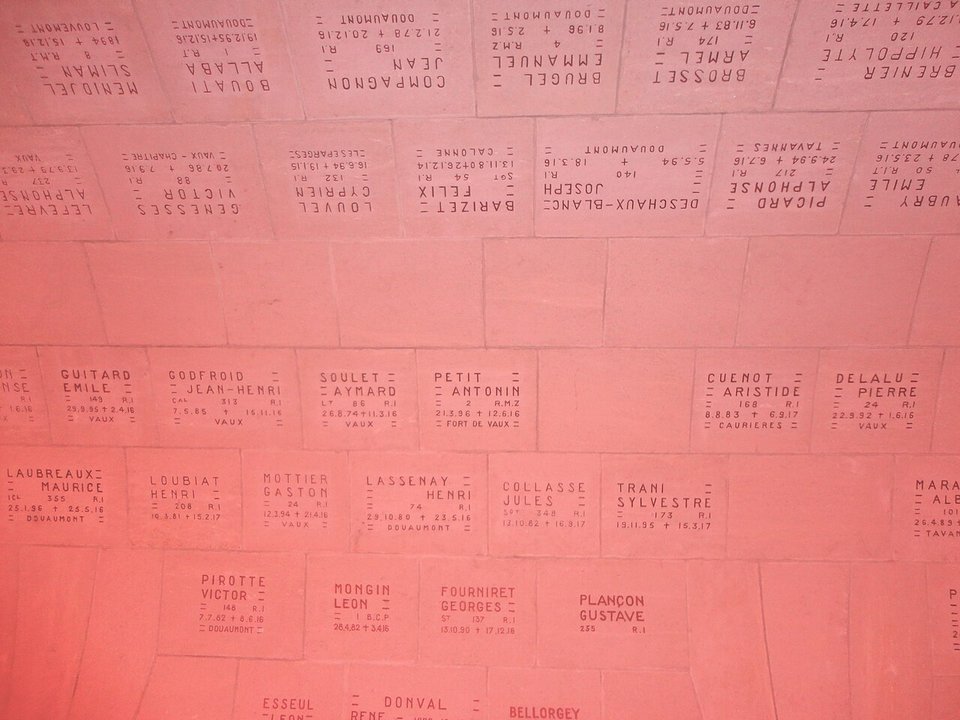
Inside the cloister the vault is covered with plaques bought by families. Each gives a name, a regiment, two dates, and the sector where the man was lost. The building sorts the unnamed by ground; the ceiling names them one at a time.
📸 Cover: the Ossuaire de Douaumont above the national cemetery, by Lukas Lober, CC BY-SA 4.0, via Wikimedia Commons. Second image: family name plaques on the cloister vault, Vaux sector, by PaulPetit67, CC BY-SA 4.0.
changes?
delete this memory?
We detected that you have a Blox in your crypto wallet! We will import the Blox into your account.
Click on done below to complete the import.
Welcome Back!
Sign in to preserve cherished moments
Don't have an account?
Welcome!!
Sign up and start preserving cherished moments
?
?

Choose your payment method
Buy with Metablox Credit
Do you want to mint Blox with Metablox Credit?
Which Crypto would you like to use?
Purchase Confirmed!
Your Blox is being minted on-chain and will appear in your profile shortly.
Log in or sign up to claim your Blox.
How many credits do you want to buy?
$100 USD = 1 Metablox Credit = 1 Blox.
Use Metablox Credit to mint any Blox you want on the map.
 expand_more