


NFL History | Briggs Stadium, Detroit — Neither Postseason Site Was Decided by Record
· 1957-12
Personal memoryBy kevin · · updated · Report an issue











































Find memories left by people near you.
Distribute Bounty
This will distribute the bounty equally among all qualifying memories. This action cannot be undone.
Cancel Bounty
Are you sure you want to cancel this bounty? The remaining amount will be refunded to your account.
Success!
Operation completed successfully.
Error
Something went wrong.
NFL History | Briggs Stadium, Detroit — Neither Postseason Site Was Decided by Record
kevin
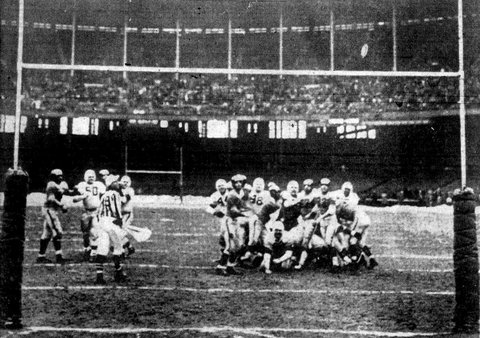
On 29 December 1957 the Detroit Lions beat the Cleveland Browns 59 to 14 for the National Football League championship, in a baseball park at the corner of Michigan and Trumbull. Pro Football Reference records the venue as Briggs Stadium and the paid attendance as 55,263. Cleveland had finished the season with nine wins, two losses and a tie. Detroit had finished eight and four. The club with the better record played the title game away from home, and the interesting thing about that is that it was not an accident of that season.
Eight days earlier the same Detroit club had been on the other side of the same indifference. Detroit and San Francisco finished the Western Conference level at eight and four, so a playoff was needed to separate them, and it was played at Kezar Stadium in San Francisco on 22 December. The Pro Football Hall of Fame's account of that afternoon has San Francisco ahead 24 to 7 at half time behind three touchdown passes from Y. A. Tittle, and Detroit coming back to win 31 to 27. Two postseason games in eight days, then, and in neither of them did the standings decide where the football was played.
For the championship game the pattern is legible in the record itself. Pro Football Reference identifies each game by its home club, and for the four seasons around this one the sequence runs: 1956 in New York, 1957 in Detroit, 1958 in New York, 1959 in Baltimore. Eastern, Western, Eastern, Western, without reference to who had played better. That observation is this entry's, taken from the home-team codes on those four box scores. No source read for this entry states the rule that produced the alternation, and this entry does not assert one; what can be said is what the record shows, which is four consecutive seasons of it.
Two seasons later the same arrangement ran the other way and cost the other conference. In 1959 the New York Giants finished ten and two, Baltimore finished nine and three, and the championship was played in Baltimore. So this is not a story about Detroit being favoured. It is a story about a league in which the location of its biggest game was knowable before a single game of the season had been played, because it belonged to a conference by turn rather than to a club by merit.
How the site of the tie-breaking playoff was chosen is a separate question, and nothing read for this entry answers it. Detroit and San Francisco had identical records and the game went west; a year later, in the same situation in the Eastern Conference, the game went to the Giants at home. Both facts are on the record and the rule behind them is not, so it is left open here rather than filled in.
Two entries on this platform sit either side of that. At Balboa Stadium in San Diego the American Football League put a title game where its landlord was, which is a different kind of answer to the same question. At Griffith Stadium in Washington the 1940 championship finished 73 to nothing, which is the comparison a reader needs before deciding what a 45-point margin means.
The building was somebody else's. It was a baseball park, and Pro Football Reference's stadium record has the Lions as tenants there from 1938 to 1974, with a professional football club confusingly called the Detroit Tigers playing the ground's first professional football game on 9 October 1921 against the Dayton Triangles, and the last one falling on Thanksgiving Day 1974, Denver 31 Detroit 27. The Lions played three postseason games there and won all three. That is the complete postseason history of the ground: three games, and this one is the last of them.
The name is disputed and the dispute is worth printing rather than smoothing. The Detroit Historical Society says the park became Briggs Stadium in 1936, when Walter Briggs senior expanded it, and that John Fetzer renamed it Tiger Stadium in 1961. Pro Football Reference's stadium record labels the same building Navin Field from 1921 to 1926, Briggs Stadium from 1927 to 1960 and Tiger Stadium from 1961 to 1974. The two accounts are eleven years apart on when the middle name began. They agree on what mattered on the day in question, which is that the box score for this game says Briggs Stadium.
The seating figures are worth setting beside each other for the same reason. The Detroit Historical Society gives the park a capacity of 54,500 by 1938. Pro Football Reference gives this game an attendance of 55,263. Those are two different producers measuring two different things, a baseball seating count and an announced football gate, and the 763-seat difference between them is this entry's arithmetic, not a finding by either. A football field laid across a baseball diamond does not use the same seats as a baseball game, which is the ordinary explanation and is offered here as an explanation rather than as a source.
The game itself was decided early and then kept going. Detroit led 17 to nothing after a quarter on a 31-yard field goal by Jim Martin and one-yard runs by Tobin Rote and Gene Gedman. Cleveland's rookie Jim Brown answered with a 29-yard run, and finished the afternoon with 20 carries for 69 yards. Rote threw touchdown passes of 26 and 23 yards to Steve Junker, 78 yards to Jim Doran and 32 yards to Dave Middleton, and finished 12 of 19 for 280 yards, four touchdowns and no interceptions, having also run for one. Terry Barr returned an interception 19 yards. Jerry Reichow threw the last touchdown, 16 yards to Howard Cassady, by which time Rote was no longer needed. Cleveland's passing that day came to four completions in eight attempts for 61 yards.
That is why this ground is on the map, and it is also why the score is remembered in Detroit as a boundary rather than a beginning. As read on 7 September 2026, Pro Football Reference's Detroit franchise page records four championships won and no Super Bowl appearances, and its season-by-season table from 1966 through 2025 records no championship at all. The four titles all predate the merger, and this game is the last of them. Any reader coming to this later should check that sentence against the current record rather than trusting it.
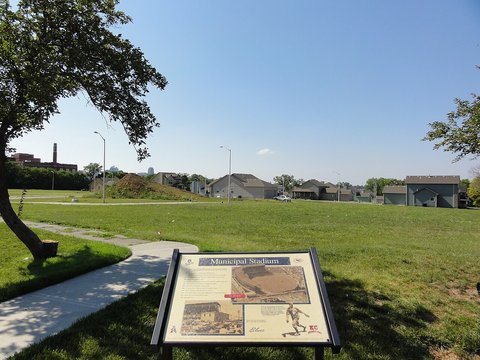
The park closed after a baseball game on 27 September 1999. The Detroit Historical Society records demolition beginning in 2008 and finishing the following year, and the Detroit Police Athletic League developing the site afterwards. The playing field is still a playing field, which is a rarer outcome for a demolished stadium than the parking lots that appear elsewhere in this series.
Coordinate. The pin is at 42.332199 north, 83.068789 west, with a precision radius of 120 metres. Two independent methods were used. OpenStreetMap carries the site as a way named The Corner Ballpark, tagged with the former name Tiger Stadium, the operator Detroit PAL and the address 1680 Michigan Avenue; its 14-node closed ring has a centroid at 42.332199, minus 83.068789, and bounds of roughly 178 metres north to south by 188 metres east to west. The United States Census TIGER geocoder, asked for 2121 Trumbull Avenue in the 48216 ZIP, returned 42.332072, minus 83.067381, and read the address back as 2121 Trumbull Street, changing the street type but keeping the number and the ZIP. The two lie about 117 metres apart, a figure computed here. That is close to half the block's east-west width, which is what you would expect from a geocoder interpolating a Trumbull frontage address against the centroid of the whole square, so the gap is the size of the block rather than a disagreement about where it is. The radius is taken from the footprint, not from the number of decimal places available.
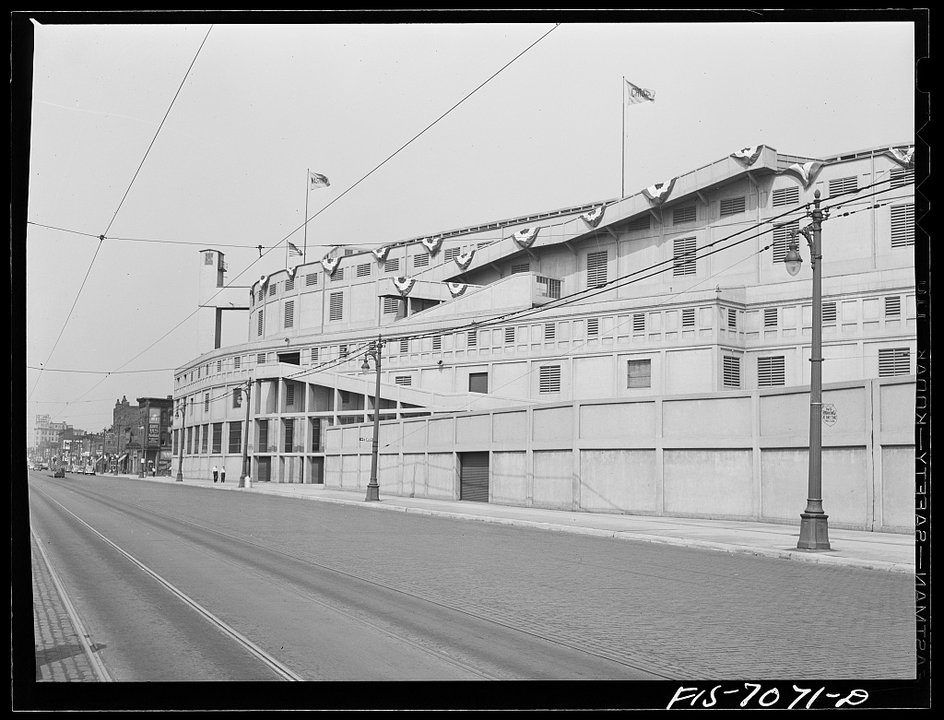
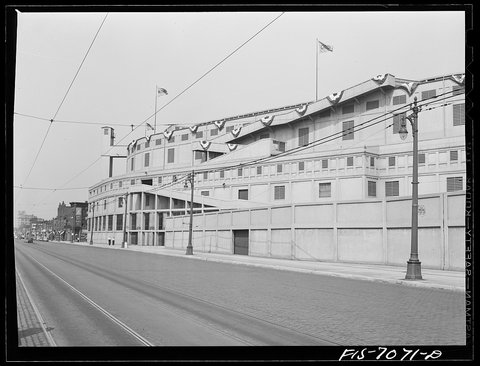
Cover image: Detroit, Michigan. Briggs Stadium, a negative by John Vachon for the Foreign Information Service of the United States Office of the Coordinator of Information, catalogued LC-USW3-007071-D in the Farm Security Administration and Office of War Information collection at the Library of Congress, which records no known restrictions on publication. The Library gives the date as August 1942 with a query mark of its own, and the frame carries the number 7071-D on the film, which is how the print was matched to the catalogue record. It shows the exterior of the double-decked grandstand from the street, with streetcar rails in the roadway and bunting hung along the upper deck. It is fifteen years earlier than this game and it is a baseball season, not a football one.
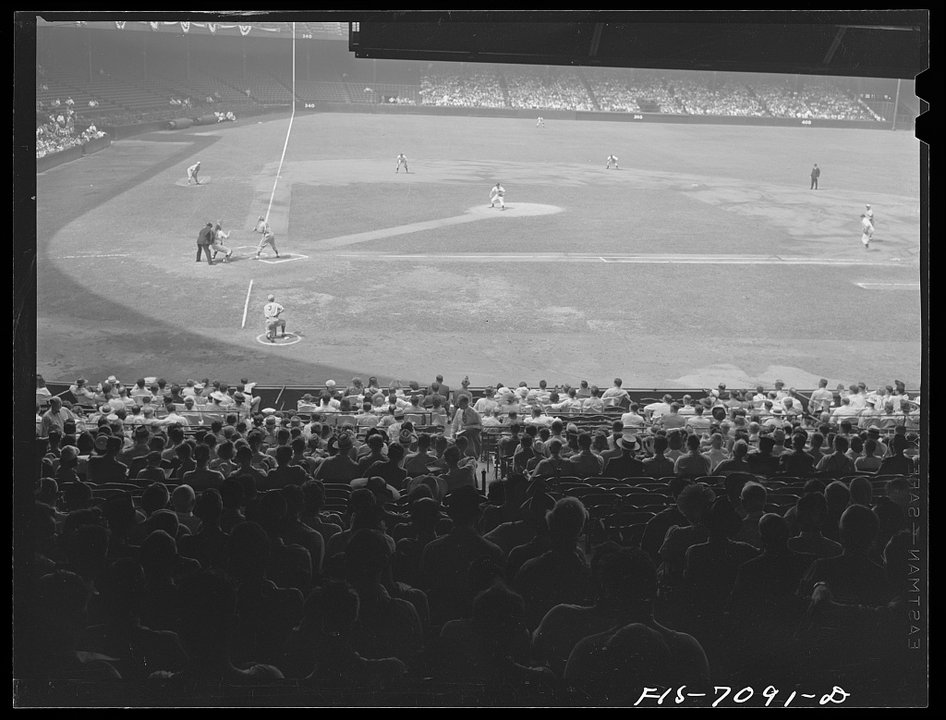
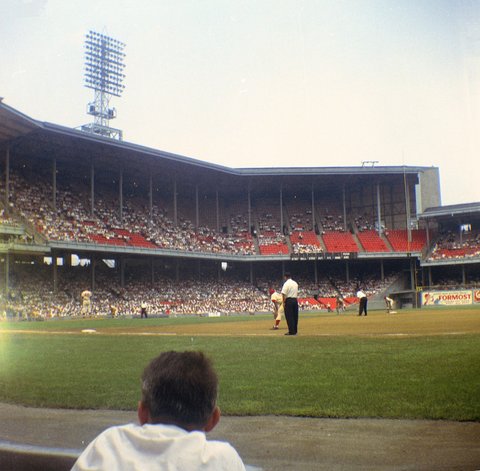
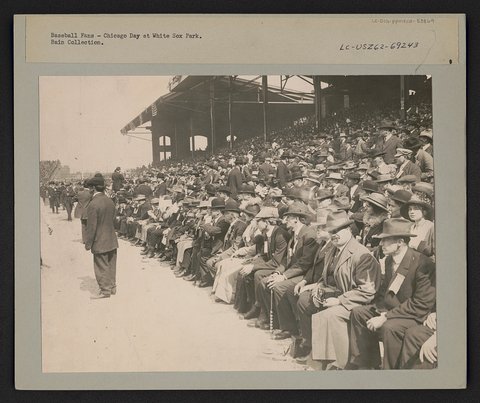
Second image: Detroit, Michigan. Detroit vs. Cleveland ball game at Briggs Stadium, LC-USW3-007091-D, the same photographer, collection and rights. It shows a baseball game in progress from the stands, with the outfield distance markings painted on the far wall. It is here because it is the shape of the enclosure a football field had to be fitted into, and it should not be read as a photograph of professional football. Nobody in that frame is playing the sport this entry is about.
changes?
delete this memory?
We detected that you have a Blox in your crypto wallet! We will import the Blox into your account.
Click on done below to complete the import.
Welcome Back!
Sign in to preserve cherished moments
Don't have an account?
Welcome!!
Sign up and start preserving cherished moments
?
?




Choose your payment method
Buy with Metablox Credit
Do you want to mint Blox with Metablox Credit?
Which Crypto would you like to use?
Purchase Confirmed!
Your Blox is being minted on-chain and will appear in your profile shortly.
Log in or sign up to claim your Blox.
How many credits do you want to buy?
$100 USD = 1 Metablox Credit = 1 Blox.
Use Metablox Credit to mint any Blox you want on the map.
 expand_more