


NFL History | Schaefer Stadium Site, Foxborough — The Ground Rule Was for the Markings, Not the Kick
· 1982-12
Personal memoryBy kevin · · Report an issue


































































Find memories left by people near you.
Distribute Bounty
This will distribute the bounty equally among all qualifying memories. This action cannot be undone.
Cancel Bounty
Are you sure you want to cancel this bounty? The remaining amount will be refunded to your account.
Success!
Operation completed successfully.
Error
Something went wrong.
NFL History | Schaefer Stadium Site, Foxborough — The Ground Rule Was for the Markings, Not the Kick
kevin
On Sunday 12 December 1982 the New England Patriots beat the Miami Dolphins 3-0 in this building. Pro-Football-Reference gives the venue as Schaefer Stadium and records exactly one scoring play in the whole afternoon: a 33-yard field goal by John Smith in the fourth quarter. Don Shula coached Miami and Ron Meyer coached New England. The game is remembered because of what was driven onto the field in the seconds before that kick, and almost every retelling of it gets the mechanism the wrong way round.
The mechanism is not that no rule existed. It is that a rule existed, had been made that afternoon, and covered something else.
Start with the surface, because it decides everything that follows. Pro-Football-Reference's record for this stadium gives the playing surface as artificial turf from 1971 to 1990 and natural grass only from 1991. So the field on 12 December 1982 was plastic, not grass. The National Weather Service's account of the game gives the temperature at kickoff as 26 degrees Fahrenheit with winds at 16 miles an hour and a wind chill of 14, and describes heavy rain the night before freezing on a surface that had no soil under it to drain into. What the players stood on was not snow over turf. It was ice bonded to a synthetic mat, with snow on top of it. That is why a rotary sweeper could do anything useful at all, and it is also why nobody could kick from an unswept spot.
The National Weather Service's account is also the source for what the officials did about it. As conditions worsened the game officials created what that account calls an emergency ground rule, made during the game rather than before it, allowing the referee to call a time out so that plows could clear snow off the markers on the field. Read that purpose closely, because it is the entire point. The sanctioned job of the machine was to uncover the markings so that the officials could see where the ball and the lines were. It was a rule about officiating, not about playing.
So when the machine came out for John Smith, it was already on the field lawfully, doing a job the officials had authorised, in a stoppage the referee had called. What changed was the purpose. Meyer directed the driver, Mark Henderson, to take the sweeper across the spot where Smith would place the ball. Smith kicked it, and those were the only points scored by either side.
This entry does not reproduce the personal details that most accounts of this game put in the first sentence about the man driving. He was a member of the crew clearing the stadium that day, and the reason he is the load-bearing figure here is not who he was but whom he answered to. That is the argument.
New England owned this building. The club had bought and operated the stadium itself rather than renting a city's ballpark, which is argued in this series at this same ground under a different question, and the grounds staff working the field on a Sunday were the home club's people. There was nobody standing between the home coach and the machine. A coach in a rented municipal stadium in 1982 could have asked for the same thing and would have had to ask somebody else.
That is what makes this the mirror image of an argument this series makes at the Polo Grounds in 1934, where the New York club was a baseball tenant, found its field frozen for a championship, and had no authority whatever to do anything to the surface it was about to play a title game on. A tenant cannot fix the field. An owner can change it while the clock is stopped. Forty-eight years apart, the same variable produces opposite outcomes, and neither outcome is about weather.
Shula protested. The National Weather Service's account reports him describing it afterwards as the most unfair act in the league's history; his exact wording is not reproduced here because no primary text of it was located. The score stood, and Pro-Football-Reference records the result as final.
Now the part that is usually asserted and that this entry could not source. It is very widely repeated that the league responded by writing a rule prohibiting this. The Pro Football Hall of Fame's chronology for 1982 records the 57-day players' strike that cut the season from sixteen games to nine, the collective bargaining agreement ratified on 17 November, the special sixteen-team playoff tournament adopted for that postseason, and an average paid attendance of 58,472. It records no rule change about field-clearing equipment. The chronology for 1983 records Super Bowl XVII and the death of George Halas on 31 October and, again, no such rule change. No playing-rule text dating a prohibition to this game was reached from here; the league's current rulebook could not be retrieved this session, and the absence of a citation is reported as an absence rather than filled in.
What is documented is the destination rather than the moment of departure. The league's own description of its Game Operations Manual says the manual now specifies the tarps that may be used on its fields down to weight and colour, on the grounds that those properties affect how fast ice and snow melt. A league that once left a frozen field to whoever owned the building now writes down the colour of the cover. Reading the distance between those two states as the real consequence of this afternoon, rather than a single prohibition adopted in response to it, is this entry's own reading and not a claim taken from a source.
Two codas, both short.
The season this game sat in was nine games long because of the strike, so a single result carried close to twice its usual weight in the standings. It did not carry it far. Pro-Football-Reference gives Miami as the division winner at 7-2 and New England as a qualifier at 5-4, and both went into the sixteen-team tournament. Twenty-seven days after losing 3-0 on the ice, Miami beat New England 28-13 in the wild card round on 8 January 1983 at the Orange Bowl, on its own dry ground, a stadium this series pins under a different question. The Hall of Fame's chronology has Miami going on to lose Super Bowl XVII to Washington at the Rose Bowl on 30 January.
And the building changed its name within weeks. Pro-Football-Reference gives the venue as Schaefer Stadium from 1971 to 1982, Sullivan Stadium from 1983 to 1988 and Foxboro Stadium from 1989 to 2001. The 1982 season was the last one played under the name in the box score above.
Coordinate. The pin is at 42.0927 north, 71.267442 west, with a precision radius of 150 metres. The primary value is the coordinate recorded for Foxboro Stadium on Wikidata, entity Q339850, which also gives the building an inception of 15 August 1971 and a demolition year of 2002. This is an improvement on the position this series was able to publish for this ground previously, and the improvement is the reason for stating it here. The earlier entry disclosed that it had found no gazetteer entry or published coordinate at all, that the United States Geological Survey names service was returning errors, and that its pin was constructed by interpolation along Washington Street rather than sourced, at a precision of 600 metres. That constructed value and the Wikidata value, derived by wholly different means, fall about 98 metres apart, which is well inside the footprint of a bowl that seated tens of thousands. Following the precedent this series set in the Bronx, convergence at that scale establishes that the two are readings of one place rather than two places, and the radius here is set at 150 metres to contain both points and the footprint around them.
Two negative results are reported rather than hidden. The OpenStreetMap raw API, which is this series' usual second leg, holds no trace of this stadium at all: an extract of the area returns Gillette Stadium as a multipolygon with a start date of 2002, the Patriots Hall of Fame as a building, and the shops and car parks of the development that now covers the site, but nothing tagged with this stadium's name in any historic-name field. And the United States Census TIGER geocoder failed in the specific way this series has learned to watch for. Asked for 1 Patriot Place, Foxborough, it returned a match at 1 PATRIOT CIR, FOXBOROUGH, MA, 02035, a different street with a similar name roughly 1.2 kilometres east. Reading the matched address string back is what caught it, and that leg was discarded rather than used.
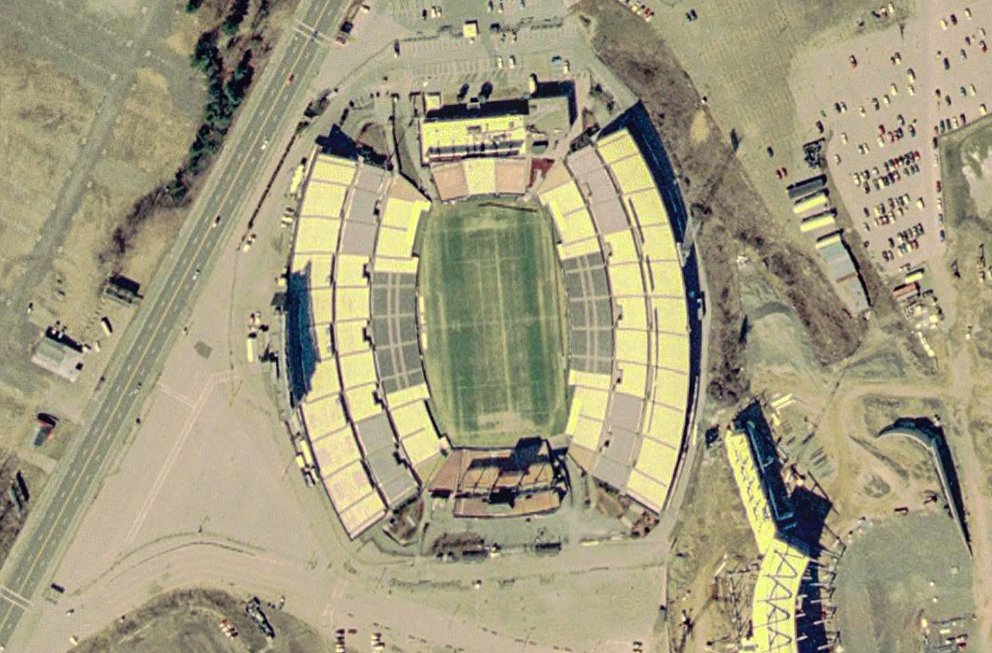
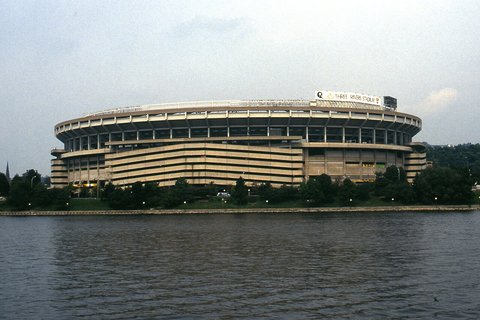
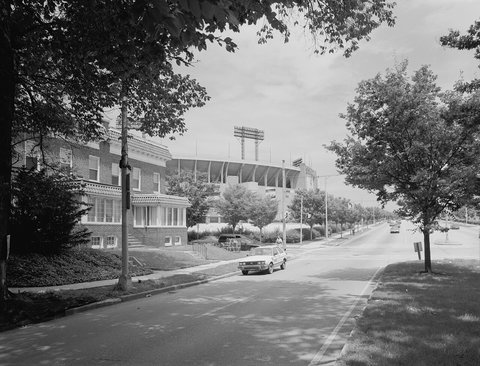
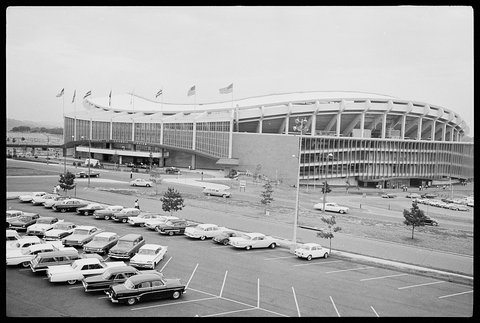
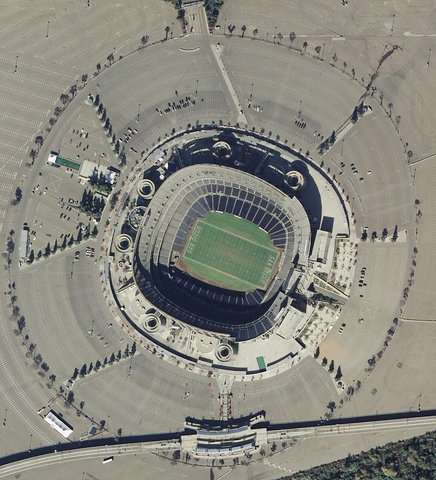
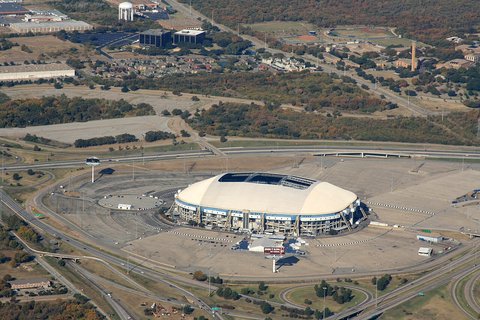
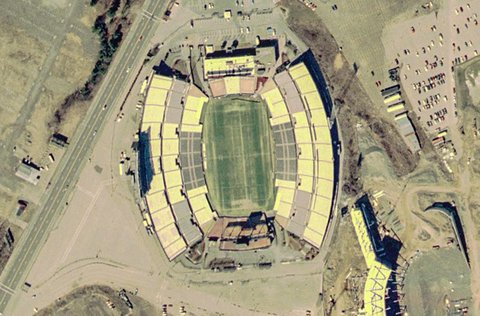
Cover image: a vertical aerial photograph of this stadium, from a screenshot of NASA World Wind software held on Wikimedia Commons, which records it as public domain and credits NASA. The file carries no date, and the file was opened and examined to establish one. Two things in the frame do it. The playing surface is green natural grass, which places the frame no earlier than 1991 on the surface record above; and along the right-hand edge, beyond the stadium's own car parks, the bare steel skeleton of a much larger structure is under construction, which is Gillette Stadium, given a start date of 2002 in OpenStreetMap and opened that year. The trees are bare and the grass off the field is brown. Dating the frame to roughly 2000 or 2001 on that evidence is this entry's own reading, not a caption supplied with the file. What the photograph shows well is the thing the memory is about: a shallow open bowl with long straight banks of bleacher seating on both sidelines, no roof over any of it, and a single rectangle of playing surface with nothing between it and the sky. It is not a photograph of the 1982 game, and it shows a grass field where the 1982 game was played on frozen plastic. No free-licensed photograph of the game itself was found.

changes?
delete this memory?
We detected that you have a Blox in your crypto wallet! We will import the Blox into your account.
Click on done below to complete the import.
Welcome Back!
Sign in to preserve cherished moments
Don't have an account?
Welcome!!
Sign up and start preserving cherished moments
?
?






Choose your payment method
Buy with Metablox Credit
Do you want to mint Blox with Metablox Credit?
Which Crypto would you like to use?
Purchase Confirmed!
Your Blox is being minted on-chain and will appear in your profile shortly.
Log in or sign up to claim your Blox.
How many credits do you want to buy?
$100 USD = 1 Metablox Credit = 1 Blox.
Use Metablox Credit to mint any Blox you want on the map.
 expand_more