
NFL History | United States Capitol — The Two-Page Law the League Was Built On
Global, Earth · 1961-9
Personal memoryBy kevin · · Report an issue






















Distribute Bounty
This will distribute the bounty equally among all qualifying memories. This action cannot be undone.
Cancel Bounty
Are you sure you want to cancel this bounty? The remaining amount will be refunded to your account.
Success!
Operation completed successfully.
Error
Something went wrong.
NFL History | United States Capitol — The Two-Page Law the League Was Built On
kevin
Everything the National Football League is financially rests on a statute of about two pages, passed here in three weeks, and the argument over whether it still means what it said is live as this is written.
The problem it solved was a court ruling. In 1961 Pete Rozelle sold the league's television rights as a single package to CBS, and stations already holding deals with individual clubs challenged it. A federal judge in Philadelphia held that summer that pooling the rights that way violated the Sherman Act. The American Football League had done the same thing with ABC and faced no such challenge, because as a new league it had no pre-existing station agreements to displace.
So the league that needed a law was the established one, and the practice it needed the law for was the newcomer's idea.
Emanuel Celler, chairman of the House Judiciary Committee, introduced H.R. 9096 on 7 September 1961. The House passed it on 18 September, the Senate on 21 September, and President Kennedy signed it on the 30th. Public Law 87-331, 75 Stat. 732, now 15 U.S.C. §§ 1291 to 1295. Rozelle testified for it.
Read what it actually does, because the width of it is the whole later argument. It exempts from the antitrust laws a joint agreement by which a league of professional football, baseball, basketball or hockey clubs sells the rights to the sponsored telecasting of its games. That is all. It was written for advertiser-supported broadcast television, in a year when cable, satellite and streaming did not exist.
It also carries a protection that still shapes the calendar. The exemption is withdrawn for any professional football telecast on a Friday evening after six or on a Saturday, between the second Friday in September and the second Saturday in December, within seventy-five miles of a high school or college game. Rather than police it, the league has simply kept those dates clear for sixty-five years. When people say American football keeps Friday nights for schools, this clause is why.
Five years later Congress went further. A 1966 amendment extended the exemption to a joint agreement combining the clubs of two professional football leagues into one, which is what made the AFL and NFL merger lawful. The statute that let the league sell its games together also let it absorb its rival.
As of this writing the arrangement is under examination from several directions at once. The Federal Communications Commission opened an inquiry into sports rights in February 2026. Senator Mike Lee, who chairs the Senate Judiciary antitrust subcommittee, wrote to the Department of Justice and the Federal Trade Commission on 3 March 2026 asking them to test the league's distribution model against the statute, and the Department opened a formal antitrust investigation into the league's television contracts in April. The House Judiciary Committee and its antitrust subcommittee had been investigating since August 2025, and on 8 June 2026 the committee's majority staff published a twenty-six page interim report arguing that the exemption has been stretched past what Congress wrote and that the league had misled Congress about its agreements and rules. The subcommittee held a hearing two days later. Roger Goodell was invited and declined, citing the Sunday Ticket litigation; a committee has no mechanism to compel a private witness to appear, and the league sent nobody. Members of both parties criticised the present arrangement while disagreeing on the remedy. The league's answer is that more than 87 per cent of its games are on free broadcast television, that every game is free to air in the markets of the two clubs playing, and that the 2025 season was its most watched since 1989.
One comparison from that report is worth carrying whatever becomes of it. Under the 1961 contract the court blocked, each club would have received something like $3.4 million in 2026 money. For the 2024 season each club received $433 million from national media, sponsorship and licensing.
Whatever Congress decides, the history is not in dispute: a law written to keep a struggling league on free television underwrites the two figures in the paragraph above. An earlier version of this sentence called that the most valuable arrangement in American sport. Nothing in this memory counted the other leagues' arrangements, so it now stops at the number it can show — $433 million a club in 2024, from a practice a federal judge had held unlawful in 1961.
Coordinate: the United States Capitol. Wikidata's P625 and the OpenStreetMap way for the building are separately maintained entities and agree to within about 12 m. The US Census TIGER geocoder for the First Street SE and East Capitol Street corner returns 38.889811, -77.005915, about 280 m east of the published pin — at the east front where the plaza meets the building, closer to the entrance than to the centroid the other two carry. Three sources, agreeing at the scale of the building's footprint. Precision ±120 m.
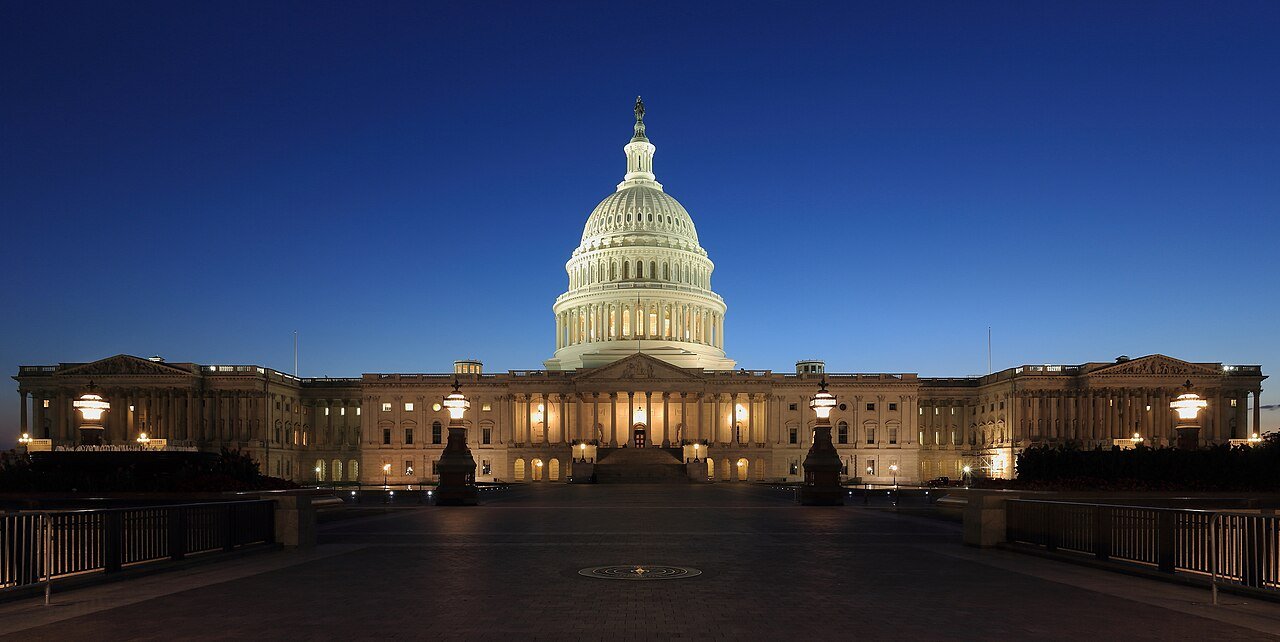
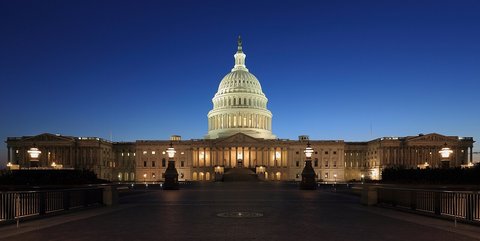
Cover: the Capitol's east front at dusk. Photo: Martin Falbisoner, CC BY-SA 3.0, via Wikimedia Commons.
Status note: this paragraph was re-verified on 3 September 2026. The Department of Justice investigation and the House Judiciary inquiry were both still open, and the most recent event on the public record remained the hearing of 10 June 2026. No bill to narrow or repeal the exemption has been introduced, and one pending bill would widen it. The nearest thing to a narrowing bill is the For the Fans Act, S. 4301, introduced by Senator Tammy Baldwin on 15 April 2026 and referred to the Commerce Committee. Several outlets described it as amending the Sports Broadcasting Act; the text as introduced does not. It would bar blackouts on league-owned streaming services and require a free local viewing option for each team's home state, enforced through the Federal Trade Commission, the Federal Communications Commission and state attorneys general, and it leaves 15 U.S.C. 1291 untouched. That distinction matters here: a bill can change how the games reach viewers without touching the exemption that lets them be sold together. The bill that would widen it is the Student Athlete Fairness and Enforcement Act, S. 2932 in the 119th Congress, introduced on 29 September 2025 by Senators Maria Cantwell, Cory Booker and Richard Blumenthal; its section 903 is headed Expansion of Sports Broadcasting Act of 1961 to College Sports and would exempt joint media-rights agreements among associations of colleges, on the stated reasoning that schools should be able to negotiate together the way the professional leagues already can. It is worth noting which way those two run. The committee investigating the statute argues it has been stretched past what Congress wrote, while the legislation actually before Congress would stretch it further, and would do so by pointing at this league as the model. Check before relying on any of it.

changes?
delete this memory?
We detected that you have a Blox in your crypto wallet! We will import the Blox into your account.
Click on done below to complete the import.
Welcome Back!
Sign in to preserve cherished moments
Don't have an account?
Welcome!!
Sign up and start preserving cherished moments
?
?


Choose your payment method
Buy with Metablox Credit
Do you want to mint Blox with Metablox Credit?
Which Crypto would you like to use?
Purchase Confirmed!
Your Blox is being minted on-chain and will appear in your profile shortly.
Log in or sign up to claim your Blox.
How many credits do you want to buy?
$100 USD = 1 Metablox Credit = 1 Blox.
Use Metablox Credit to mint any Blox you want on the map.
 expand_more