

NFL History | Forbes Field, Pittsburgh — Four Wednesdays Before the Vote Made Sunday Legal
· 1933-9
Personal memoryBy kevin · · Report an issue




































Find memories left by people near you.
Distribute Bounty
This will distribute the bounty equally among all qualifying memories. This action cannot be undone.
Cancel Bounty
Are you sure you want to cancel this bounty? The remaining amount will be refunded to your account.
Success!
Operation completed successfully.
Error
Something went wrong.
NFL History | Forbes Field, Pittsburgh — Four Wednesdays Before the Vote Made Sunday Legal
kevin
Pittsburgh's first National Football League home game kicked off on a Wednesday. So did its second, its third and its fourth.
Pro Football Reference's game log for the 1933 Pittsburgh club carries a day-of-week column, and that column is the cheapest place to see the whole argument at once. Home to the New York Giants, Wednesday 20 September 1933, lost 2-23 in front of 20,000. Home to the Chicago Cardinals, Wednesday 27 September, won 14-13 in front of 5,000. Home to Boston, Wednesday 4 October, lost 6-21 in front of 15,000. Home to Cincinnati, Wednesday 11 October, won 17-3 in front of 5,000. Every one of the four at Forbes Field. Then the club left town for four consecutive Sundays on the road.
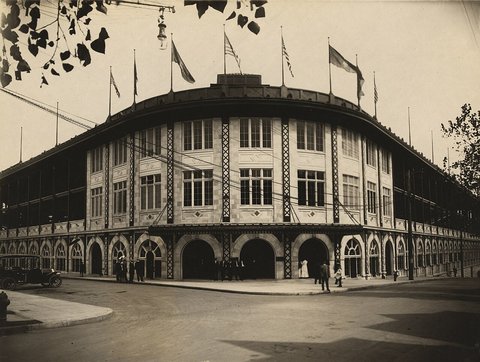
The club was not called the Steelers. It was the Pittsburgh Pirates, borrowing the name of the baseball club whose ballpark it rented; the football side took its present name in 1940. Its landlord's ground had opened in 1909 and was built for baseball, which is the ordinary condition of professional football in this period and the reason so many of these entries are about somebody else's building.
What made the first four dates fall midweek was a statute. Pennsylvania's Act of 1794 barred worldly employment on Sunday, with exceptions for necessity, charity and wholesome recreation, and through the nineteenth century and well into the twentieth it was read to prohibit commercial sport on that day. J. Thomas Jable's 1975 paper, Sunday Sport Comes to Pennsylvania: Professional Baseball and Football Triumph over the Commonwealth's Archaic Blue Laws, 1919-1933, traces how that reading survived until the legislature moved in 1933.
Governor Gifford Pinchot signed the Schwartz bill in April 1933. It did not legalise Sunday sport. It gave every city, borough and township in the Commonwealth the right to decide the question for itself at a referendum, and it fixed the hours within which a Sunday game could be played. The permitted window is one of two points on which the sources consulted here disagree: the Society for American Baseball Research gives it as two o'clock to six; Jable gives two o'clock to half past five, and says the earlier curfew was set so that games would end before Baptist and Methodist evening worship. Both figures are printed here because neither was resolved.
The National Football League awarded franchises to Pittsburgh and Philadelphia in July 1933, four months before the vote that would decide whether either city could play its games on the day the rest of the league played. Jable states plainly that the franchises were granted in anticipation of approval. The league bet on an election.
The election was held on 7 November 1933. Voters in both cities approved Sunday sport by a lopsided margin. The exact figure could not be fixed here: the material consulted returns both a two-to-one and a three-to-one margin, and no vote totals were located, so no ratio is asserted.
Five days later the schedule changed shape. On Sunday 12 November 1933 the Pittsburgh club played Brooklyn at Forbes Field and lost 32-0 in front of 12,000. The same afternoon in Philadelphia, the Eagles tied the Chicago Bears 3-3 at Baker Bowl in front of 20,000. Jable identifies that Sunday as professional football's Pennsylvania debut on the day, and his attendance figures for both games match Pro Football Reference's box scores exactly, which is two records made in different decades from different materials agreeing on the same afternoon.
Philadelphia's 1933 log makes the same point from the other end of the state. The Eagles had exactly one home date before the referendum, Wednesday 18 October. Every home date they played afterwards, from 12 November to the end of the season, was a Sunday. Two clubs, two cities, one statute, one switch.
The dry part is the gate. The four Wednesday dates at Forbes Field averaged 11,250 paid. The first legal Sunday drew 12,000. Whatever the law had been costing the club, a Sunday kickoff on its own did not fill the ballpark, and the 1933 side finished 3-6-2. The constraint was real; the cure was not immediate.
One account should be named and left standing. Wikipedia's page on the 1933 season repeats, from a 1977 encyclopedic history of the league, that Art Rooney dealt with the blue laws by supplying the superintendent of police with free box seats. That anecdote is not tested here. What can be said against it is narrow: the schedule shows no Sunday home date at Forbes Field before the referendum, so whatever it describes, it is not a Sunday league game in this ballpark.
Forbes Field kept the football tenancy for thirty-one seasons, through the wartime combinations of 1943 and 1944, until the club played its last game there on 1 December 1963 and moved to Pitt Stadium; Three Rivers Stadium, and the marked spot on West General Robinson Street, came in 1970. The ground also housed the Homestead Grays, because the owners of organised baseball kept Black players out of the white major leagues, and a Negro league club needed a landlord like anyone else.
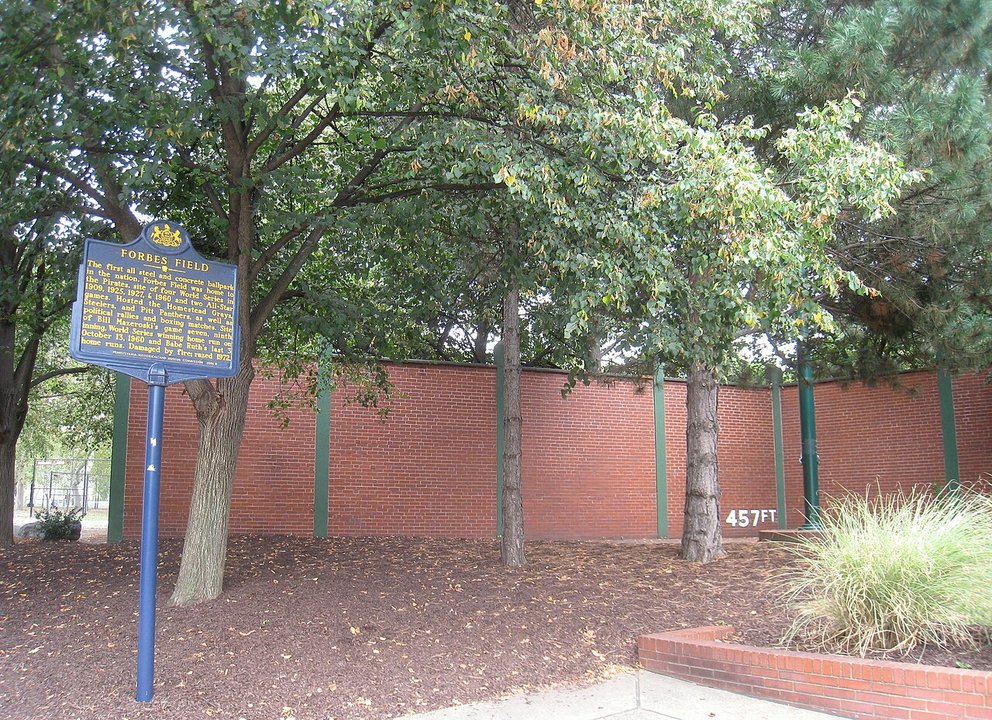
The ballpark is gone, and what is left of it is small and specific. A segment of the left-centre and centre field brick wall still stands beside Roberto Clemente Drive on the University of Pittsburgh campus, carrying the painted distances 457 FT and 436 FT. The flagpole is still there. Home plate is preserved under glass inside Posvar Hall, about 92 metres north-west of the wall. A further section of wall was moved to PNC Park.
The Pennsylvania Historical and Museum Commission dedicated a marker at the wall on 7 July 2006. Its wording is given identically by the Commission's own ExplorePAhistory site and by the Historical Marker Database, and it is legible in the second photograph attached here. Two things about it are worth stating. It lists the Steelers among the ground's tenants, which is the name the club took seven years after it started playing here, and it records that the stadium was damaged by fire and razed in 1972, where the fuller account has demolition beginning on 28 July 1971, eleven days after the second of two fires. The marker's date and that account are both reported; neither is corrected here.
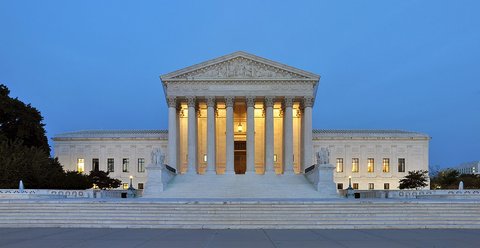
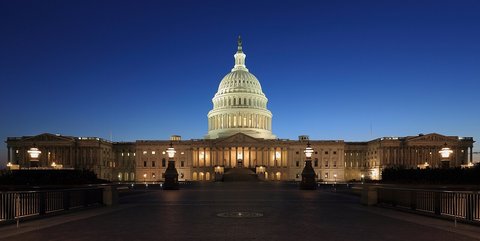
COORDINATE. Latitude 40.441433, longitude -79.952750, pinned at the state marker and the surviving outfield wall rather than at the centre of the vanished ballpark. Three methods were compared and agree: the Historical Marker Database gives the marker at 40 degrees 26.486 minutes north, 79 degrees 57.165 minutes west; Wikidata's Forbes Field item gives 40.44118, -79.95255; and OpenStreetMap carries the wall and flagpole as a separately maintained feature at 40.4412213, -79.9526917. The widest separation among the three is about 33 metres, so the honest radius is plus or minus 40 metres. The United States Census Bureau geocoder, which has been the reliable independent check at other sites in this series, returned no match for any street address tried here, as it did at the United States Capitol. Note that this pin is the far edge of the playing surface, not the middle of it: home plate's preserved position lies about 92 metres to the north-west, inside a building.
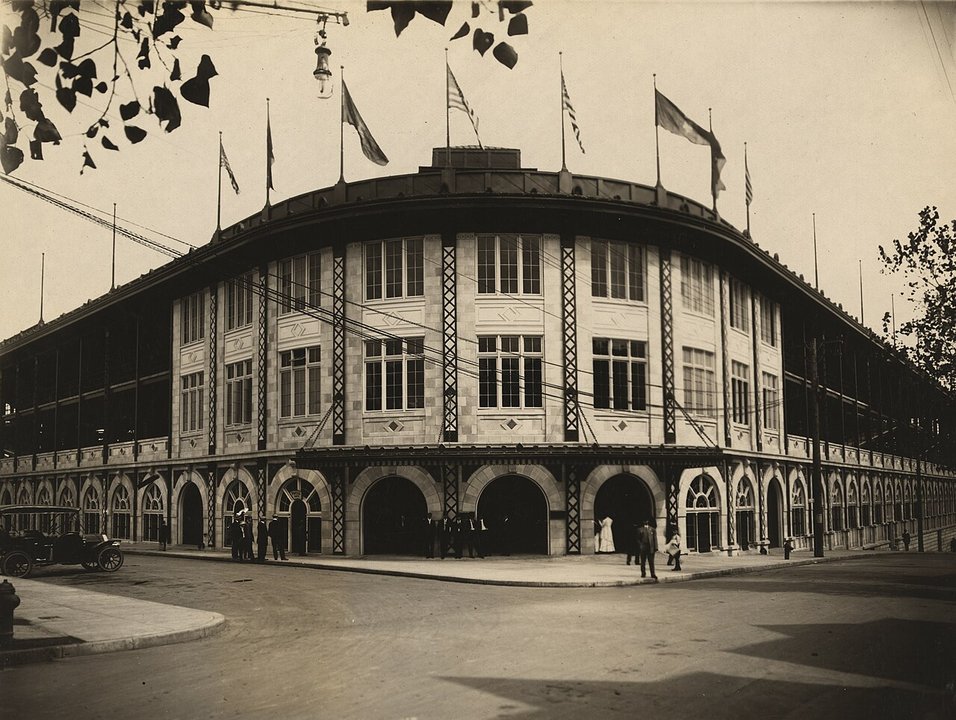
COVER. Exterior of Forbes Field, Pittsburgh, Pennsylvania, circa 1909, photographer unknown, Library of Congress Prints and Photographs Division, public domain, via Wikimedia Commons as File:Forbes Field exterior.jpg. The photograph shows the Bouquet Street pavilion of a baseball ballpark twenty-four years before a professional football club rented it, and it was made for baseball. It is used here because it is the building, not because it is the game.
SECOND IMAGE. Forbes Field monument, University of Pittsburgh, photographed by the Wikimedia contributor Daderot on 22 August 2010 and released into the public domain, via Wikimedia Commons as File:Forbes Field Monument, Pittsburgh, PA.JPG. It shows the 2006 state marker standing in front of the surviving brick wall, with the painted 457 FT visible at the right. That distance is a baseball measurement on a wall that this entry is writing about for football, which is worth saying rather than letting the picture imply otherwise.
changes?
delete this memory?
We detected that you have a Blox in your crypto wallet! We will import the Blox into your account.
Click on done below to complete the import.
Welcome Back!
Sign in to preserve cherished moments
Don't have an account?
Welcome!!
Sign up and start preserving cherished moments
?
?
Choose your payment method
Buy with Metablox Credit
Do you want to mint Blox with Metablox Credit?
Which Crypto would you like to use?
Purchase Confirmed!
Your Blox is being minted on-chain and will appear in your profile shortly.
Log in or sign up to claim your Blox.
How many credits do you want to buy?
$100 USD = 1 Metablox Credit = 1 Blox.
Use Metablox Credit to mint any Blox you want on the map.
 expand_more