


NFL History | PSINet Stadium, Baltimore — The Referendum an Appropriations Clause Prevented
· 2000-12
Personal memoryBy kevin · · Report an issue


































Find memories left by people near you.
Distribute Bounty
This will distribute the bounty equally among all qualifying memories. This action cannot be undone.
Cancel Bounty
Are you sure you want to cancel this bounty? The remaining amount will be refunded to your account.
Success!
Operation completed successfully.
Error
Something went wrong.
NFL History | PSINet Stadium, Baltimore — The Referendum an Appropriations Clause Prevented
kevin
On the last day of 2000 the Baltimore Ravens beat the Denver Broncos 21-3 in a wild-card game, in a building then called PSINet Stadium. Pro-Football-Reference's box score gives the attendance as 69,638 and the quarters as Denver 0, 3, 0, 0 and Baltimore 0, 14, 7, 0. It was the only home game of the run that followed. The same postseason table lists the divisional round at Tennessee, the conference championship at Oakland, and a 34-7 win over the New York Giants at a neutral site four weeks later. The 2000 club finished 12-4, second in its division, and allowed 165 points, 10.3 a game, first of the thirty-one teams in the league that season.
Thirteen years before that afternoon, Marylanders tried to vote on whether the building should exist. They were told they could not, and the thing that stopped them was a clause.
THE AUTHORITY, AND THEN THE PETITION
The Maryland Stadium Authority was formed by the General Assembly in 1986 under Chapter 283 of that year's Acts, according to the Maryland Manual published by the state archives, and was empowered to select a site for new sports stadiums in the Baltimore area and to acquire, construct and operate them. The legislature returned to the subject in 1987.
An opposition committee called Marylanders for Sports Sanity set out to put the project before the voters at the 1988 election. The committee is named in Baltimore Magazine's April 2022 account of the Camden Yards project by Ron Cassie, which also says that Governor William Donald Schaefer pushed the General Assembly to approve the project and then blocked the referendum campaign, and that polling indicated the measure would not have passed. That is the magazine's framing of the politics and it is set down here as the magazine's, not as a finding.
The legal mechanism is separate and better documented. Maryland's constitution gives citizens a power of referendum in Article XVI and exempts from it any law making an appropriation for maintaining the state government. A Guide to the Citizen's Power of Referendum in Maryland, published by the Department of Legislative Services, states that the Court of Appeals interpreted that exception to prohibit a referendum on two 1987 enactments concerning the Maryland Stadium Authority. The guide describes the holding without naming the case, and this entry does not supply a citation it has not read.
The guide also sets out what a statewide petition requires: signatures from three per cent of registered voters, more than a third of them filed by 1 June and the remainder by 30 June, and no more than half drawn from any single county or from Baltimore City. The worked figure the guide attaches to that rule -- 55,736 valid signatures -- belongs to the 2011 to 2014 cycle. Nothing consulted here gives the threshold that would have applied in 1987, and none is claimed.
So the argument of this pin is narrow and it is not about whether the stadium was a good use of public money. It is that the one instrument capable of settling that question in public was closed, not by a vote and not by a governor, but by a sentence in the state constitution about appropriations. Another entry in this series, at the site of Memorial Stadium six kilometres north, deals with the franchise Baltimore lost and the one it received; this one is about the ballot that was never printed.
THREE STATE ACCOUNTS OF THE MONEY, AND THEY DO NOT LIST THE SAME THINGS
The Authority's own page for the stadium says it was completed in 1998 at an estimated cost of 220 million dollars, gives its capacity as 71,008, and describes the original funding as a combination of proceeds from the sale of tax-exempt revenue bonds and debt service paid by lottery proceeds.
The Maryland Manual, describing the Authority's Financing Fund, names proceeds from the sale of Authority bonds together with revenues collected from any other source, including a tax on gate receipts at Oriole Park. It does not mention a lottery anywhere.
Baltimore Magazine says state lottery money and state bonds.
The three are not flatly contradictory -- a bond can be serviced out of lottery revenue -- but no source read for this entry sets out the whole structure, and none of the three is complete on its own. They are printed here unreconciled. The capacity figure and the 2000 attendance figure sit in the same entry deliberately; no ratio is computed from them, and the capacity given is the Authority's present one, not a 2000 figure.
THREE RECORDS, THREE OPENING DATES
The Authority's history page gives the stadium's opening as 6 August 1998. The Maryland Manual gives 6 September 1998. Pro-Football-Reference's 1998 schedule places the club in Pittsburgh on 6 September, losing 20-13, and gives 27 September as its first home date, a 31-24 win over Cincinnati at a ground it names Ravens Stadium at Camden Yards.
A preseason opening would account for August. Nothing consulted accounts for the September date, which cannot be the first professional game in the building because the club was in another state that day. The disagreement is left standing.
The building's name has changed more than once inside this vertical's own sources: Ravens Stadium at Camden Yards on the 1998 schedule, PSINet Stadium on the 2000 box score, M&T Bank Stadium on every current record consulted. The anchor is titled for the name it carried on the day of the game.
AND THE MONEY DID NOT STOP
The Authority records a three-year investment of approximately 120 million dollars by the club, completed in 2019, with a further 24 million from the Authority, and a multi-year renovation announced in December 2023 drawing an estimated 430 million dollars from 600 million dollars of state funds allotted for improvements, running from 2024. Thirty-six years after the referendum was foreclosed, the state was still writing the cheques.
STATUS NOTE, SEPTEMBER 2026
This entry describes the ground as its sources describe it. The Maryland Stadium Authority's own pages, read in September 2026, give the current name as M&T Bank Stadium, the Authority as owner in partnership with the club, and the 2024 renovation programme as in progress. Nothing consulted here establishes what has been completed on the site since, or what the building's capacity is today. Re-check the renovation figures after 2027.
COORDINATE
39.279654, -76.623523. Precision plus or minus 350 metres.
One method, disclosed. The United States Census Bureau's TIGER geocoder matched the stadium's postal address, 1101 Russell Street, Baltimore, Maryland 21230, exactly as written, and returned that point. TIGER interpolates along a street address range, so this is a road point on Russell Street and the bowl lies to the south-east of it; the radius is sized to contain the playing field from the pin, not from the geocoder's decimal places.
Three attempts at a second, independent record failed, and the failures are recorded because they are reusable. The Historical Marker Database returns nothing for this ground -- a sourced absence, not an unchecked one. Baltimore City is not a Socrata municipality and the catalogue endpoint that serves other cities in this series returns a 404 for it. And a second TIGER query intended to bracket the site from the south, on Ostend Street, matched West Ostend Street instead: a different street of similar name, about 800 metres west, in Pigtown. It was discarded rather than averaged. Reading the matched address string is what caught it.
COVER IMAGE
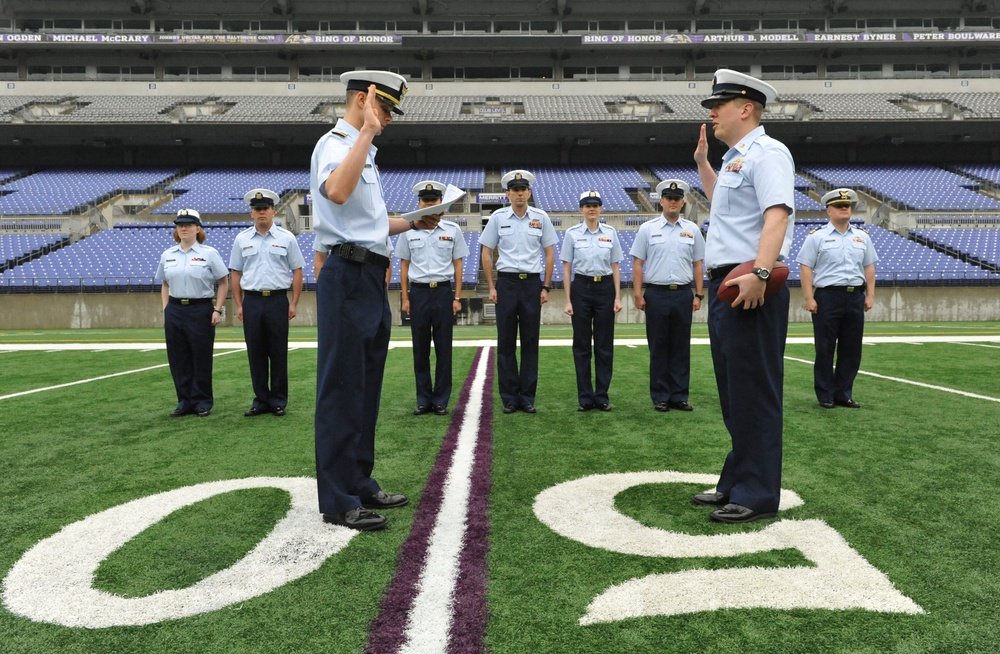
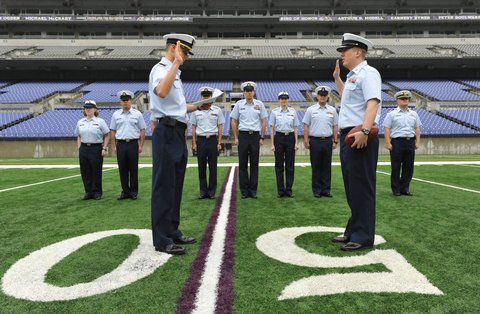
United States Coast Guard photograph by Petty Officer 3rd Class Robert Brazzell, 8 April 2011, public domain, via the Defense Visual Information Distribution Service. It shows a Coast Guard reenlistment ceremony on the fifty-yard line of an empty M&T Bank Stadium, and it is here for the bowl behind the ceremony rather than for the ceremony. The Ring of Honor band across the upper deck is legible in it, including panels for Arthur B. Modell, Earnest Byner, Peter Boulware and Michael McCrary, and a panel naming the Baltimore Colts. It is not a photograph of a game, and it is not a photograph of the 2000 game.
SECOND IMAGE
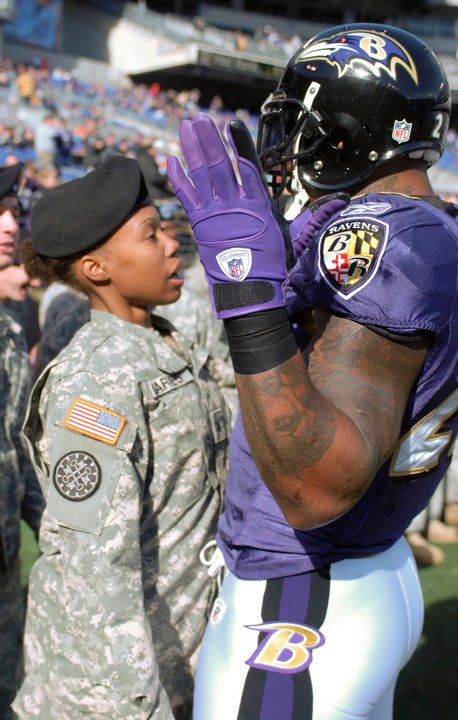
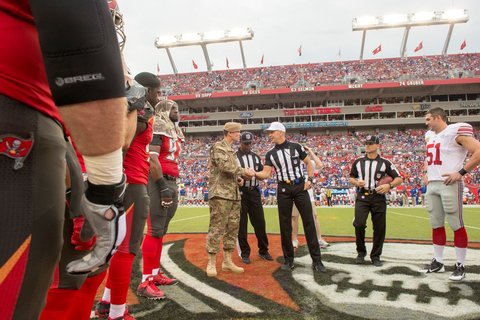
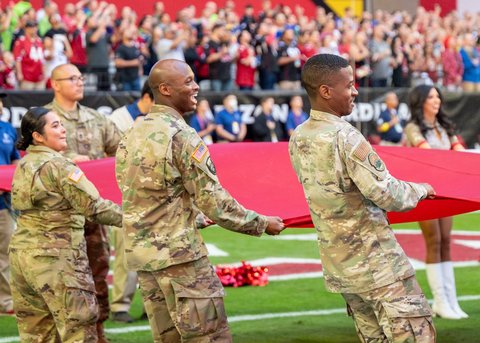
United States Army photograph by Rob Barker, 29th Mobile Public Affairs Detachment, 7 November 2010, public domain, via the Defense Visual Information Distribution Service. Maryland National Guard members were invited to the stadium for a Veterans Day event at a Ravens home game; the frame shows a player greeting a soldier on the sideline with the stands behind. Two cautions about the record rather than the picture: its location field reads Baltimore, Alabama, and only the caption places it in Baltimore, Maryland, so the caption is the field relied on here; and the page gives the photographer's rank two different ways, so no rank is printed. Neither image shows the 31 December 2000 game, and no photograph of it was found through any route open to this work.
changes?
delete this memory?
We detected that you have a Blox in your crypto wallet! We will import the Blox into your account.
Click on done below to complete the import.
Welcome Back!
Sign in to preserve cherished moments
Don't have an account?
Welcome!!
Sign up and start preserving cherished moments
?
?
Choose your payment method
Buy with Metablox Credit
Do you want to mint Blox with Metablox Credit?
Which Crypto would you like to use?
Purchase Confirmed!
Your Blox is being minted on-chain and will appear in your profile shortly.
Log in or sign up to claim your Blox.
How many credits do you want to buy?
$100 USD = 1 Metablox Credit = 1 Blox.
Use Metablox Credit to mint any Blox you want on the map.
 expand_more