


Semiconductor History | 3065 Bowers Avenue — 2,300 Transistors and an Advertisement in a Trade Weekly
· 1971-11
Personal memoryBy kevin · · updated · Report an issue










































































Find memories left by people near you.
Distribute Bounty
This will distribute the bounty equally among all qualifying memories. This action cannot be undone.
Cancel Bounty
Are you sure you want to cancel this bounty? The remaining amount will be refunded to your account.
Success!
Operation completed successfully.
Error
Something went wrong.
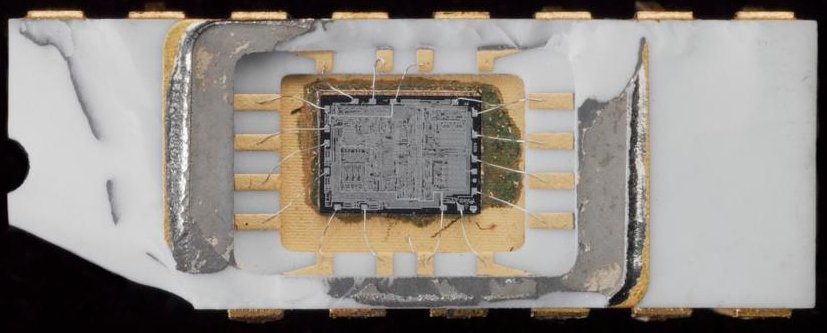
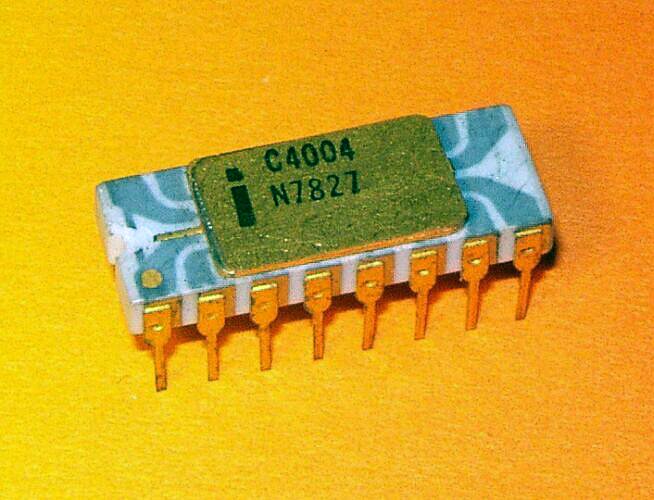
Semiconductor History | 3065 Bowers Avenue — 2,300 Transistors and an Advertisement in a Trade Weekly
kevin
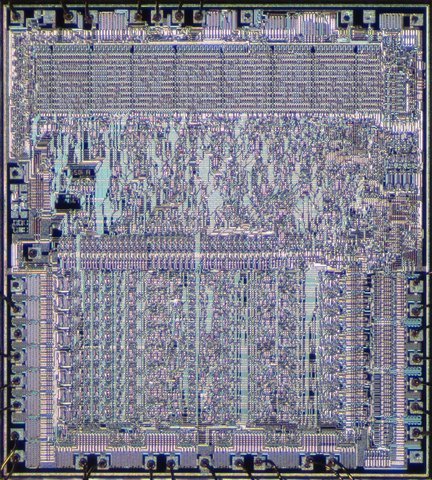
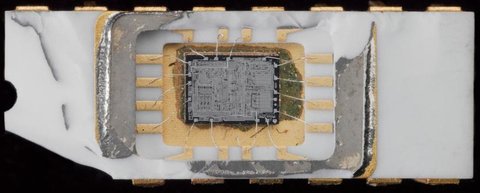
The die is a rectangle of silicon a few millimetres on a side carrying 2,300 transistors at ten micrometres, wired out to sixteen gold legs. The photograph shows one with the lid taken off, which is the only way to see it.
On 15 November 1971 Intel ran a two-page advertisement in the trade weekly Electronic News for a set of four chips it called the MCS-4, one of which was a programmable processor.
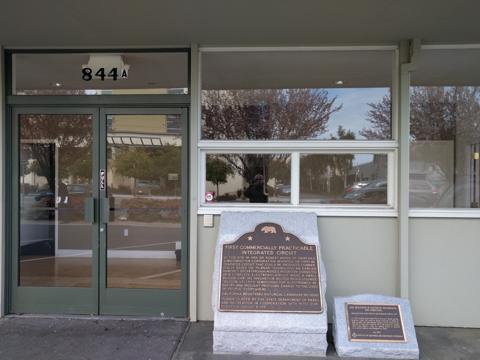
The address printed at the foot of that advertisement was 3065 Bowers Avenue, Santa Clara.
The engineering team had moved into that building earlier the same year, and it was later known inside the company as SC1; the design work had started two and a half kilometres away on East Middlefield Road, in the offices Intel had rented from Union Carbide in 1968.
Their customer made calculators.
Nippon Calculating Machine Corporation came to Intel in 1969 wanting a custom chip set for a printing calculator, and Marcian Hoff proposed something smaller and more general instead, with the program in memory rather than wired into logic.
Accounts differ on how many chips Busicom originally asked for, which is worth noting because the number gets printed confidently in both directions.
Stanley Mazor worked on the architecture, Federico Faggin led the design from April 1970, and Busicom sent its own engineer, Masatoshi Shima, to work alongside them.
The first fully operational part was delivered in March 1971 for the Busicom 141-PF prototype, which now sits in the Computer History Museum.
Busicom owned the exclusive rights and then did not want them.
The desktop calculator market collapsed while the chips were being designed, the customer asked to renegotiate, and Intel bought the rights back and sold the parts to everyone else.
The careful claim is that the 4004 was the first commercially available single-chip microprocessor.
Rival claims exist — a classified processor built for the F-14, Four-Phase Systems' AL1, work at Texas Instruments — and every one of them turns on what is meant by single-chip, general-purpose or commercial, so the superlative is only safe with all three words attached.
Intel was a memory company at the time and much of the industry read the advertisement as a distraction from that.
The site is still Intel's. In 2023 the city of Santa Clara required a historic resource evaluation of 3065 Bowers Avenue, one chapter of which covers Intel and the microprocessor, as part of reviewing a redevelopment of the parcel, and further new buildings there went before the city in October 2025.
Photo: the Science Museum, CC BY 4.0, via Wikimedia Commons; Christian Bassow, CC BY-SA 4.0, via Wikimedia Commons.




changes?
delete this memory?
We detected that you have a Blox in your crypto wallet! We will import the Blox into your account.
Click on done below to complete the import.
Welcome Back!
Sign in to preserve cherished moments
Don't have an account?
Welcome!!
Sign up and start preserving cherished moments
?
?






Choose your payment method
Buy with Metablox Credit
Do you want to mint Blox with Metablox Credit?
Which Crypto would you like to use?
Purchase Confirmed!
Your Blox is being minted on-chain and will appear in your profile shortly.
Log in or sign up to claim your Blox.
How many credits do you want to buy?
$100 USD = 1 Metablox Credit = 1 Blox.
Use Metablox Credit to mint any Blox you want on the map.
 expand_more