


Semiconductor History | Hillsboro, Oregon — The First High-NA Machine, 165 Tonnes of It
· 2024-4
Personal memoryBy kevin · · updated · Report an issue





































































Find memories left by people near you.
Distribute Bounty
This will distribute the bounty equally among all qualifying memories. This action cannot be undone.
Cancel Bounty
Are you sure you want to cancel this bounty? The remaining amount will be refunded to your account.
Success!
Operation completed successfully.
Error
Something went wrong.
Semiconductor History | Hillsboro, Oregon — The First High-NA Machine, 165 Tonnes of It
kevin
The machine weighs 165 tonnes and arrived in Oregon in pieces in January 2024.
ASML technicians spent weeks assembling it inside a cleanroom, and in April 2024 Intel announced that assembly was finished and calibration had begun on the industry's first commercial High Numerical Aperture extreme ultraviolet scanner, a TWINSCAN EXE:5000, in its Fab D1X at Hillsboro.
High-NA does not use shorter light.
Its wavelength is the same 13.5 nanometres that ordinary EUV uses; what changes is the numerical aperture of the optics, from 0.33 to 0.55, which is a bigger and much harder set of mirrors gathering light over a wider angle.
The gain is resolution and contrast, down to roughly eight nanometres, with features in a single exposure that would otherwise need two.
The cost is field size. The exposure field is halved, so more exposures are needed per wafer and patterns have to be stitched together, and whether that arithmetic favours High-NA has been argued in public by engineers at Intel, ASML and IBM.
This is the far end of a journey that appears elsewhere in this collection as a row of containers parked in a Tainan village.
A standard EUV system ships as roughly forty freight containers, twenty trucks and three Boeing 747 freighters; the High-NA machines ship in about 250 crates, and they go to the small number of companies that can absorb both the price and the disruption.
Oregon is where Intel does process development rather than volume production.
The campus, now named for Gordon Moore, has been the company's research site for decades, and the pattern since has been to prove a node here and then ramp it in Arizona.
What happened after is still being reported rather than settled.
Trade accounts describe a production-model EXE:5200B accepted at D1X later, and material exposed on High-NA tools in Oregon reaching customers during 2026, but those are supply-chain and press accounts rather than company milestones, and this memory stops where the announcement does.
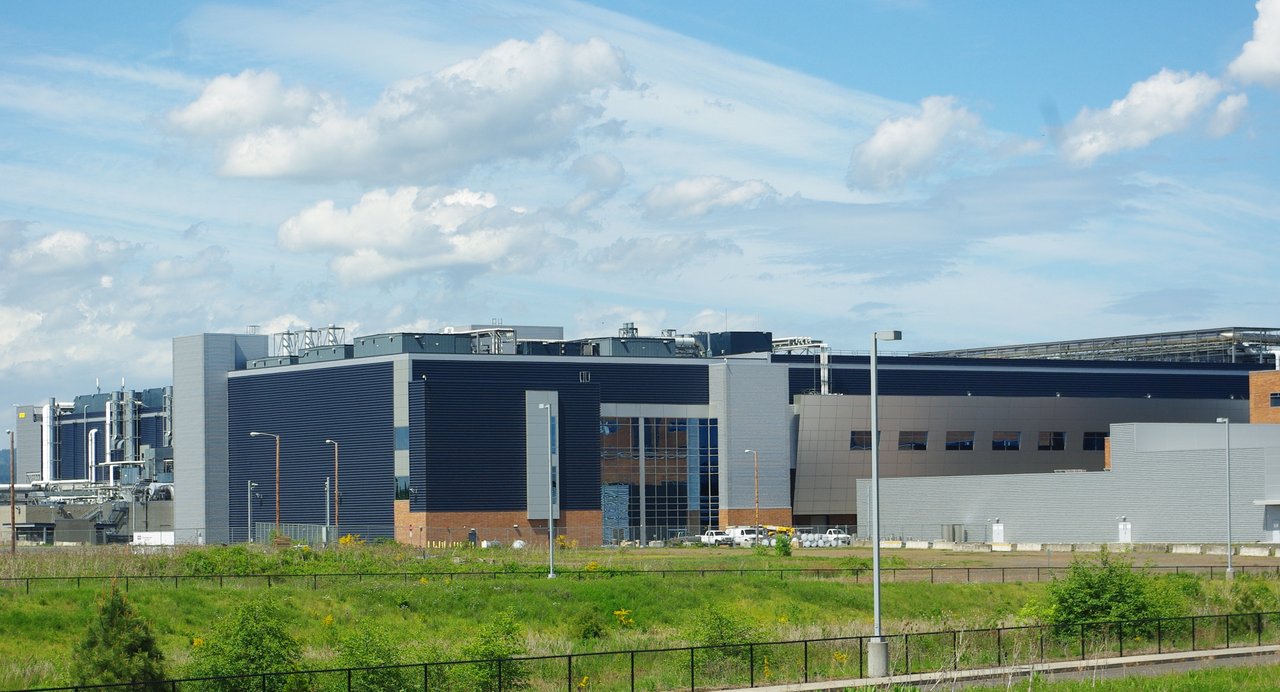
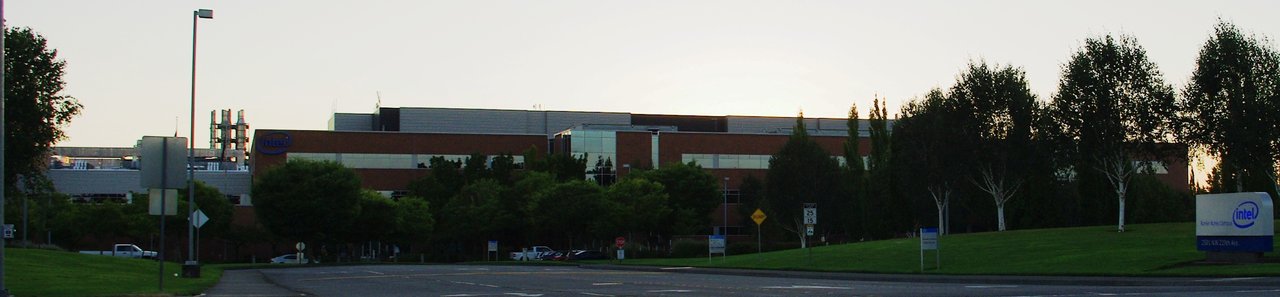
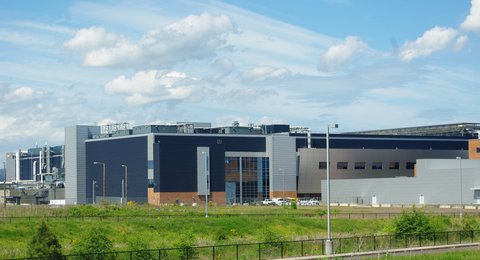
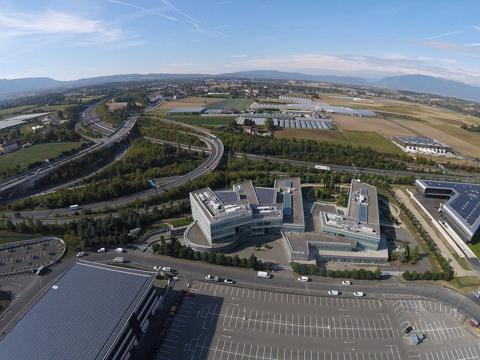
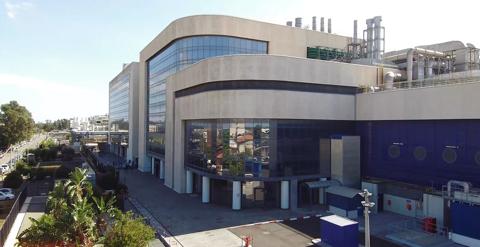
The photograph shows a production building on the Ronler Acres campus from public ground in 2009, several years before D1X was built, with process piping along one flank and a fence and a field in front of it.
That is as close as anyone gets to a machine that has never been photographed from outside its own cleanroom.
Photo: M.O. Stevens, CC BY 3.0, via Wikimedia Commons; M.O. Stevens, CC BY-SA 3.0, via Wikimedia Commons.




changes?
delete this memory?
We detected that you have a Blox in your crypto wallet! We will import the Blox into your account.
Click on done below to complete the import.
Welcome Back!
Sign in to preserve cherished moments
Don't have an account?
Welcome!!
Sign up and start preserving cherished moments
?
?




Choose your payment method
Buy with Metablox Credit
Do you want to mint Blox with Metablox Credit?
Which Crypto would you like to use?
Purchase Confirmed!
Your Blox is being minted on-chain and will appear in your profile shortly.
Log in or sign up to claim your Blox.
How many credits do you want to buy?
$100 USD = 1 Metablox Credit = 1 Blox.
Use Metablox Credit to mint any Blox you want on the map.
 expand_more