
Semiconductor History | Veldhoven — The Leaky Shed That Became a Chokepoint
· 1985
Personal memoryBy kevin · · updated · Report an issue






















Find memories left by people near you.
Distribute Bounty
This will distribute the bounty equally among all qualifying memories. This action cannot be undone.
Cancel Bounty
Are you sure you want to cancel this bounty? The remaining amount will be refunded to your account.
Success!
Operation completed successfully.
Error
Something went wrong.
Semiconductor History | Veldhoven — The Leaky Shed That Became a Chokepoint
kevin
Every advanced chip in the world is patterned by a machine built in a Dutch town of about fifty thousand people.
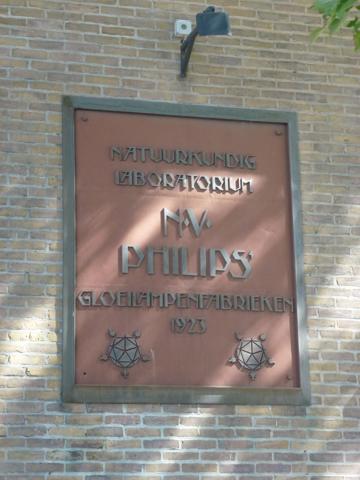
ASML moved into a newly built office and factory here in 1985, a few kilometres from the Philips research laboratories, with roughly a hundred employees.
The company had been created the year before, on 1 April 1984, as ASM Lithography, a joint venture between Philips and ASM International with one job: to commercialise a wafer stepper called the PAS 2000 that Philips had developed in-house and could not sell.
Fifty Philips employees were offered terms to move across. Forty-seven took them, and by their own later accounts they regarded the transfer as asset-stripping rather than opportunity, since they were giving up jobs for life at Philips for a start-up with no customers.
The founding conditions are told two different ways by ASML itself.
One company page says the first offices were a leaky shed beside a Philips building in Eindhoven; another says the venture began inside Philips's Strijp TQ building, and secondary accounts add a wooden shed and a headcount of thirty-one.
Take the shed as real in outline and the details as unsettled, because the company's own two versions disagree.
The first product failed.
The PAS 2000 was neither a commercial nor a technical success, and ASML's position only became durable with the PAS 5500 in the early 1990s. The company began studying extreme ultraviolet lithography in 1997 and did not ship production-ready EUV systems for two decades.
What ASML does not do is as important as what it does.
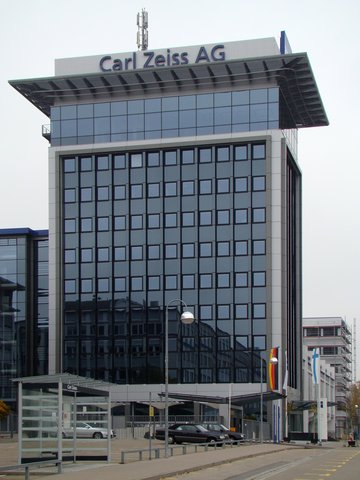
It does not make the light source, the optics, or the lasers. Cymer supplies the plasma source, Zeiss in Oberkochen grinds the mirrors, Trumpf in Ditzingen builds the drive lasers, and Veldhoven is where several thousand interdependent technologies are made to work as one machine.
No other company sells production-ready EUV systems, which is why a town most people cannot place on a map turns up in export-control negotiations between governments.
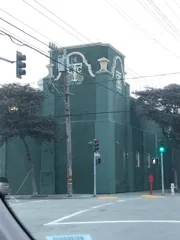
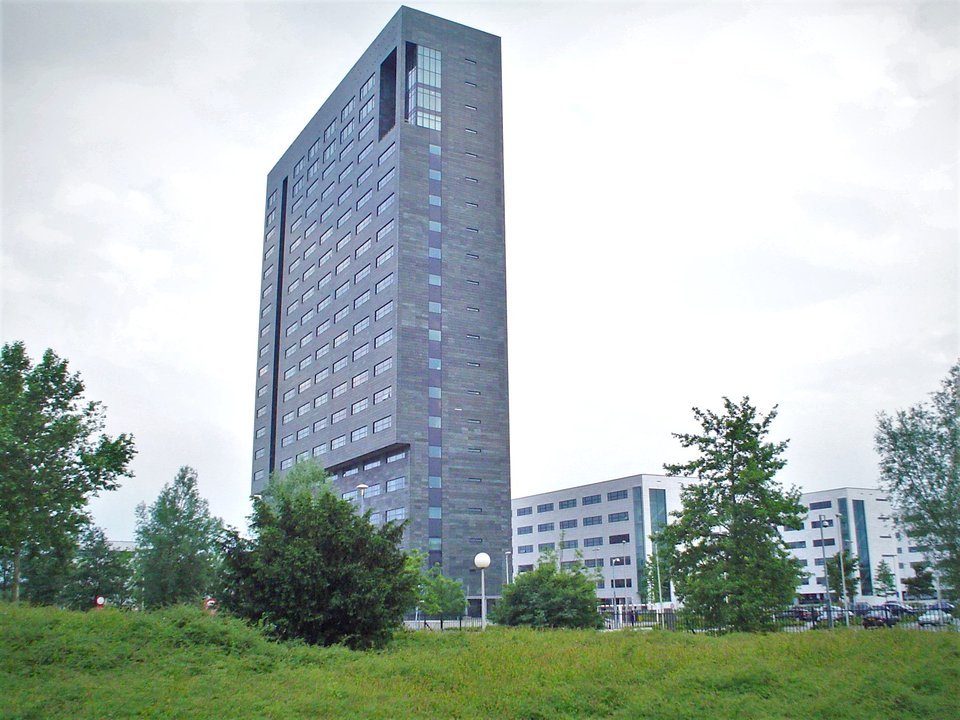
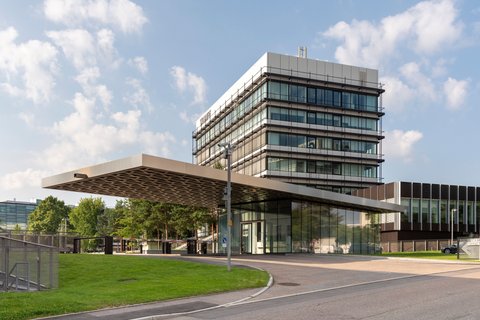
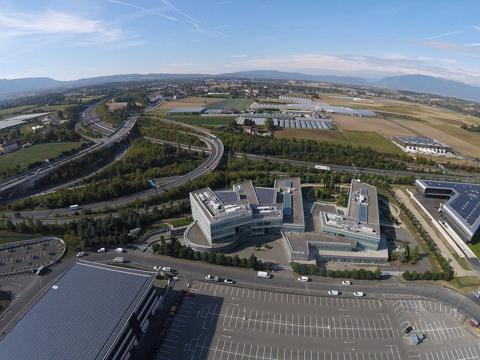
The headquarters tower on De Run is 82 metres tall and visible from the road, which is as much as a visitor gets.
The campus is a working manufacturing site, not a museum, and the machines inside it leave by aircraft in pieces.
Photo: A ansems, public domain, via Wikimedia Commons (ASML's corporate headquarters, Veldhoven).


changes?
delete this memory?
We detected that you have a Blox in your crypto wallet! We will import the Blox into your account.
Click on done below to complete the import.
Welcome Back!
Sign in to preserve cherished moments
Don't have an account?
Welcome!!
Sign up and start preserving cherished moments
?
?
Choose your payment method
Buy with Metablox Credit
Do you want to mint Blox with Metablox Credit?
Which Crypto would you like to use?
Purchase Confirmed!
Your Blox is being minted on-chain and will appear in your profile shortly.
Log in or sign up to claim your Blox.
How many credits do you want to buy?
$100 USD = 1 Metablox Credit = 1 Blox.
Use Metablox Credit to mint any Blox you want on the map.
 expand_more