


Military History | Kasinopuisto, Suomenlinna — Sited Away From the Camp
· 2004-9
Unreviewed contributionBy kevin · · updated · Report an issue


































Find memories left by people near you.
Distribute Bounty
This will distribute the bounty equally among all qualifying memories. This action cannot be undone.
Cancel Bounty
Are you sure you want to cancel this bounty? The remaining amount will be refunded to your account.
Success!
Operation completed successfully.
Error
Something went wrong.
Military History | Kasinopuisto, Suomenlinna — Sited Away From the Camp
kevin
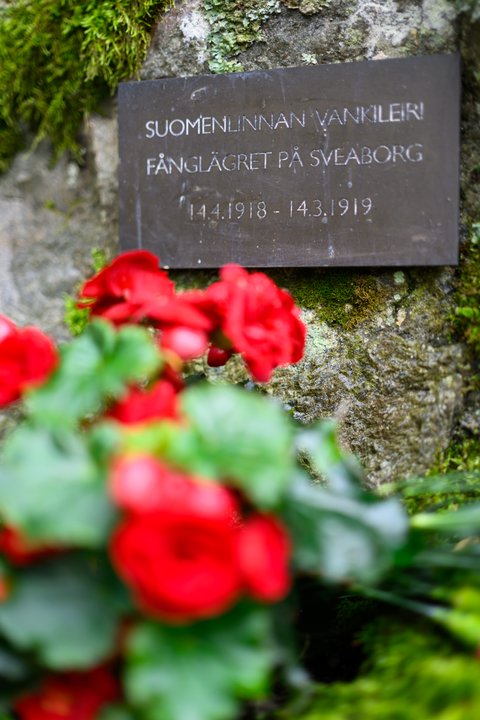
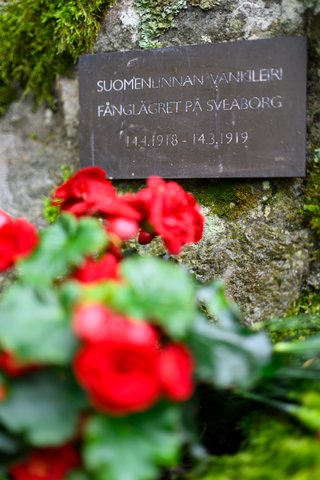
A bronze plaque is set flat into a mossy rock face in Kasinopuisto, on the north shore of Iso Mustasaari. Three lines, incised: SUOMENLINNAN VANKILEIRI / FÅNGLÄGRET PÅ SVEABORG / 14.4.1918 - 14.3.1919. The Governing Body of Suomenlinna heads its own account sotavankileiri, prisoner-of-war camp. The plaque drops the war.
German troops took Helsinki between 11 and 13 April 1918, in a war the Governing Body calls kansalaissota and the City of Helsinki sisällissota. The City records prisoners arriving at the fortress — then Viapori, renamed Suomenlinna the following month — on 14 April, the day after the Russian garrison left it, and 4,200 held there by the 16th. A national Sotavankilaitos set up at the end of April took over running the Helsinki camps; in September the Suomenlinna camp became a forced-labour institution.
Every institution counts differently. The Governing Body says 8,000 prisoners in all, Red Guards or people suspected of being Red, and one in ten dead of hunger and disease. Kansan Arkisto and Työväen Arkisto, the labour archives whose exhibition stands on the islands, count six prison districts holding about 10,000, and about 1,100 dead. The City puts 934 dead at the Suomenlinna camps and about 1,550 across all the Helsinki camps; the Valtion taideteostoimikunta gives about 1,600 for Suomenlinna. Executions before a national reprieve in December 1918: seventy-one by the City's count, eighty by the archives'. All of them were buried on Santahamina, where the women prisoners had been held. The last prisoners left on 14 March 1919.
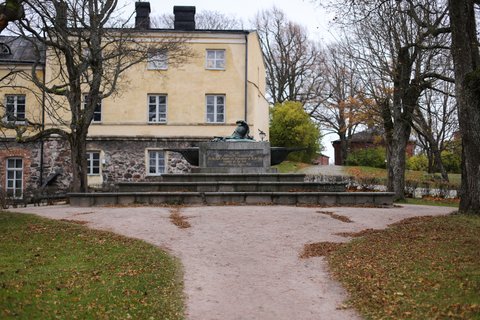
A memorial came eighty-six years later. The Valtion taideteostoimikunta commissioned it from Marja Kanervo in 2003, on the initiative of prisoners' relatives; it was unveiled on 28 September 2004. The Governing Body's Finnish and Swedish pages give the reason for the site; its English page omits it. Kasinopuisto was chosen for lying quietly outside the main routes, apart from the ground the camp had used.
Water runs over the smooth rock where 1918 and 1919 are cut, wearing them down. In a photograph taken twenty years to the day after the unveiling, red roses lie under the plaque.
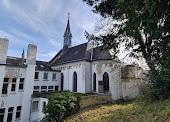
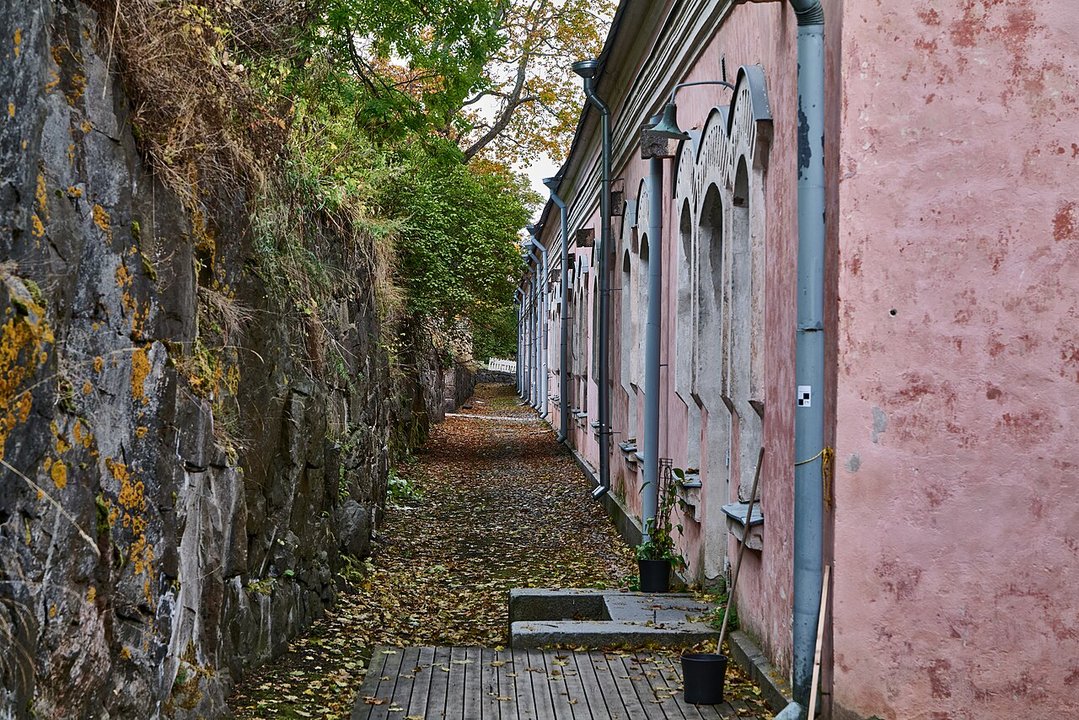
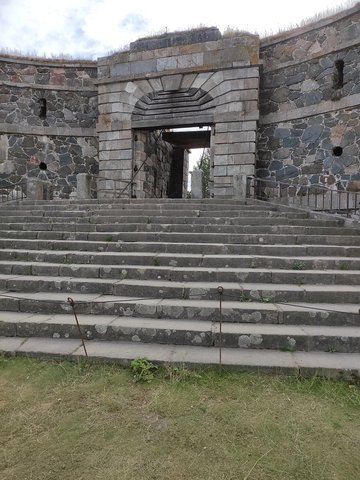
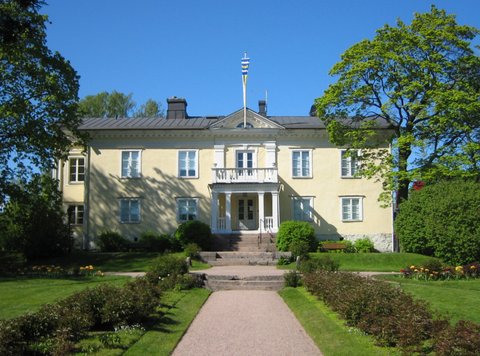
📸 Cover: the memorial's bronze plaque set into the mossy rock at Kasinopuisto, red roses laid beneath it. Photograph by Henry Söderlund, 28 September 2024, CC BY 2.0 via Wikimedia Commons — the plaque, not Marja Kanervo's wider rock composition. Second image, a lane along the Rantakasarmi (Jetty Barracks) on Iso Mustasaari, which the walk from the ferry passes; area view, not the memorial. By Leonhard Lenz (User:GPSLeo), 17 September 2022, CC0.


changes?
delete this memory?
We detected that you have a Blox in your crypto wallet! We will import the Blox into your account.
Click on done below to complete the import.
Welcome Back!
Sign in to preserve cherished moments
Don't have an account?
Welcome!!
Sign up and start preserving cherished moments
?
?
Choose your payment method
Buy with Metablox Credit
Do you want to mint Blox with Metablox Credit?
Which Crypto would you like to use?
Purchase Confirmed!
Your Blox is being minted on-chain and will appear in your profile shortly.
Log in or sign up to claim your Blox.
How many credits do you want to buy?
$100 USD = 1 Metablox Credit = 1 Blox.
Use Metablox Credit to mint any Blox you want on the map.
 expand_more