


Military History | Cimetière chinois de Nolette — Where a Pine Stands Instead of the Cross
· 1921
Unreviewed contributionBy kevin · · Report an issue





































































Find memories left by people near you.
Distribute Bounty
This will distribute the bounty equally among all qualifying memories. This action cannot be undone.
Cancel Bounty
Are you sure you want to cancel this bounty? The remaining amount will be refunded to your account.
Success!
Operation completed successfully.
Error
Something went wrong.
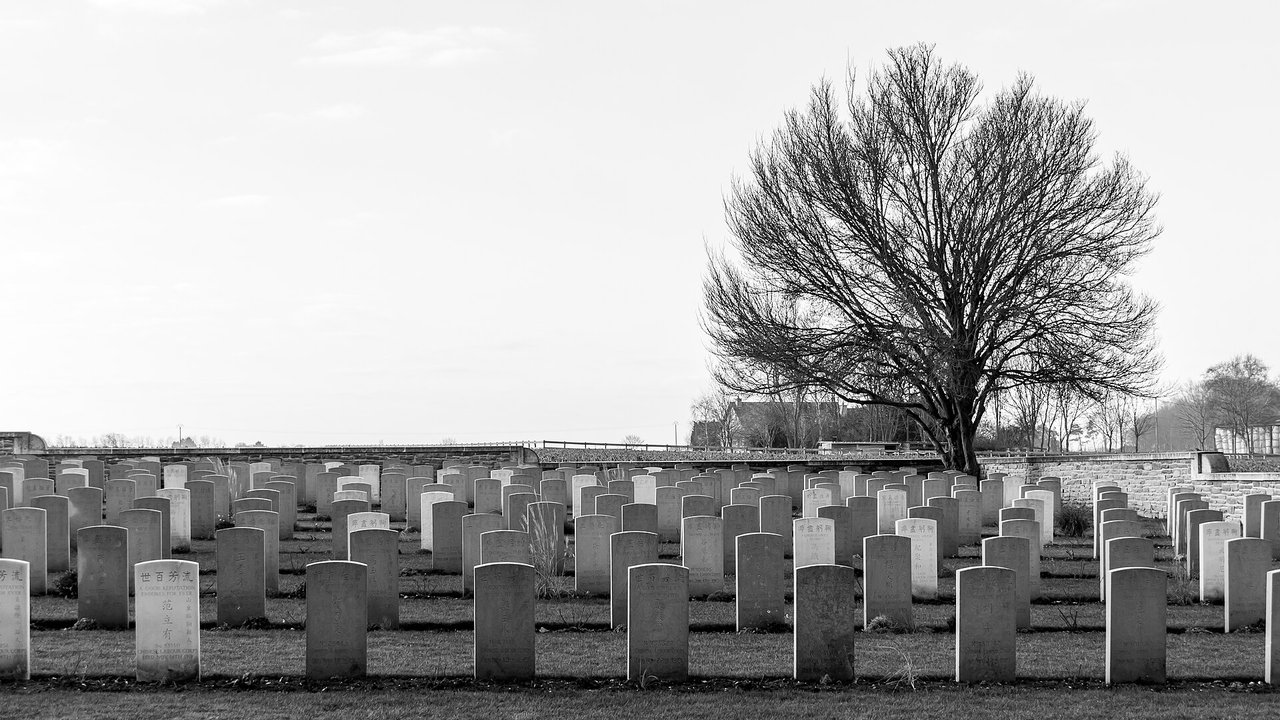
Military History | Cimetière chinois de Nolette — Where a Pine Stands Instead of the Cross
kevin
The Commonwealth War Graves Commission began work here in 1921, on a field beside the hamlet of Nolette, and the cemetery it laid out is unlike its others on the Western Front: the men buried in it had never been soldiers.
From 1917 the British army ran the largest camp of its Chinese Labour Corps (中國勞工旅) at Noyelles-sur-Mer. The French dossier prepared for the site's UNESCO listing describes a transit camp here through which every Chinese worker the army recruited passed for medical examination, and a work camp beside it employing up to two thousand men a day; a hospital stood among the huts, and its burial ground is where the cemetery began. The men were civilians on contract, a large proportion of them from Shandong. The British government's own account of their work says they dug trenches and cleared casualties and the wounded from the battlefields. Most of those buried at Nolette died at the very end of the war or after it, of wounds or of disease.
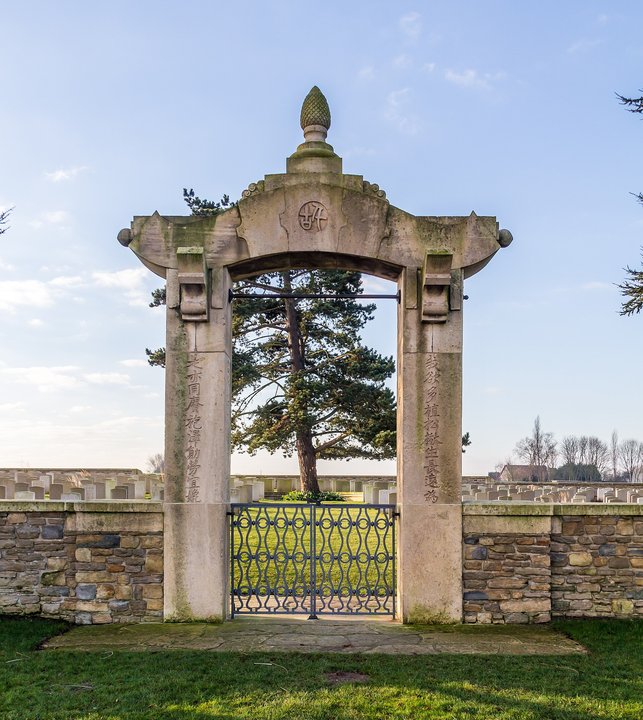
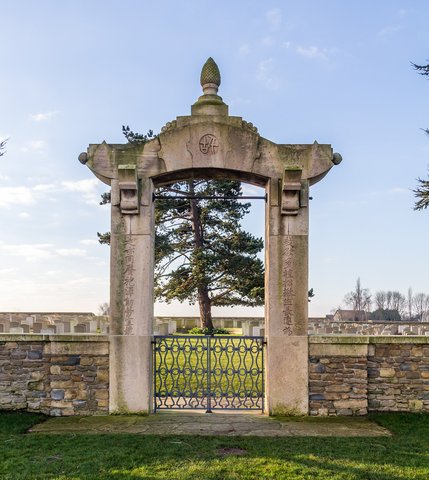
Edwin Lutyens designed the cemetery, assisted by Captain Truelove, and the Commission's usual grammar is present in the dressed stone wall, the white headstones in rank, the mown grass. Two of its standard objects are not. There is no Cross of Sacrifice and no Stone of Remembrance; a pine grows where the cross would stand, and down the piers of the roofed gateway runs a couplet cut in Chinese that begins 我欲多植松柏 — I would plant many pines and cypresses.
The stones carry a four-character Chinese formula above the name, and they are not all the same. One in the front rank reads 流芳百世, with A GOOD REPUTATION ENDURES FOR EVER cut beneath it; a narrower column beside the name gives the county in Shandong the man came from. That dossier counts 841 graves, three of them unnamed, and other published counts differ. Since the early 2000s the Chinese communities of the Paris region have kept Qingming here each 5 April.
📸 Cover: the gateway at Nolette, with the pine standing beyond it — Raimond Spekking, CC BY-SA 4.0, via Wikimedia Commons. Second image: the headstones in rank, same photographer and licence.





changes?
delete this memory?
We detected that you have a Blox in your crypto wallet! We will import the Blox into your account.
Click on done below to complete the import.
Welcome Back!
Sign in to preserve cherished moments
Don't have an account?
Welcome!!
Sign up and start preserving cherished moments
?
?




Choose your payment method
Buy with Metablox Credit
Do you want to mint Blox with Metablox Credit?
Which Crypto would you like to use?
Purchase Confirmed!
Your Blox is being minted on-chain and will appear in your profile shortly.
Log in or sign up to claim your Blox.
How many credits do you want to buy?
$100 USD = 1 Metablox Credit = 1 Blox.
Use Metablox Credit to mint any Blox you want on the map.
 expand_more