


Military History | Lakenhalle, Grote Markt, Ieper — The Argument Over the Ruins
· 1919-1
Personal memoryBy kevin · · updated · Report an issue



































Find memories left by people near you.
Distribute Bounty
This will distribute the bounty equally among all qualifying memories. This action cannot be undone.
Cancel Bounty
Are you sure you want to cancel this bounty? The remaining amount will be refunded to your account.
Success!
Operation completed successfully.
Error
Something went wrong.
Military History | Lakenhalle, Grote Markt, Ieper — The Argument Over the Ruins
kevin
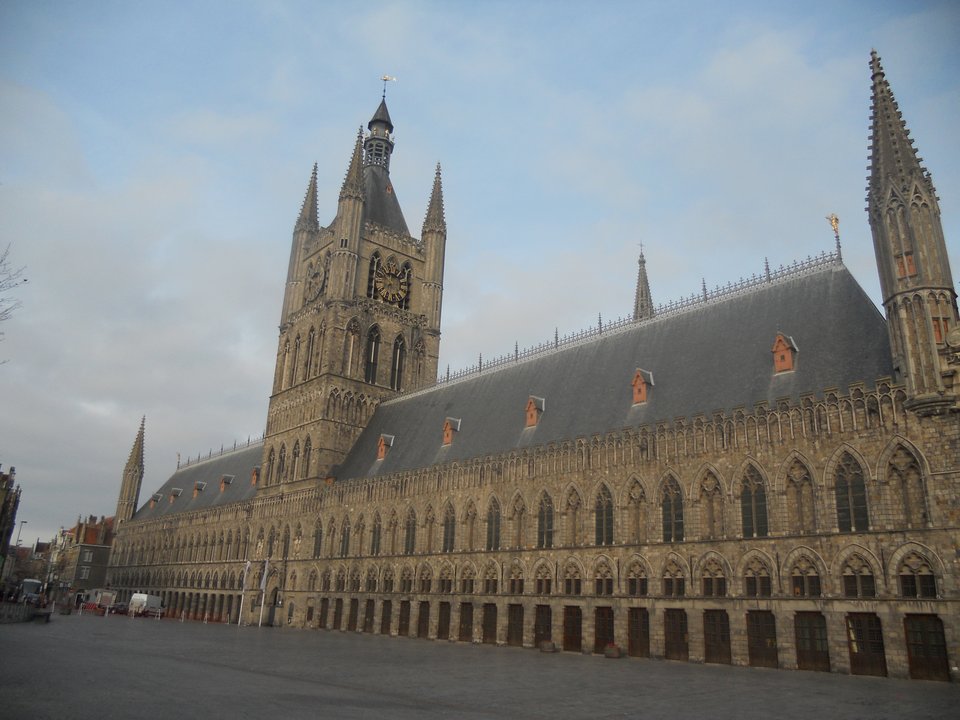
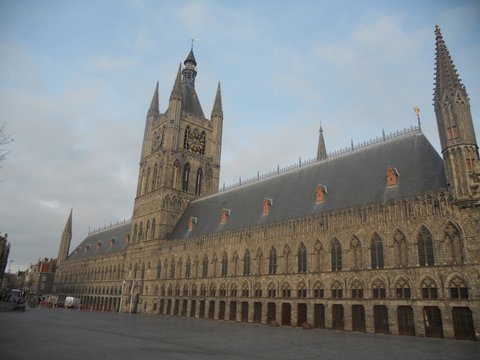
Jules Coomans, the city architect, had nearly finished restoring the Lakenhalle when the systematic shelling of Ieper — Ypres in French and English — began in November 1914. The Flemish heritage register puts the outcome in one line: by the end of the war there was only a great heap of rubble. The hall had stood on the Grote Markt since the thirteenth century, the belfry begun about 1250 and the long trapezoidal block raised between 1285 and 1304, and it had been the town's cloth market and its warehouse.
What should happen to the rubble was argued over by more people than lived in it. At a meeting of the Imperial War Graves Commission on 21 January 1919, Winston Churchill said he should like Britain to acquire the whole of the ruins of Ypres, because a more sacred place for the British race did not exist in the world. The historians Gertjan Plets and Dominiek Dendooven quote him, and record what came back: the British town major, Henry Beckles Willson, calling the town a heritage for all civilised people; the burgomaster, René Colaert, answering that it was holy ground for its inhabitants as well, and going into the November elections on a promise that Ypres would be rebuilt as it had been. That July the two governments agreed that houses and public buildings could go up while the Lakenhalle, Sint-Maartenskerk and one block of houses stayed as they were. Dendooven records that Britain withdrew the request in 1921, when the Menin Gate was settled on instead.
Coomans got his belfry back. Work on it ran from the late 1920s into the 1930s, and the last of the reconstruction came off its scaffolding in 1967. The hall was listed as a protected monument in February 1940, with the rebuilding of it still decades from done.
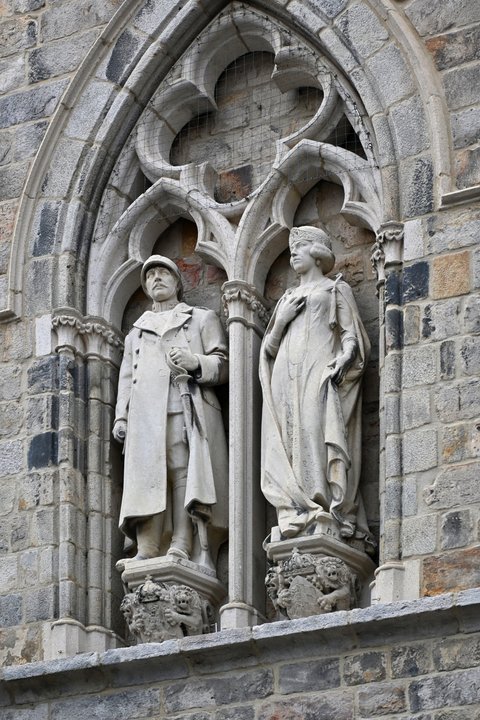
Today the ground floor has TOERISME cut into the stonework and the In Flanders Fields Museum is upstairs. High on the front, in a niche shaped for saints, stand King Albert I in greatcoat and steel helmet and Queen Elisabeth in a mantle. Both pedestals are signed, in cursive, A. De Beule.
📸 Cover: the Lakenhalle and its belfry across an empty Grote Markt. Laika ac, 2011, CC BY-SA 2.0. Second image: the sculptures of Albert I and Elisabeth in their niche on the facade. DimiTalen, 22 June 2025, CC0. Both via Wikimedia Commons.
changes?
delete this memory?
We detected that you have a Blox in your crypto wallet! We will import the Blox into your account.
Click on done below to complete the import.
Welcome Back!
Sign in to preserve cherished moments
Don't have an account?
Welcome!!
Sign up and start preserving cherished moments
?
?


Choose your payment method
Buy with Metablox Credit
Do you want to mint Blox with Metablox Credit?
Which Crypto would you like to use?
Purchase Confirmed!
Your Blox is being minted on-chain and will appear in your profile shortly.
Log in or sign up to claim your Blox.
How many credits do you want to buy?
$100 USD = 1 Metablox Credit = 1 Blox.
Use Metablox Credit to mint any Blox you want on the map.
 expand_more