


NFL History | Fenway Park, Boston — The Home Championship Date Went to the Polo Grounds
· 1936-12
Personal memoryBy kevin · · Report an issue








































Find memories left by people near you.
Distribute Bounty
This will distribute the bounty equally among all qualifying memories. This action cannot be undone.
Cancel Bounty
Are you sure you want to cancel this bounty? The remaining amount will be refunded to your account.
Success!
Operation completed successfully.
Error
Something went wrong.
NFL History | Fenway Park, Boston — The Home Championship Date Went to the Polo Grounds
kevin
This entry is pinned at Fenway Park, and the game it argues about was played in another city. On 13 December 1936 the National Football League's championship was decided at the Polo Grounds in New York. Pro-Football-Reference's 1936 schedule still lists that fixture with Green Bay as the visiting club and Boston as the home club, and its 1936 Boston season page still marks the championship row Home. The home club's ground was this one, off Jersey Street in the Fens. It did not host the game.
How the club came to be here is a Fenway story. The Boston Globe's Steve Annear, writing on 19 July 2020, records that George Preston Marshall took over the city's National Football League franchise in 1932, that it played that first season at Braves Field, and that on moving to Fenway Park in 1933 it was renamed - the account Annear takes from the team historian Mike Richman being that Marshall wanted a kinship with the Red Sox while keeping the club's existing Native American theme. Annear reproduces the Globe's own 1933 headline announcing the change. Boston Magazine's Eric Randall, writing on 12 December 2013, instead gives the club's Fenway years as 1932 to 1936. Both accounts are printed here as they stand; nothing in the sources consulted settles which is right.
The name the club carried in Boston was retired by the franchise, by then long since in Washington, in July 2020, as Annear's article reports. It is not used again below; the club is called the Boston club.
The ballpark's own museum keeps a timeline of what happened here in the 1930s. It gives the club's first Fenway game as 8 October 1933, a 21-10 win over the New York Giants before 15,000; a 4-3 record at the ballpark in 1936; and a last game on 29 November 1936, a 30-0 win over Pittsburgh with about 4,000 present. The Boston Globe's Andrew Mahoney, in a 17 November 2015 timeline of football at Fenway, calls the club the first of five professional teams to use the ballpark as a home field.
Pro-Football-Reference gives Ray Flaherty as coach, a record of 7-5-0, first place in the league's Eastern division, and Fenway Park as the home stadium. For crowds there is one database and it is not the league's. Profootballarchives' game-by-game table for the 1936 Boston club prints home attendances of 14,133 against the Giants on 4 October, 4,392 against Philadelphia on 18 October, 7,000 against the Chicago Cardinals on 1 November, 11,220 against Green Bay on 8 November, 11,200 against the Chicago Bears on 15 November, 4,197 against Brooklyn on 22 November and 4,813 against Pittsburgh on 29 November. Three cautions belong with those figures. Pro-Football-Reference's own 1936 pages carry no attendance column at all, so nothing here corroborates them. The same table lists an eighth home date, 25 October against the Providence Steam Roller, which Pro-Football-Reference's 1936 schedule does not carry. And its figure for 29 November, 4,813, is not the ballpark museum's about 4,000 for the same afternoon. No figure above has been added to another, and none is offered as a season total.
Then the championship went to New York. The Pro Football Hall of Fame's 1936 chronology states that Marshall, faced with poor attendance in Boston, moved the game to the Polo Grounds, and that Green Bay won it 21-6 on 13 December. Boston Magazine describes the same decision differently: that Marshall lobbied the league to move the game and surrendered home advantage. Whether the owner moved it or the league granted his request is a distinction the sources consulted here do not resolve, and it matters, because it is the difference between a club disposing of its own date and a league agreeing to let it. The New England Historical Society's Leslie Landrigan, in a piece published 14 December 2014 and updated in 2022, adds a grievance rather than a mechanism: that Marshall resented how little space the Boston press gave his club beside the city's college teams and its two baseball clubs. Landrigan reports a parting remark by Marshall about Boston's treatment of him; it reaches her through retelling, so it is not quoted here.
Pro-Football-Reference's box score for the game gives the venue as the Polo Grounds and attendance as 29,545. The quarter cells are printed here as that table gives them and are not summed into a halftime score: Green Bay 7, 0, 7, 7; Boston 0, 6, 0, 0. Don Hutson caught a 48-yard pass from Arnie Herber in the first quarter, Ernie Smith converting; Pug Rentner ran two yards in the second; Milt Gantenbein caught an 8-yard pass from Herber in the third, Smith converting; Bob Monnett ran two yards in the fourth, Tiny Engebretsen converting.
The Milwaukee Journal's report of 14 December 1936, republished on the Green Bay Press-Gazette's site in 2017, is the nearest thing to a contemporaneous account reachable here, and it supplies the number that makes the argument. Paid attendance 29,545; gate receipts $33,741. The winning players divided their share thirty ways at about $250 each and the losing players took about $180. The field, the Journal reports, was heavy after nearly a week of rain and dried under the Sunday morning sun.
That is what that date was worth in New York, and it is why the mechanism here is worth naming. A championship home game is not a property of the ground. It is a property of the club, and in 1936 the club could carry it out of the city that housed it, play it on another club's field, and keep its place in the record as the home team. Fenway Park's owners were not a party to the decision in any source consulted here. The tenant took the fixture with it. Other entries in this series describe clubs renting other people's civic buildings and being constrained by them; this is the inverse case, in which the ground had no claim at all on the most valuable date its tenant held.
One further fact of 1936 sits alongside the empty seats without explaining them. The Hall of Fame's chronology for that year records that a rival league had formed, the second to call itself the American Football League, and that its champions were the Boston Shamrocks. Two records disagree about when that club used this ballpark: Mahoney's Globe timeline says the Shamrocks split home games between Braves Field and Fenway for two seasons, while the ballpark museum's timeline lists Shamrocks games at Fenway in 1937 and 1938. No causal claim is made here between a second professional club in the city and the crowds the first one drew; the two facts are simply both true of Boston in 1936.
The club moved to Washington for the 1937 season, as both Landrigan and Annear record.
Coordinate. The published pin, 42.346133 / -71.095850, is the field reading transcribed by the Historical Marker Database for marker 56691, a Fenway Park marker erected by the Bostonian Society and described there as standing at the Van Ness Street gate - a marker at the site, though its inscription is entirely about baseball and says nothing about football. That is one volunteer-compiled record. The second, independent record is the United States Census Bureau's TIGER geocoder, which returned 42.345470 / -71.098229 for 4 Jersey Street, Boston, matching the string 4 JERSEY ST, BOSTON, MA, 02215 on side L of an address range running 2 to 4. A control query on the same street, 100 Jersey Street, returned 42.343659 / -71.097314, side L, range 100 to 102 - a second point interpolated along the same centreline, which establishes that the geocoder returned a road point rather than a building point and is the reason the marker's reading was published instead. The two records sit on different sides of the ballpark, the geocoder's on Jersey Street to the west and the marker's on Van Ness Street to the south, roughly two hundred metres apart. The precision radius is therefore ±250 m, sized from the ballpark's footprint rather than from the decimal places of either reading.
Status note, September 2026. This entry describes the ballpark as its sources describe it; the most recently revised of them is the New England Historical Society piece, updated in 2022. Nothing here establishes what stands on the block today beyond the marker record and the ballpark museum's own timeline.
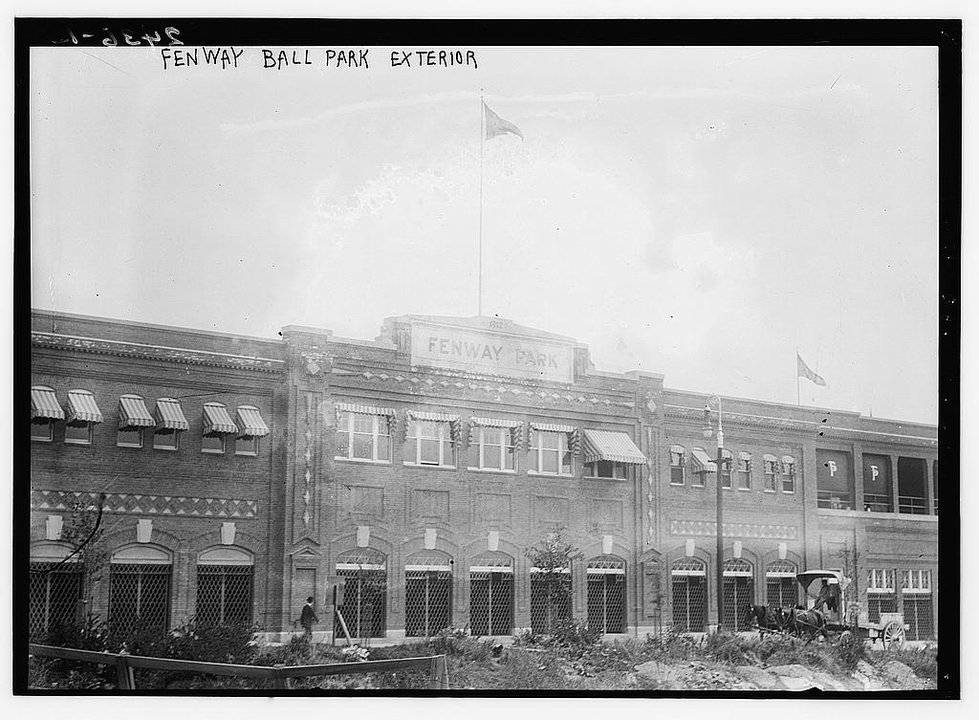
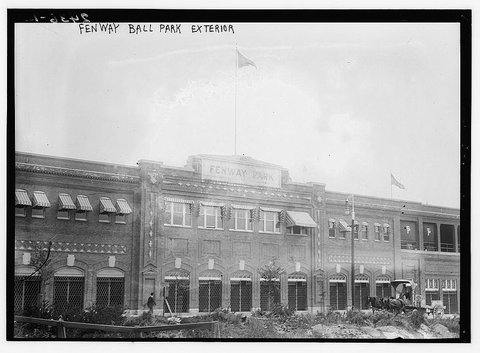
Cover image: Fenway Ball Park - Exterior, Bain News Service, Library of Congress Prints and Photographs Division, ggbain 10737, dated 1914 by the Library, no known restrictions on publication. It shows the brick street front with FENWAY PARK and 1912 on the pediment, awnings over the office windows, and a horse-drawn wagon at the kerb. The negative carries its own handwritten caption along the top edge, reading FENWAY BALL PARK EXTERIOR. The Library dates the photograph 1914; the season described above is 1936, and no interval is drawn between them. It is used because the free archive for this ground is baseball, and it shows nothing of any football game.
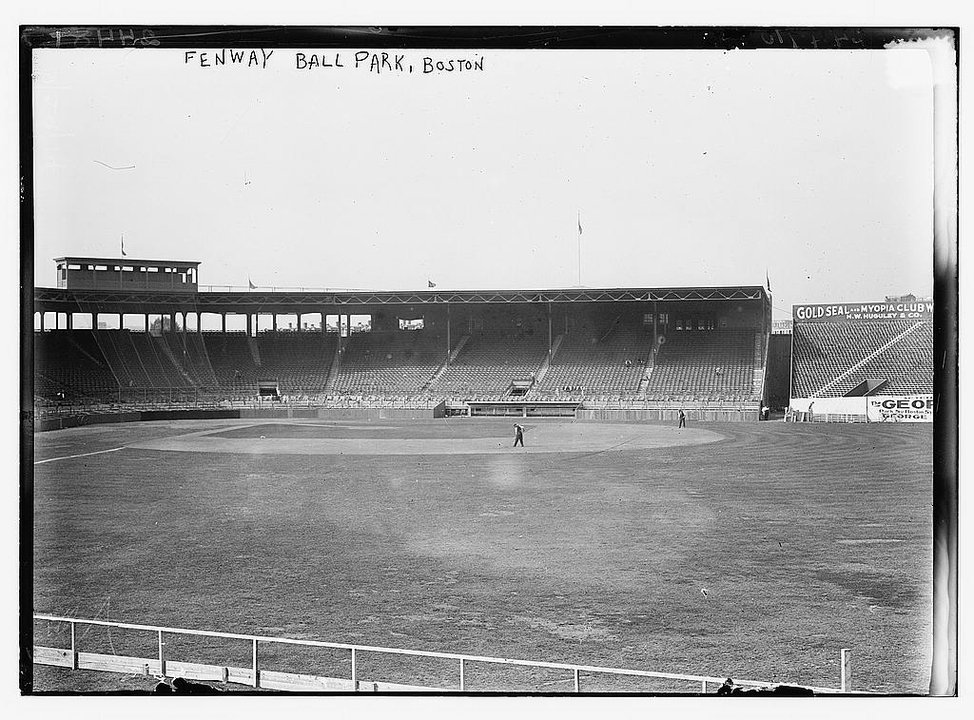
Second image: Fenway Ball Park, Boston, Bain News Service, Library of Congress Prints and Photographs Division, ggbain 10854, dated 1914 by the Library, no known restrictions on publication. An empty grandstand seen from the outfield, with a wooden press box on the roof and advertising boards along the right-field wall. It is also captioned by hand on the negative. The frame shows no crowd. Nothing in the Library's record says why, and it is not evidence of any 1936 attendance; no claim of that kind is made from it.
A Library of Congress photograph does exist of this club losing to Green Bay in 1936 - Boston misses point after touchdown, digital id cph 3c16100, from the New York World-Telegram and the Sun Newspaper Photograph Collection. It carries a publication-may-be-restricted advisory and is therefore named here rather than reproduced.
changes?
delete this memory?
We detected that you have a Blox in your crypto wallet! We will import the Blox into your account.
Click on done below to complete the import.
Welcome Back!
Sign in to preserve cherished moments
Don't have an account?
Welcome!!
Sign up and start preserving cherished moments
?
?
Choose your payment method
Buy with Metablox Credit
Do you want to mint Blox with Metablox Credit?
Which Crypto would you like to use?
Purchase Confirmed!
Your Blox is being minted on-chain and will appear in your profile shortly.
Log in or sign up to claim your Blox.
How many credits do you want to buy?
$100 USD = 1 Metablox Credit = 1 Blox.
Use Metablox Credit to mint any Blox you want on the map.
 expand_more