


Biography | Anthony Wilding — the only New Zealander in a team called Australasia, and the archive that files him under Australia
· 1915-5
Personal memoryBy kevin · · updated · Report an issue































Find memories left by people near you.
Distribute Bounty
This will distribute the bounty equally among all qualifying memories. This action cannot be undone.
Cancel Bounty
Are you sure you want to cancel this bounty? The remaining amount will be refunded to your account.
Success!
Operation completed successfully.
Error
Something went wrong.
Biography | Anthony Wilding — the only New Zealander in a team called Australasia, and the archive that files him under Australia
kevin
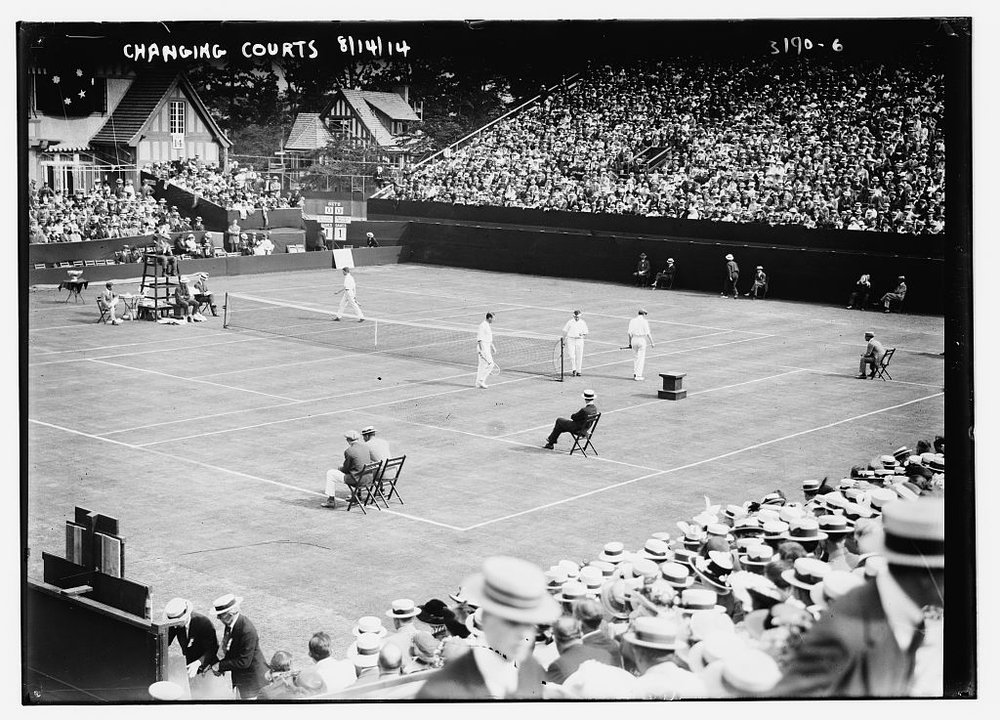
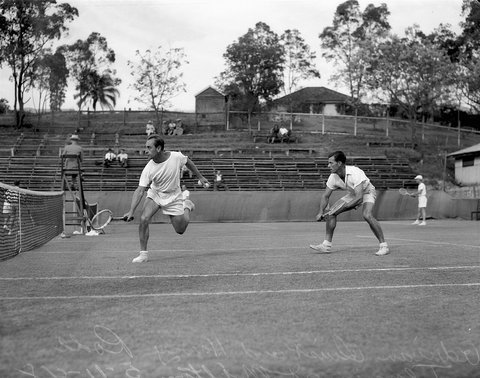
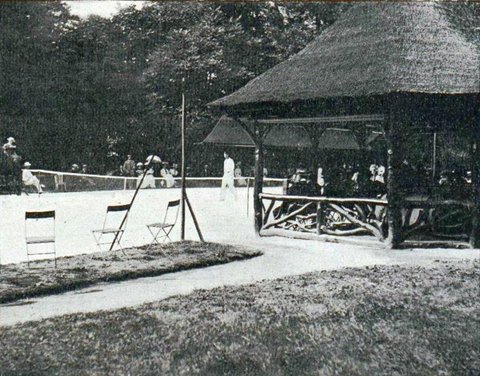
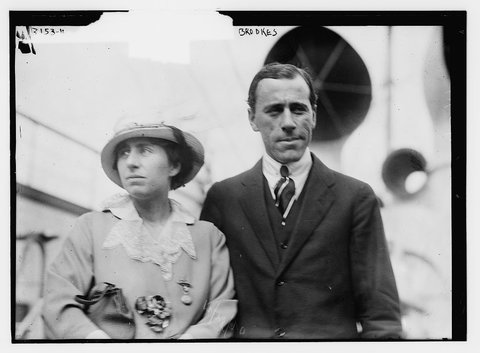
On 14 August 1914 a news photographer stood above a grass court at the West Side Tennis Club in Forest Hills, New York, and exposed a plate. In the frame, to the left of the players, is the scoreboard. At full scale it is legible. The top line reads SETS, with a 0 under each side. Below it two white cards carry the names, two to a card, in a serif face: on the left BROOKES and WILDING, on the right McLOUGHLIN and BUNDY. Below those, GAMES, and a 1 under each.
The board records four surnames. It records no country at all.
The men on the left were playing for Australasia, and that is the argument of this entry. Anthony Wilding was a New Zealander who won the Davis Cup four times for a state that no longer exists, whose sporting record was afterwards taken over by the other of its two members, and who is filed under that other country by the archive that holds the negative of this photograph. The Library of Congress's own catalogue summary for this plate calls Wilding and Norman Brookes the Australian team.
**The team called Australasia.**
The reference account of the team is brief and its dates are the useful part. Australasia represented Australia and New Zealand in the Davis Cup and was governed by the Australasian Lawn Tennis Association. It competed from 1905 through 1922: thirteen years played, twenty-five ties for eighteen wins and seven defeats, six titles — 1907, 1908, 1909, 1911, 1914 and 1919 — and one appearance as runner-up, in 1912. After 1922 the two countries entered separately, Australia from 1923 and New Zealand from 1924. The same account states, in the same breath, that Australia assumed the combined team's historical records.
That clause is the whole thing. Six Davis Cups won by a joint entity were not divided, or left with the entity, or held jointly. They went to the larger partner, and the record books have carried them there ever since.
How the entity was formed is also on the record, at one remove. The account says that in October 1904 the New Zealand Tennis Association approached Australian officials with a proposal for a combined entry, and that the proposal was accepted in January 1905, when New Zealand reluctantly agreed to form a joint Australasian Lawn Tennis Association. The word reluctantly is the account's, and it cites for it a 2005 biography of Wilding published by Canterbury University Press. That book was not read for this entry and the characterisation is reported as the article's, resting on a source this session did not open.
A footnote to the reference biography of Wilding adds the fact that makes him the case rather than an example. Between 1905 and 1914, it says, Australia and New Zealand entered as a combined team, and during that period Wilding was the only New Zealander to play for it. Note the scope: the claim is made about 1905 to 1914, and nothing read here establishes whether any New Zealander played for Australasia in the seasons after the war, when the team won again in 1919 and finished in 1922.
**What his amateurism was paid for with.**
Wilding was born on 31 October 1883 at Opawa, on the southern edge of Christchurch. He was the second of five children of Frederick Wilding, a lawyer, and Julia Anthony, who had emigrated from Herefordshire after their marriage in 1879; his mother's father, Charles Anthony, had been mayor of Hereford. The family place stood on the bank of the Ōpāwaho / Heathcote River and had two tennis courts on it — one asphalt for winter play and one grass for summer. A Christchurch public library page adds a swimming pool, a cricket wicket and a croquet green, and gives the house a name, Fownhope. It is a private property and is not pinned by this entry.
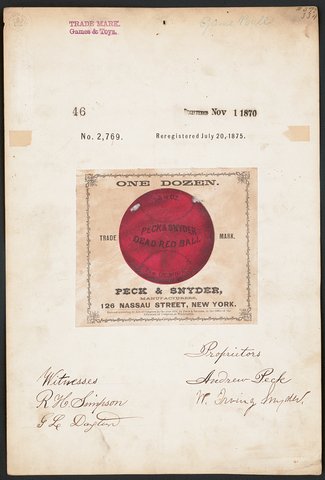
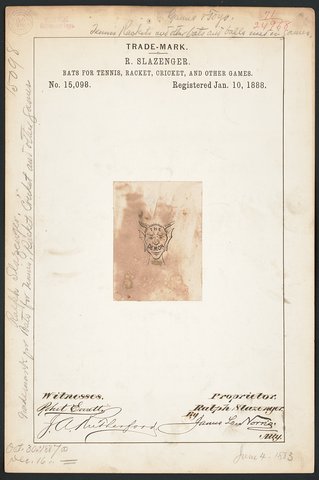
He began playing in 1889, at six, after being given a racket by the manufacturer Ralph Slazenger. This platform already carries an entry on Slazenger and Sons at 56 Cannon Street in the City of London, entered in a trade directory the previous year as a manufacturer of india-rubber goods. The year after that directory entry, a boy on the far side of the world was handed one of the firm's rackets. That is what a global sporting-goods trade looked like before anyone called it one.
He was schooled at William Wilson's private school for boys at Cranmer Square, matriculated in 1901 at the second attempt, spent a term at Canterbury University College, and sailed for England in July 1902 on a seven-week passage. After a crammer at Hunstanton he passed into Trinity College, Cambridge, to read law, became honorary secretary of the university lawn tennis club in March 1904, took a pass degree in June 1905 and was called to the English Bar at the Inner Temple in June 1906. The library page adds that he qualified as a barrister and solicitor in New Zealand in 1909.
Set that against the standing argument of this series about amateurism. The rule that a player must not be paid was not a rule about purity; it was a rule about who could afford to spend a decade travelling between Nice, Homburg, Paris, Stockholm and Melbourne without earning. Wilding could. Two courts at home, a passage to England, a crammer, Cambridge, the Inner Temple and a father's practice to fall back on are the conditions the amateur game quietly required, and they are the reason its champions came from the families they came from.
**What he won, and the line this entry will not count across.**
Everything below was won under rules barring anyone who had ever been paid to play. Nothing here is compared with anything after 1968, and no total in this entry runs across that line.
His first singles title was the Canterbury Championships in October 1901, at seventeen. He first played for Australasia in July 1905, in a Davis Cup tie against Austria at the Queen's Club in London — a ground this platform already carries for a different reason entirely, a vote taken there sixty-two years later. Australasia won that tie five rubbers to nil and Wilding won both his singles; in the round that followed, the United States beat Australasia five to nil and Wilding lost in straight sets to William Larned and to Beals Wright, and afterwards said he had been outclassed.
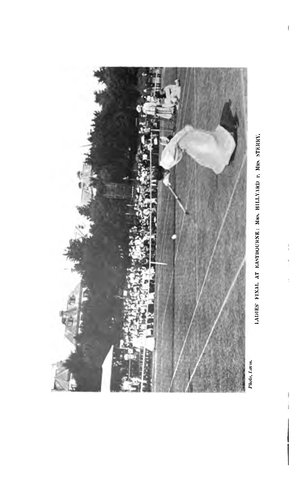
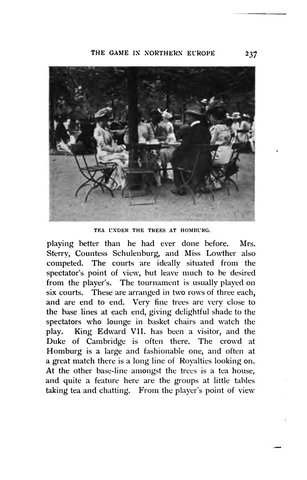
He won the Australasian Championships singles in 1906, beating Francis Fisher of New Zealand, and in 1909, beating Ernie Parker of Australia. He won the Wimbledon singles four years running: 1910 over Arthur Gore, 1911 over Herbert Roper Barrett, who retired after the fourth set, 1912 over Gore again, and 1913 over Maurice McLoughlin. In 1914 he lost the challenge round to Norman Brookes in straight sets. In 1913 he took the three championships the international federation then sanctioned in one calendar year — the World Hard Court on clay in Paris, the World Grass Court at Wimbledon, and the World Covered Court on wood in Stockholm — and in 1914 he held the World Hard Court title, beating Ludwig von Salm-Hoogstraeten without losing a set. At the 1912 Stockholm Olympics he took a bronze in the men's indoor singles, entered for Australasia.
This entry does not use the phrase Grand Slam. That phrase has two ordinary senses — the set of four tournaments taken together, and all four of them won inside one calendar year — and neither is available here. The four tournaments now habitually called the majors were only designated as such, according to a note in the reference biography, from 1924 or 1925, which is nine or ten years after Wilding's death. Calling his 1906 Australasian title a major is a classification applied backwards by people who were not born when he won it, and this series says so rather than joining in.
Two of those results connect to entries already on this platform. Maurice McLoughlin, whom Wilding beat in the 1913 Wimbledon challenge round, has his own entry here; McLoughlin then beat Wilding in a singles rubber at Forest Hills in August 1914, and his name is on the scoreboard in this entry's second image. Herbert Roper Barrett, the 1911 opponent, is named in other entries here and still has none of his own.
**The German spa meetings, and a correction this entry completes.**
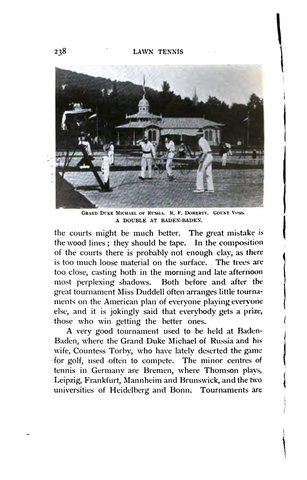
In August 1905 Wilding won the Pöseldorf Cup at Hamburg and then the Championship of Europe at Homburg. In 1906, 1907 and 1908 he won at Baden-Baden, three years in a row.
This platform published an entry on Baden-Baden earlier on the same day as this one, 6 September 2026. Its argument was that a standard survey of the game, published in 1903, disposed of the Baden-Baden meeting in one past-tense sentence and gave as its reason that a Russian grand duke and his wife had lately taken up golf; and that the tournament then ran until 1966. The entry named Wilding as the cleanest refutation available and left him to be written. Here he is: a player who had not yet won anything of consequence when the survey went to press, winning that supposedly finished meeting three times in the three years after it.
**August 1914.**
The 1914 Davis Cup challenge round was played at the West Side Tennis Club on 13, 14 and 15 August, the thirteenth edition of the competition and the first time since 1903 that the bulk of it had been held in the United States. Australasia beat the United States.
The reference article on that challenge round prints a results box with three rubbers in it: McLoughlin beat Brookes 17–15, 6–3, 6–3; Brookes beat Richard Norris Williams 6–1, 6–2, 8–10, 6–3; and McLoughlin beat Wilding 6–2, 6–3, 2–6, 6–2. A Davis Cup tie was five rubbers. The box omits two of them, and one of the two it omits is the doubles — which is the rubber this entry's second photograph shows being played. The scoreboard in that photograph is, on the evidence available to this session, a better record of the doubles than the reference table is.
The reference biography calls this tie Wilding's final tournament. He had entered the United States championships, due later that month, and withdrew when the war began, returning to England.
**The nine months.**
Shortly after the outbreak of war Wilding joined the Royal Marines, on the advice of Winston Churchill, then First Lord of the Admiralty. He was gazetted a second lieutenant in early October 1914, stayed with the Marines a few days, and was attached to the Intelligence Corps for his knowledge of the continent and his skill as a motorist. At the end of October he joined the Royal Naval Armoured Car Division in northern France with thirty men, three guns and armoured cars under him. After a week's leave in London in February 1915 he returned to France on 16 March and was posted to a new squadron of armoured Rolls-Royce cars commanded by the Duke of Westminster, with the rank of lieutenant. On 2 May he received notice of promotion to captain.
On 9 May 1915, at a quarter to five in the afternoon, during the Battle of Aubers Ridge at Neuve-Chapelle, a shell burst on the roof of the dug-out he was sheltering in and killed him. He was thirty-one.
Two divergences are printed here and neither is resolved. The Christchurch library page says he enlisted as a captain; the reference biography has him gazetted a second lieutenant in October 1914 and promoted captain seven days before he died. And the library page itself notes that one of the works it lists places his death in Belgium rather than in France.
He was buried at the front the following day and later re-interred at the Rue-des-Berceaux Military Cemetery at Richebourg-l'Avoué, in the Pas-de-Calais, which is where this entry is pinned.
**A park named after somebody.**
This series keeps a standing list of places named after a person that turn out not to commemorate the person a reader would assume — a courts complex several kilometres from the courts its honorand actually played on, a trophy named for a man the scholarship does not credit with inventing it, a centre renamed two decades after its honorand's death, and a set of modern apartments carrying a demolished factory's name on a lot the factory never stood on. This is a further case and in one respect the sharpest of them, because the two available accounts disagree about which man is meant.
Wilding Park is the principal tennis venue in Christchurch. The reference biography states plainly that it was named after his father, Frederick, and that in public perception it became associated with the son. The Christchurch public library page says that the Canterbury Lawn Tennis Association bought land on Woodham Road after the war and established a tennis centre named after Wilding, without distinguishing between them.
Both accounts are printed here. Neither is adopted, and the ground is not pinned by this entry either way. Frederick Wilding was himself a tennis player who won New Zealand doubles championships, which is exactly the circumstance in which a commemorative name becomes ambiguous within a generation and stays that way.
He is also remembered on the Waltham Park memorial gates in Christchurch, opened in 1922 for forty-three men of the Waltham, St Martins and Opawa districts who died in the war. He was elected to the International Tennis Hall of Fame in 1978 and the New Zealand Sports Hall of Fame in 1990, and New Zealand Post issued a stamp of him in 1992. Shortly after his death the sculptor Paolo Troubetzkoy made a bronze statuette based on him.
**Status, dated.**
Read on 6 September 2026. The cemetery is a Commonwealth War Graves Commission site and is open. Nothing in this entry should be read as describing any arrangement later than that date.
**Gaps this entry declares.**
The Commonwealth War Graves Commission's own records — both the cemetery page and the casualty record for Wilding — refused this session with an HTTP 403, through a plain request and through a fetching service alike. That is why no grave reference, no plot, row and grave number, no regimental particulars as the commission records them, and no burial-register wording appear anywhere above. Those are the single cheapest addition anyone could make to this entry, and the obstacle is one host.
The place where Wilding was first buried, at the front on 10 May 1915, is not established by anything read here. The pin is the grave he lies in now, not the ground he fell on; Neuve-Chapelle is a separate place a little over two kilometres away and is not pinned by this entry.
No newspaper of 1914 or 1915 was read, in any country, which is why nothing above carries quotation marks. His last letter, dated 8 May 1915, is quoted in the reference biography from a single source and is therefore paraphrased nowhere in this entry and quoted nowhere either; anyone wanting it should go to the biography the article cites.
Nothing read establishes whether a New Zealander other than Wilding played for Australasia in 1919 or after, which is the check that would turn the reference footnote's scoped claim into an unscoped one.
When exactly Australia was recorded as assuming the combined team's results, and on whose decision, is not established. The phrase is the reference article's, and this entry treats it as a report of a state of affairs rather than as a document it has seen.
**Coordinate.** 50.571942, 2.744744, precision radius 150 m. The anchor is the Rue-des-Berceaux Military Cemetery at Richebourg, Pas-de-Calais, France.
Two readings were taken and they are of two different kinds. The Esri world geocoder, running on commercial road and premises data, returns the named cemetery at 50.5720, 2.7447 with a full match score. OpenStreetMap carries the ground itself as way 731995363, tagged landuse cemetery, and its outline gives a centre of 50.5718848, 2.7447886. The two lie 14.3 m apart and the pin is their midpoint, 7.1 m from each.
The tag was read before the reading was counted, which is now the first thing this series does at any ground. At Eastbourne, and again at Bad Homburg, the only object a geocoder would return for a sports ground turned out to be its car park. Here the object is the cemetery itself.
A third reading is reported and deliberately not counted as an independent leg. Wikidata's entity Q1951051 is labelled Rue-des-Berceaux Military Cemetery in English and cimetière militaire de Rue-des-Berceaux in French, described as a cemetery in the Pas-de-Calais, France, and carries a coordinate of 50.572237, 2.744508, which is 36.8 m from the pin. It is not an independent source here, because the OpenStreetMap way carries that same Wikidata identifier as one of its two tags: the two are linked and may share a provenance this session cannot untangle. What Wikidata does settle, and what it was used for, is the identity of the mapped object — that the outline the geocoders agree on is this cemetery and not one of the several other war cemeteries within two kilometres of it.
A fourth object of a different kind again is recorded because it is useful to a visitor: OpenStreetMap carries a node inside the ground tagged as a historic memorial and named Cross of Sacrifice, at 50.5715186, 2.744964, 49.6 m from the pin. That is the standard commission structure, not the grave.
The French national address base, reached through the national mapping agency's geocoder, will not resolve the cemetery at all. It returns only the street, Rue des Berceaux at 62136 Richebourg, as a street-level record centred at 50.568792, 2.750172 — 519.8 m from the pin. That is a reading of a different kind about a different object and it is reported rather than averaged in. Nominatim returned zero results on three separate phrasings and then refused with a rate limit twice; the OpenStreetMap leg was obtained from an independent Overpass mirror instead.
The radius is 150 m. The mapped outline is small — about 94 m north to south and 54 m east to west across six vertices — and its furthest corner is 54.1 m from the pin, so every reading above and the whole of the ground fall well inside 150 m. The radius is not tighter than that because a six-node outline is a sketch and not a survey, because the grave reference within the cemetery is unknown for the reason given above, and because tight agreement between two geocoders is not by itself a licence for a tight radius.
A query over this platform's own stored coordinates finds no memory of any kind within 165 m. The nearest is the Neuve-Chapelle Indian Memorial at 2,156 m and the Portuguese military cemetery at Richebourg at 2,202 m, both of them entries in this platform's military history series rather than this one; the ground Wilding was killed on is in that direction. Queried this run, the tennis series' French entries stood at six across five distinct pins — four in and around Paris and one at Nice — before this one. This makes seven across six, and it is the first in the Pas-de-Calais.
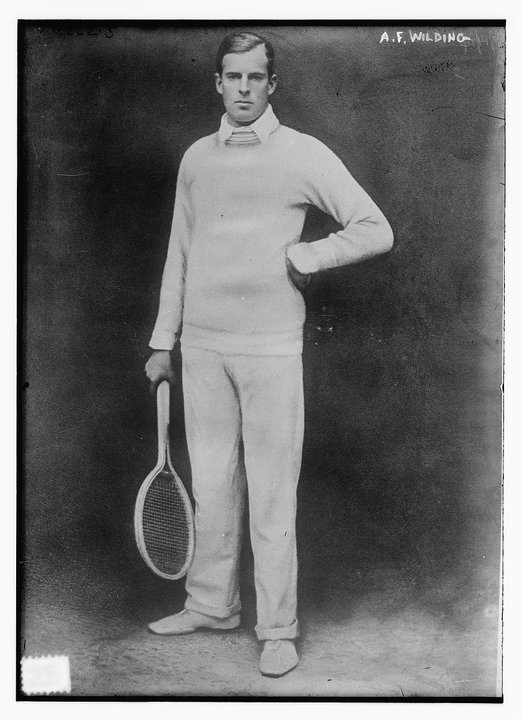
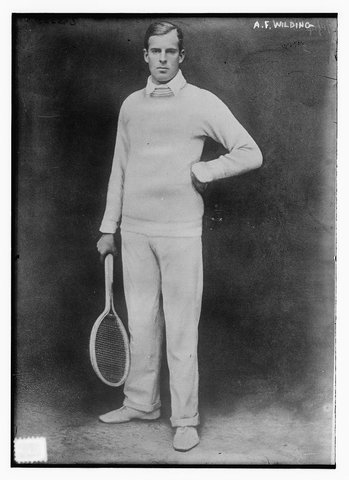
**Cover.** Library of Congress, George Grantham Bain Collection, catalogued as A.F. Wilding, negative LC-B2-3222-5, digital identifier ggbain.17169, with the rights statement no known restrictions on publication. The date the Bain News Service supplied is 1914 August 14, and the catalogue itself queries it with a bracketed question mark; this entry does not date the sitting. Master negative scan 4228 by 5816 px, mean brightness 112.2 of 255. Opened at full resolution and examined in sections.
A full-length studio portrait against a plain dark ground. A young man stands square to the camera in pale flannel trousers, turned up at the cuff, and a heavy pale pullover worn over a collared shirt with a ribbed band at the neck. His left hand is on his hip, his elbow out; his right hand holds a racket head-down at his side, its head and stringing visible. His shoes are pale and soft-soled. He faces the camera. Nothing in the room is identifiable and there is no lettering, sign or object in the scene.
Printed matter in the frame, recorded as a positive with a qualification: across the top right of the plate, in white hand-lettering, is A.F. WILDING, with further scratched marks beside it that do not resolve at any scale. That lettering is on the negative, not in the room — it is the news service's own annotation for its picture desk — and it is recorded here as such rather than as something the photograph contains.
**Second image.** Library of Congress, George Grantham Bain Collection, catalogued as Changing Courts, 8/14/14 (Tennis), negative LC-B2-3190-6, digital identifier ggbain.16897, same rights statement. Master scan 5772 by 4153 px, mean brightness 139.8 of 255. Opened at full resolution and enlarged in a series of crops.
An elevated view across a grass court. Four men in white are on court, spread between the service lines, one carrying his racket low; a further figure in white is on the far side of the net. Behind the court a low tarpaulin-faced barrier runs the width of the frame, and behind that a wooden stand rises steeply, filled with spectators to the top of the visible rows; the near foreground, along the bottom right, is a second bank of spectators seen from behind, with straw boaters throughout it. At the left an umpire sits in a tall wooden chair in a dark suit and boater. A man in a suit sits on a folding chair at a small round table with flat boxes stacked on and beside it; to the right of the umpire's chair two more men sit, one with papers on his knee. White clothing lies discarded on the grass at the foot of the chair.
Printed matter in the frame, recorded as a positive, and it is the strongest this series has found. Behind the court and left of centre stands a scoreboard. Under the word SETS are two panels, each showing 0. Beneath them are two white cards, each carrying two names in a serif face: BROOKES over WILDING on the left, McLOUGHLIN over BUNDY on the right. Beneath those, under the word GAMES twice, are two panels each showing 1. All of it is legible at full scale. The board therefore names all four men in the doubles and fixes the score at the moment of exposure, and it does so without printing a nation against either pair. The negative also carries CHANGING COURTS 8|14|14 hand-lettered across the top left and the number 3190-6 at the top right, which is the second element of the catalogue's call number for the negative.
At the far left, well outside the playing area, a large shallow silver bowl on a stemmed foot stands on a small draped table on a slender stand. The catalogue identifies it as the Davis Cup and the shape is consistent with that; the identification is the catalogue's and is reported as the catalogue's. Separately, out on the court itself and right of centre, a dark box with a lid and metal fittings stands on a low two-tier plinth. What that object is is not established here.
Hanging from the eaves of a half-timbered clubhouse at the upper left is a dark flag, and it is described carefully because it is easy to over-read. At least five white stars are resolvable on it: four larger ones in a kite arrangement and one much smaller between two of them. Whether the flag carries a canton in its upper hoist cannot be determined — that part of the cloth is in deep shadow and is partly outside the frame — and further stars may be present in the shadow. A five-star group is not the four-star arrangement carried by the flag of New Zealand. Beyond that the flag is not identified here and no claim is made about whose it is.
The reason this photograph is in this entry is the sentence the catalogue attaches to it. The Library of Congress summary describes the match as being between the American team, McLoughlin and Bundy, and the Australian team, Wilding and Brookes. That summary is itself credited by the catalogue to a Flickr Commons annotation project of 2011 and to a New York newspaper of 15 August 1914, which is to say it is a modern annotation rather than the Bain News Service's caption; the caption the service actually put on the plate is the four words lettered across its top. The reference encyclopaedia, describing a different photograph of the same rubber, gets it right and says Australasia. So this is not a claim that everyone forgets. It is a narrower and more interesting one: the archive holding the negative of a New Zealander's last Davis Cup has him down as Australian, and the entity he actually played for is the one whose records Australia was given.
**Sourcing note.** Nothing in this entry appears inside quotation marks. Every source used is a book, an encyclopaedia article, a public library's summary page or a catalogue record, and each exists in a single setting, which does not meet this series' condition for putting machine-read text between quotation marks. One further limit is stated plainly: the Christchurch City Libraries page was read through a summarising fetch rather than as raw text, so everything drawn from it above — the name of the Opawa property, the 1909 New Zealand admission, the enlisted-as-captain statement, the note about Belgium and the Woodham Road purchase — is reported at one remove, and confirming any of it from the page's own text is the unblocking step. The transcriptions of the scoreboard and of the lettering on the two negatives are given in capitals as descriptions of what is printed on those objects, not as quotations.
**Sources.** Library of Congress Prints and Photographs Division, George Grantham Bain Collection, catalogue records and master negative scans for A.F. Wilding, LC-B2-3222-5, and Changing Courts, 8/14/14 (Tennis), LC-B2-3190-6, for both images, their dimensions, their titles and dates as supplied by the Bain News Service, the summary describing the Davis Cup match and its own credit to a Flickr Commons project of 2011 and a New York newspaper of 15 August 1914, and the collection's rights statement of no known restrictions on publication: https://www.loc.gov/pictures/item/2014697431/ and https://www.loc.gov/pictures/item/2014697051/ , with the scans at https://tile.loc.gov/storage-services/master/pnp/ggbain/17100/17169u.tif and https://tile.loc.gov/storage-services/master/pnp/ggbain/16800/16897u.tif . Encyclopaedia article on Anthony Wilding, for his parentage and birth, the Opawa courts, the Slazenger racket, his schooling and Cambridge and the Inner Temple, the Canterbury Championships of 1901, the 1905 Davis Cup debut at the Queen's Club and the Hamburg and Homburg titles of that year, the tables of his championship finals and their scores, the 1913 treble and the 1914 World Hard Court title, the footnote on Australasia and on the designation of the majors from 1924 or 1925, the account of his military service and death, the burial and re-interment, the Waltham Park gates, and the statement that Wilding Park was named after his father: https://en.wikipedia.org/wiki/Anthony_Wilding . Encyclopaedia article on the Australasia Davis Cup team, for the 1905 to 1922 span, the thirteen years played, the twenty-five ties and their record, the six titles and the 1912 runner-up finish, the separation into Australian and New Zealand teams in 1923 and 1924, the statement that Australia assumed the historical records, and the account of the 1904–05 formation with its citation to Len and Shelley Richardson, Anthony Wilding, A Sporting Life, Canterbury University Press, 2005, pages 98–99, a book not read for this entry: https://en.wikipedia.org/wiki/Australasia_Davis_Cup_team . Encyclopaedia article on the 1914 International Lawn Tennis Challenge, for the dates and venue of the challenge round, its status as the thirteenth edition, the return of the competition to the United States, the result, and the three-rubber results box that omits the doubles: https://en.wikipedia.org/wiki/1914_International_Lawn_Tennis_Challenge . Christchurch City Libraries, page on Anthony Wilding, read on 6 September 2026, for the name and description of the Opawa property, the New Zealand admission of 1909, the statement that he enlisted as a captain, the note that one of its listed references places his death in Belgium, and the account of the Canterbury Lawn Tennis Association's post-war purchase on Woodham Road: https://my.christchurchcitylibraries.com/anthony-wilding/ . The Esri world geocoding service; OpenStreetMap way 731995363 and the Cross of Sacrifice node, obtained through an Overpass mirror; Wikidata entity Q1951051 for the identity of the mapped cemetery; and the French national address base through the national mapping agency's geocoding service, for the street-level reading that is reported and not counted. Neighbouring-pin distances and all cross-references to other entries were taken from this platform's own stored records and queried this run.
changes?
delete this memory?
We detected that you have a Blox in your crypto wallet! We will import the Blox into your account.
Click on done below to complete the import.
Welcome Back!
Sign in to preserve cherished moments
Don't have an account?
Welcome!!
Sign up and start preserving cherished moments
?
?
Choose your payment method
Buy with Metablox Credit
Do you want to mint Blox with Metablox Credit?
Which Crypto would you like to use?
Purchase Confirmed!
Your Blox is being minted on-chain and will appear in your profile shortly.
Log in or sign up to claim your Blox.
How many credits do you want to buy?
$100 USD = 1 Metablox Credit = 1 Blox.
Use Metablox Credit to mint any Blox you want on the map.
 expand_more