


Biography | Norman Brookes — a team's six Davis Cups became Australia's, a brother's two football games became his, and the archive files him as Brooks, Kooyong, 1919
· 1919
Personal memoryBy kevin · · updated · Report an issue


























Find memories left by people near you.
Distribute Bounty
This will distribute the bounty equally among all qualifying memories. This action cannot be undone.
Cancel Bounty
Are you sure you want to cancel this bounty? The remaining amount will be refunded to your account.
Success!
Operation completed successfully.
Error
Something went wrong.
Biography | Norman Brookes — a team's six Davis Cups became Australia's, a brother's two football games became his, and the archive files him as Brooks, Kooyong, 1919
kevin
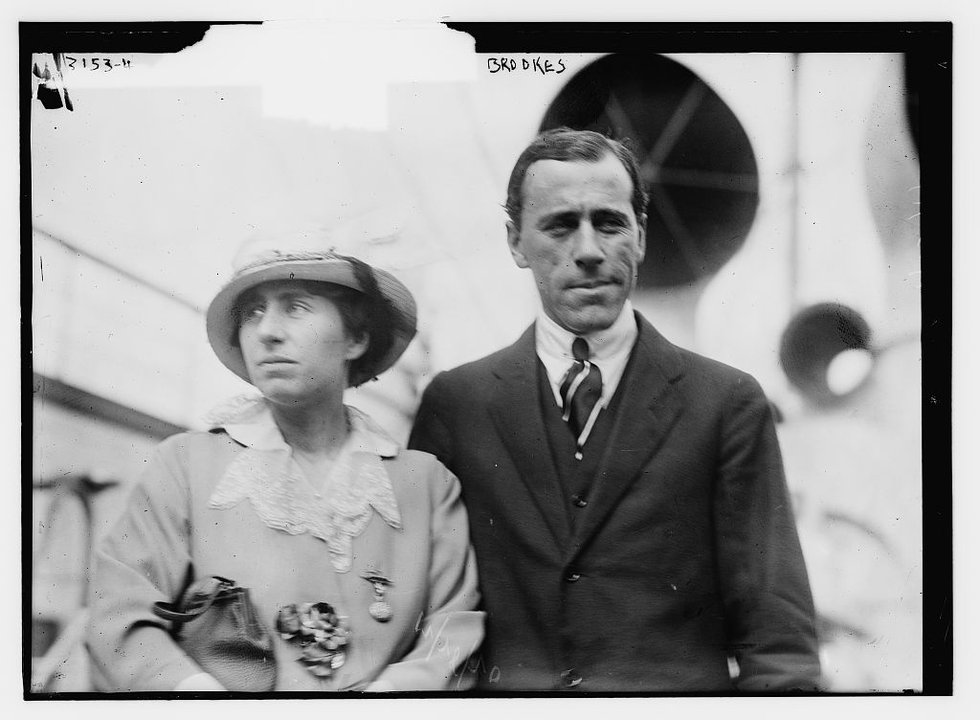
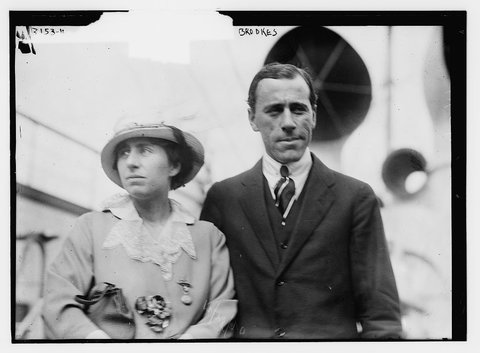
A photographer working for the Bain News Service, a New York picture agency, exposed a plate of a man and a woman standing on the deck of a ship. Across the top right of the negative, in the photographer's own white hand-lettering, is a single word: BROOKES. At the top left is the number 3153-4, which is the second element of the call number the Library of Congress later gave the negative.
The catalogue title the Library of Congress carries for that plate is Norman Brooks and wife.
The word on the glass has an e in it. The word in the catalogue does not. That is a small thing, and it is the third of three misattributions attached to this man that this entry is about, all of them documented, none of them secret, and all of them still in place.
**Who he was, and what his amateurism required.**
Norman Everard Brookes was born on 14 November 1877 at St Kilda, on Port Phillip Bay in Melbourne, the youngest son of William Brookes and Catherine Margaret Brookes, née Robinson. His father was an English immigrant who came to Australia in 1852 and made money out of gold at Bendigo before becoming a contractor and manufacturer; the reference biography and the Australian Dictionary of Biography agree on the outline. Norman was educated at Melbourne Church of England Grammar School, matriculated in 1895, and on leaving school joined Australian Paper Mills, of which his father was managing director. He began as a junior clerk. By 1904 he was a director of the firm.
The family had its own tennis court. There were courts near by where he could watch better players, and he was coached by Wilberforce Eaves, a doctor. In 1896 he was selected to play for Victoria against New South Wales, and in the same year, according to the reference biography, he became a regular player at the Royal South Yarra Tennis Club.
The Australian Dictionary of Biography then states the thing this series has been arguing about the amateur game for sixty-odd entries, and states it as a plain condition of his career rather than as a criticism: he had the means to go to Europe and play in tournaments there.
That is the whole of it. The rule that a player must never be paid was not a rule about purity. It was a rule about who could afford a court at home, a coach, and a sea passage to a European season and back — a journey the encyclopaedia's article on the Australian tournament puts at about forty-five days each way in the 1920s, a decade later than his own travelling. Brookes could. A boy from a family without paper mills could not, and would not appear in any of the rolls this entry counts from.
**What he won, and the two lines this entry will not count across.**
Everything below was won under rules barring anyone who had ever been paid to play. Nothing here is set against anything after 1968, and no total in this entry crosses that line.
The second line is a naming line. The English-language encyclopaedia article on Brookes summarises his career as three Grand Slam singles titles. That phrase has two ordinary senses — the four tournaments taken as a set, and all four of them won inside one calendar year — and neither is available for a man who stopped playing in 1928. The platform's entry on Anthony Wilding, published earlier on the same day as this one, records the reference biography's own note that the four tournaments were designated as majors only from 1924 or 1925. Brookes won his first of them in 1907. Calling it a Grand Slam title is a classification applied backwards, and this entry reports the phrase as the encyclopaedia's rather than adopting it.
With those two lines drawn: he first went to Wimbledon in 1905, won the all-comers' event, and lost the challenge round to the holder, Laurence Doherty. He returned in 1907 and won the singles, the doubles with Wilding, and the mixed. He won Wimbledon again in 1914, and the doubles with Wilding again. He won the Australasian Championships singles in 1911, in Melbourne, beating Horace Rice. He won the Australasian doubles in 1924 and the United States doubles in 1919. In May 1914 he won the Surrey championship at Surbiton, beating Gordon Lowe in five sets.
The 1907 Wimbledon is where the firsts start, and there are three published versions of it. The encyclopaedia's opening sentence calls him the first non-British-born individual to win it. Its own body calls him the first non-British player and the first left-hander. The Australian Dictionary of Biography calls him the first player from overseas and the first left-hander to win the world title. This series blocks a bare first, and it will not manufacture a fourth formulation to settle three.
What can be reported is what the roll shows. The article prints the men's singles champions from 1877 onwards. Counted off that roll line by line for this entry rather than recalled: the thirty championships from 1877 to 1906 were won by thirteen different men, and the fourteenth different man on the list, at 1907, is Brookes. What the three formulations have in common is that something about him was outside the run of the first thirty; what they disagree about is whether the thing was birth, representation, or residence, and that disagreement is not resolved here.
**The first misattribution: six Davis Cups and a country that stopped existing.**
Brookes played the Davis Cup for Australasia, the joint entity of Australia and New Zealand that competed from 1905 to 1922 under the Australasian Lawn Tennis Association. The platform's Wilding entry sets out its record: thirteen years played, twenty-five ties, eighteen wins, seven defeats, six titles and one appearance as runner-up. After 1922 the two countries entered separately, and Australia assumed the combined team's historical records.
Brookes is where those records landed. He was in the team that took the trophy from the British Isles in 1907 — a side the Australian Dictionary of Biography calls Great Britain, and which this entry names as the other entries on this platform name it, without establishing which name the competition used at the time — and in the teams that held it afterwards; he was in the team that took it back from the United States at Forest Hills in August 1914, a few days after the war began; and he was in the team of 1919.
How many of the six were his is a question three readings of the same encyclopaedia will not answer the same way. Its infobox lists him as a winner in 1907, 1908, 1909, 1911, 1914 and 1919 — six. Its own body text, four paragraphs below, lists 1907, 1908, 1909, 1914 and 1919 — five, with 1911 missing. The Australian Dictionary of Biography says he and Wilding captured it in 1907 and that their partnership enabled Australasia to retain it in 1908, 1909 and 1911, notes that there was no challenge in 1910, has them regain it in 1914, and then says only that he represented Australasia in Davis Cup matches in 1919 and 1920 without saying whether those were won. All three are printed here and none is adopted.
The same article's sentence about his Davis Cup appearances shows the difficulty in miniature. It says he played thirty-nine Davis Cup matches for Australia/New Zealand and the Australian Davis Cup team between 1905 and 1920. The team he actually played for had a name — Australasia — and the sentence does not use it.
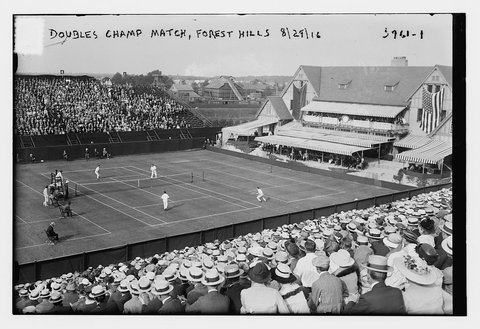
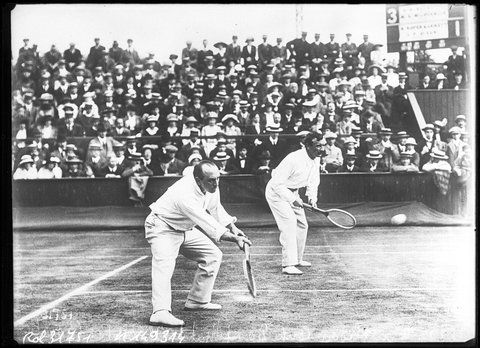
Two of his defeats in that competition are already on this platform from the other side. On 28, 29 and 30 November 1912, at the Albert Ground in Melbourne, the British Isles took the trophy from Australasia by three matches to two, and James Cecil Parke beat Brookes 8-6, 6-3, 5-7, 6-2 on the first day. And the doubles rubber in New York in August 1914, in which Brookes and Wilding beat Maurice McLoughlin and Thomas Bundy, is the match shown in the second photograph of the Wilding entry, where a scoreboard names all four men and no country at all.
**The second misattribution: two football games that were his brother's.**
Brookes played Australian rules football as a schoolboy, chiefly for Melbourne Grammar. Beyond that, the encyclopaedia records something more useful than a career: until 2016 it was believed that he had played two games in the Victorian Football League for St Kilda in 1898, and it was in fact his elder brother Harold who had played them.
For a hundred and eighteen years, on that account, a record belonging to one brother sat under the name of the other, in a competition with keepers and statisticians and published lists, and it took until 2016 for somebody to take it back off him. Nothing read here establishes who made the correction or on what evidence, and that is a gap this entry declares rather than fills.
**The third misattribution: the catalogue and the negative.**
The Library of Congress holds one photograph catalogued under Norman Brookes's name. A search of its prints catalogue for the exact phrase Norman Brooks returns one item. A search for Brookes and tennis returns eleven, of which the only one connected to him is the doubles plate this platform's Wilding entry already uses, catalogued under a title that names neither man. The one item is this entry's cover, and its catalogue title spells the surname without its e, while the negative itself, lettered by hand at the time, spells it with one.
The catalogue is not concealing anything. Its own note says the title comes from unverified data supplied by the Bain News Service on the negatives or caption cards, which is the Library's standing disclaimer for this collection and is the reason a reader can check the plate against its own label at all. The encyclopaedia article on him carries a hatnote directing readers of a similar name to a disambiguation page for Norman Brooks. The confusion is old and it is known.
What makes it worth an entry is where the misspelling then travels. The Australian Dictionary of Biography's article on Brookes, published in hardcopy in 1979 and online in 2006 by the National Centre of Biography at the Australian National University, illustrates itself with this same Library of Congress photograph, credited on the page as Norman Brookes, with his wife, no date, Library of Congress, USA. And in its own body text, in the sentence about 1907, it writes: that year Brooks and Wilding captured the Davis Cup from Great Britain. One sentence, one letter, in a national biographical dictionary, about its own subject.
Three sources, three spellings of one man's name, and the only one that gets it right every time is the plate.
**The administrator, and the ground this entry is pinned to.**
Brookes stopped playing Davis Cup after 1920, played his last Wimbledon in 1924 and retired in 1928. What he did next is why the pin is at Kooyong.
He was president of the Lawn Tennis Association of Victoria from 1925 until 1937, and the Australian Dictionary of Biography says it was largely due to his enterprise that Kooyong, purchased in 1919, was developed as a tennis centre. The platform's existing entry on this ground records that Kooyong Lawn Tennis Club built its stadium here in 1927 on Glenferrie Road, in Toorak, and that the Australian championship came to it about a dozen times over the next four decades before Melbourne was given the tournament outright in 1972 on the ground that it drew the largest crowds.
In 1926 he became the first president of the Lawn Tennis Association of Australia. He held that office until June 1955. The encyclopaedia calls that twenty-nine years; the Australian Dictionary of Biography calls it twenty-eight. From 1926 to June 1955 is twenty-eight years and about seven months elapsed, which is a figure that will round either way depending on whether whole years or completed terms are being counted. Neither source shows its working and neither figure is adopted here.
The Australian Dictionary of Biography does not leave the presidency as an honour. It records that despite his prestige he did not escape the charge of being autocratic, and that he came under criticism as a selector of Davis Cup teams. That is the shape of the thing: the man whose name the record carries also, for nearly three decades, ran the body that kept it and picked the teams that added to it.
He was knighted in 1939, in the Birthday Honours, for public services in the Commonwealth of Australia. He was elected to the International Tennis Hall of Fame in 1977. He married Mabel Balcombe Emmerton, daughter of the solicitor Harry Emmerton, at St Paul's Cathedral in Melbourne on 19 April 1911; she was twenty, and she was later made a Dame Commander of the Order of the British Empire. He died at his home in South Yarra on 28 September 1968, aged ninety, and was buried in the St Kilda cemetery. Neither the house he died in nor the family house of his boyhood is pinned by this entry.
**A trophy with his name on it, and the list it goes on.**
The men's singles winner at the Australian Open is presented with the Norman Brookes Challenge Cup.
This series keeps a standing list of places and objects named after a person that turn out not to commemorate what a reader would assume: a public courts complex named for a champion who played about five kilometres away; a team trophy named for a man the scholarship does not credit with inventing it; a tennis centre renamed for its honorand twenty-one years after his death; a block of apartments carrying a demolished factory's name on a lot the factory never occupied; and a tennis park in Christchurch that one source says was named for Anthony Wilding's father and another for Wilding himself.
The Brookes cup is the inverse case and belongs on the list for that reason. There is no doubt at all about which man it means. What is not established by anything read for this entry is when the men's singles trophy acquired his name, on whose decision, or whether he was president of the association at the time. There is no encyclopaedia article on the trophy at all: its name redirects to the article on the tournament, which states only that the men's singles winner is presented with it and that the rights to make the cups were awarded under a contract in 2013. The association's own records, and the Australian newspaper archive, are the route to the answer, and neither was reachable for this entry.
**Status, dated.**
Read on 6 September 2026. Kooyong Lawn Tennis Club occupies the ground and its stadium stands; the Australian Open has been played about 4.9 km away, by this platform's own stored coordinates, at the complex that opened in 1988 as Flinders Park and was later renamed Melbourne Park. Nothing here should be read as describing any arrangement later than that date.
**Gaps this entry declares.**
No newspaper of any period was read, in any country, which is why nothing above appears inside quotation marks. Australia's digitised newspaper archive was not attempted this session; the standing record of this series is that its current interface requires a key nobody here holds. The encyclopaedia's own footnotes point at a Melbourne weekly of 25 April 1908 for the cancellation of his 1908 Wimbledon defence, which is the cheapest single document anyone could add here.
The 2005 and 2011 books that the encyclopaedia leans on for his early life, and the 1956 memoir by his wife that the Australian Dictionary of Biography lists in its bibliography, were not read for this entry. Everything drawn from them is at one remove, through the articles that cite them.
When the Norman Brookes Challenge Cup was named, and by whom, is not established. Who corrected the football record in 2016, and on what evidence, is not established. Whether the photograph in this entry's cover was taken in New York, and on what occasion, is not established: the setting is a ship, the collection is a New York news agency's, and nothing in the frame names a port.
The date of the cover photograph is given three ways by three sources and none is adopted. The Library of Congress records it as between about 1910 and about 1915. The Australian Dictionary of Biography, using the same photograph, gives no date at all. The encyclopaedia article on Brookes carries a picture of him with his wife which it captions 1914; whether that is this plate was not established here.
Nothing read establishes what Kooyong's grounds looked like in 1919, when they were bought, or which parts of the present layout are the ground Brookes developed. The pin is the club and the stadium as they now stand.
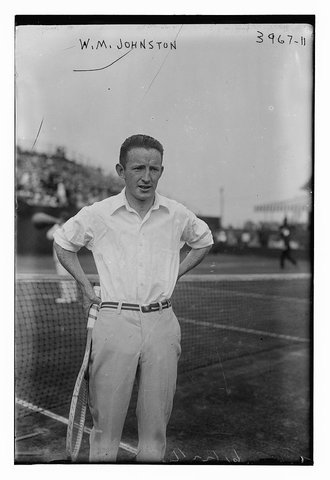
The Australian Dictionary of Biography gives a reason for his being rejected for active service in the First World War. It is a medical reason, and this series does not assert a player's medical history from a secondary source, so it is not repeated here. What is reported is the rest: he was rejected, and he served instead as a commissioner for the Australian branch of the British Red Cross in Egypt from August 1915 to late 1916, then as commissioner for the British Red Cross in Mesopotamia from May 1917, and then as assistant director of local resources for the British Expeditionary Force there with the rank of lieutenant-colonel. Wilding, who was in the same doubles pair in the photograph on this platform, enlisted and was killed in France in May 1915.
**Coordinate.** -37.838356, 145.031049, precision radius 250 m. The anchor is the grounds of the Kooyong Lawn Tennis Club, off Glenferrie Road, Toorak, Melbourne.
This coordinate is not new. It is the pin already carried by two entries on this platform — the account of the Australian major's sixty-seven years without a fixed address, and the 1953 Davis Cup challenge round at which Lewis Hoad beat Vic Seixas — and it is reused deliberately, because the ground is the same ground. What is new is that it was re-established from scratch this session rather than inherited, and it holds.
Three readings were taken and they are of three different kinds, which is the test this series applies after finding twice in one week that two agreeing geocoders can be two instances of the same estimate. The Esri world geocoder, running on commercial road and premises data, returns 489 Glenferrie Road as a point address at -37.839901, 145.031933 with a full match score; that is 188.5 m from the pin. OpenStreetMap carries the club's grounds as way 28317137, tagged as a sports centre with the sport given as tennis, whose outline centres at -37.838540, 145.030145, or 82.0 m from the pin. OpenStreetMap separately carries the stadium itself as way 38939485, tagged as a stadium with the sport given as tennis and bearing its own Wikidata identifier, centred at -37.838195, 145.031922, or 78.7 m from the pin. An address point, a mapped ground and a mapped stadium are three kinds of object, and all three fall inside the radius.
The tag was read before each reading was counted. At two grounds earlier in this series the only object a geocoder would return was a car park; here both mapped objects are the things themselves.
A fourth reading is reported and deliberately not counted. Nominatim returns the same way 28317137 with a centre of -37.838380, 145.030154, which is 17.9 m from the Overpass centre of the identical object. That is a difference between two ways of finding the middle of one polygon, not a second source, and it is set out so that nobody later counts it as one.
The radius is 250 m because the anchor is a complex rather than a point. The furthest of the three readings from the pin is the address point, at 188.5 m, so nothing under about 190 m would enclose them all. It is set at 250 m rather than 190 m because the three figures are centres and not outlines: the club object and the stadium object lie 160.7 m apart, the address point is 218.1 m from the club object, each mapped object covers ground of its own, and nothing read locates the boundary of the 1919 purchase within the present layout. It is not wider still because a query over this platform's own stored coordinates finds nothing else at all near it: the nearest pin of any kind is a Melbourne restaurant entry at 3,794.6 m, and the nearest in this series is the Melbourne Park entry at 4,872.7 m. Distances computed in-session.
This is the platform's sixth tennis entry in Australia and its third at Kooyong, across four distinct Australian pins. The count was taken by querying every entry in the series by country this run rather than recalled.
**Cover.** Library of Congress Prints and Photographs Division, George Grantham Bain Collection, catalogued as Norman Brooks and wife, negative LC-B2-3153-4, digital identifier ggbain.16604, reproduction number LC-DIG-ggbain-16604, dated by the catalogue as between about 1910 and about 1915. The catalogue's rights information reads: no known restrictions on publication, and the record is flagged unrestricted. Master negative scan 5804 by 4260 px, mean brightness 151.2 of 255. Opened at full resolution and examined in sections.
A man and a woman stand close together, three-quarter length, filling most of the frame. She is at the left, in a light coat over a blouse with a deep scalloped lace collar, and a straw hat with a soft band and a low crown; a dark cluster that reads as a corsage of flowers is pinned at her breast, and beside it hangs a small badge or medal on a short ribbon, its face not resolvable. She is looking past the camera rather than into it. He is at the right in a dark single-breasted suit buttoned once, a high stiff white collar and a striped tie, and he is looking straight into the lens, unsmiling.
They are on the deck of a ship. Behind them, out of focus, are the sloping white canvas of an awning, taut rigging, and two large dark round-mouthed shapes that read as ventilator cowls, the nearer of them with its mouth turned away. Nothing in the frame names the vessel or the port, and the entry does not say where it was taken.
Printed matter in the frame, recorded as a positive with a qualification, because it is the reason this plate is the cover. Across the top of the negative, in white hand-lettering that is on the glass and not in the scene, are the number 3153-4 at the left and the word BROOKES at the right. A further sequence is scratched into the emulsion low in the centre of the plate, over the woman's coat: it is arranged as three groups separated by two strokes, in the shape a date takes, and it does not resolve to a reading this entry will assert. It is recorded as present and unread.
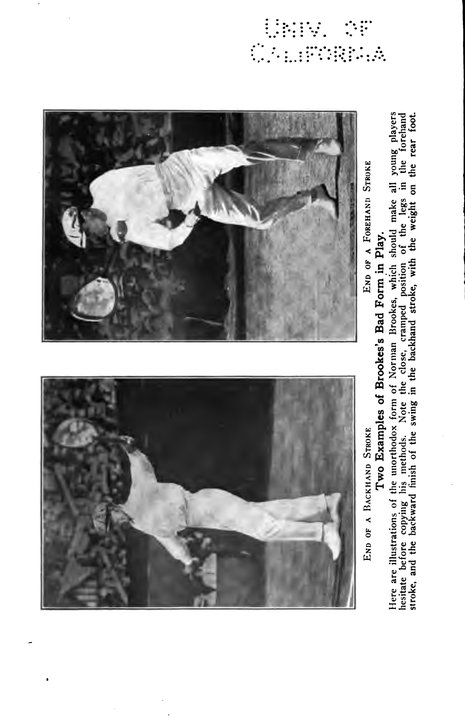
**Second image.** The leaf the Internet Archive numbers n41 in its scan of J. Parmly Paret, Methods and Players of Modern Lawn Tennis, published in New York by American Lawn Tennis on 1 August 1915 and edited by S. Wallis Merrihew; digitised from the University of California's copy, sponsored by Google, catalogued there as not in copyright. It sits immediately after the leaf carrying printed page 12, which was fetched and opened this session to place it, and that matches the entry in the book's own list of illustrations for a plate facing page 12. The leaf numbering the archive uses and the page numbering the book uses do not run together, and the plate was located by opening leaves rather than by arithmetic. 3359 by 5200 px, mean brightness 181.6 of 255. Opened at full size, rotated, and enlarged in crops.
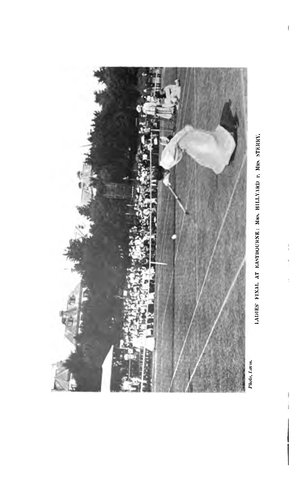
It is a full-page plate, printed sideways, carrying two photographs side by side. Above the left one, in small capitals: END OF A BACKHAND STROKE. Above the right one: END OF A FOREHAND STROKE. Beneath both, in bold: Two Examples of Brookes's Bad Form in Play. And beneath that, in three lines of body type, the reason they are in the book — that here are illustrations of the unorthodox form of Norman Brookes, which should make all young players hesitate before copying his methods; note the close, cramped position of the legs in the forehand stroke, and the backward finish of the swing in the backhand stroke, with the weight on the rear foot.
In both photographs a slight man in a long-sleeved white shirt and white flannels stands at the end of a stroke on grass, wearing a soft peaked cap. In the backhand photograph, at the left, he is turned partly away from the camera with the racket carried high and out to the side at the finish of the swing. In the forehand photograph, at the right, he faces more nearly towards the camera with the racket away to one side at about head height, its head caught pale against a dark ground, and his legs are close together, which is the fault the caption complains of. Where his weight is at either instant is the caption's claim and not something this entry can resolve from the plate. Behind him in both is a crowd several rows deep, dark and undifferentiated; behind the left-hand stand a gabled roofline rises, with what read as timbered gables. No lettering, board or sign is legible inside either photograph.
The cap is worth one sentence, because it is the only independent confirmation available here that the man in the plate is the man in this entry. The Australian Dictionary of Biography, describing his appearance without reference to this book, says he wore long-sleeved shirts and a peaked tweed cap, and used a heavy flat-topped racquet with slack strings.
Printed matter in the frame, recorded as a positive of a different kind: across the upper right of the leaf, perforated through the paper in dotted capitals, is the library ownership stamp UNIV. OF CALIFORNIA. The list of illustrations credits the backhand photograph to Edwin Levick and the forehand photograph to Brown Brothers, both commercial agencies of the period; the plate itself carries no credit line.
This is the image, rather than a portrait, because of what it does to the reverence. In 1915 an American instructional book, edited by the editor of the country's tennis magazine, used a man who had twice won Wimbledon and was in the side then holding the Davis Cup as its worked example of how not to play, in print, by name. Eleven years later he was running Australian tennis, and the men's trophy of the Australian championship now carries his name.
**Sourcing note.** Nothing in this entry appears inside quotation marks, and that is deliberate. Every source used — a scholarly biographical dictionary, encyclopaedia articles, a catalogue record and a 1915 instruction book — exists in a single typesetting, and this series requires a second independent setting of the same copy before machine-read text is placed inside quotation marks. The captions and the hand-lettering on the negative are transcribed in capitals as descriptions of what is printed on those objects, not as quotations. The paraphrase of the plate's instructional caption follows its wording closely and is offered as a paraphrase.
**Sources.** Library of Congress Prints and Photographs Division, George Grantham Bain Collection, catalogue record and master negative scan for Norman Brooks and wife, LC-B2-3153-4, for the cover, its dimensions, its catalogue title and date, the note that the title comes from unverified data supplied by the Bain News Service, and the rights information stating no known restrictions on publication: https://www.loc.gov/pictures/item/2014696758/ , with the scan at https://tile.loc.gov/storage-services/master/pnp/ggbain/16600/16604u.tif . W. H. Frederick, Sir Norman Everard Brookes (1877-1968), Australian Dictionary of Biography, National Centre of Biography, Australian National University, published in hardcopy in volume 7 in 1979 and online in 2006, for his parentage and birth, Melbourne Grammar and the paper mills, the family court and Wilberforce Eaves, the 1896 Victorian selection, the statement that he had the means to play in Europe, the 1905 all-comers' win and challenge-round defeat, the 1907 treble and the Davis Cup sequence, the rejection for active service and the Red Cross and Expeditionary Force appointments, the presidencies of the Victorian and Australian associations and the twenty-eight-year figure, the purchase of Kooyong in 1919 and its development, the criticism of him as autocratic and as a selector, the knighthood, the marriage, the death at South Yarra and the burial at St Kilda, the description of his dress and racquet, and the article's own use of the Library of Congress photograph — and for the sentence in which it spells the name Brooks: https://adb.anu.edu.au/biography/brookes-sir-norman-everard-5373 . Encyclopaedia article on Norman Brookes, for the dates, the infobox and body listings of his Davis Cup years, the thirty-nine matches, the Royal South Yarra membership in 1896, the cancelled 1908 defence and its citation to a Melbourne weekly of 25 April 1908, the 1914 Surrey title, the statement that until 2016 two Victorian Football League games for St Kilda in 1898 were believed to be his and were his brother Harold's, the marriage, the 1939 knighthood, the twenty-nine-year presidency figure, the three formulations of the 1907 first, the roll of Wimbledon men's singles champions counted here, and the hatnote pointing to a disambiguation page for Norman Brooks: https://en.wikipedia.org/wiki/Norman_Brookes . Encyclopaedia article on the Australian Open, reached this session through the redirect from the trophy's own name, for the naming of the Norman Brookes Challenge Cup, the 2013 contract to make the cups, the tournament's presence at Kooyong and its move to Melbourne Park in 1988: https://en.wikipedia.org/wiki/Australian_Open . J. Parmly Paret, Methods and Players of Modern Lawn Tennis, edited by S. Wallis Merrihew, American Lawn Tennis, New York, published 1 August 1915, for the second image, its caption and the credits in its list of illustrations, the archive item giving the contributing library as the University of California, the sponsor as Google and the rights status as not in copyright: https://archive.org/details/methodsandplaye01paregoog with the page at https://archive.org/download/methodsandplaye01paregoog/page/n41.jpg . The Esri world geocoding service; OpenStreetMap ways 28317137 and 38939485, obtained through an Overpass mirror, with Nominatim's reading of the first recorded and not counted. All neighbouring-pin distances, the Australian anchor count, the reuse of the Kooyong coordinate and every cross-reference to another entry were taken from this platform's own stored records and queried this run.
changes?
delete this memory?
We detected that you have a Blox in your crypto wallet! We will import the Blox into your account.
Click on done below to complete the import.
Welcome Back!
Sign in to preserve cherished moments
Don't have an account?
Welcome!!
Sign up and start preserving cherished moments
?
?
Choose your payment method
Buy with Metablox Credit
Do you want to mint Blox with Metablox Credit?
Which Crypto would you like to use?
Purchase Confirmed!
Your Blox is being minted on-chain and will appear in your profile shortly.
Log in or sign up to claim your Blox.
How many credits do you want to buy?
$100 USD = 1 Metablox Credit = 1 Blox.
Use Metablox Credit to mint any Blox you want on the map.
 expand_more