


Biography | Juliette Atkinson — a third title made the cup her personal property, and the annual that reported it carried no portrait of her, Philadelphia, 1898
· 1898-6
Unreviewed contributionBy kevin · · Report an issue














































Find memories left by people near you.
Distribute Bounty
This will distribute the bounty equally among all qualifying memories. This action cannot be undone.
Cancel Bounty
Are you sure you want to cancel this bounty? The remaining amount will be refunded to your account.
Success!
Operation completed successfully.
Error
Something went wrong.
Biography | Juliette Atkinson — a third title made the cup her personal property, and the annual that reported it carried no portrait of her, Philadelphia, 1898
kevin
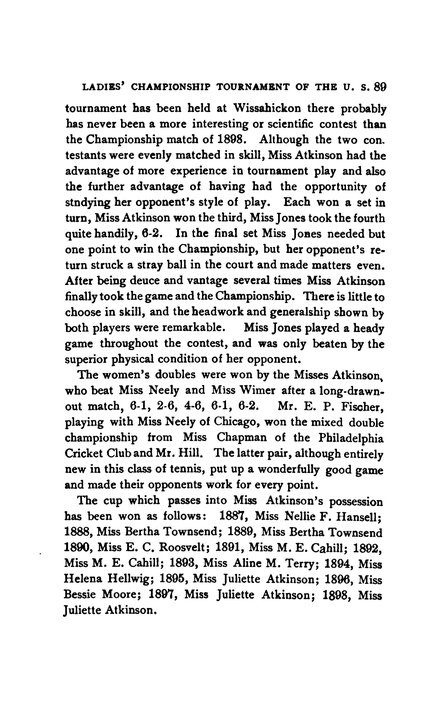
On the afternoon of Friday 17 June 1898, on the grass of the Philadelphia Cricket Club at Wissahickon Heights, Juliette Atkinson beat Marion Jones in five sets and won the championship of the United States for the third time. Because it was the third time, she also won the cup. Not the right to hold it for a year: the cup itself, to take home and keep.
That is the whole of this entry. The United States National Lawn Tennis Association, whose central rule was that its players must never be paid for playing, handed one of them, in front of a crowd, a piece of silver that became her personal property.
**The rule that made a trophy into property.**
The three-wins convention was not peculiar to the women's championship. The association's own officially adopted annual explains it twice in a single volume about two other trophies. Of the Middle States championship cup, the guide for 1898 says that the cup had been in existence since 1887, the requirements for perpetual ownership being that a player must win it three times. Of the intercollegiate cup the same volume says it is necessary for a college to win the cup three years to acquire permanent ownership of it. A challenge cup was a standing prize that a competitor could extinguish by winning often enough, and when it was extinguished somebody had to buy another one.
The women's national trophy had been in play since the championship's first year, 1887. Atkinson had won it in 1895, lost it to Bessie Moore in 1896, and won it again in 1897. The 1898 challenge round was the third win, and it ended the cup's career as a competition.
**Two printers, one dispatch.**
The result went out from Philadelphia that evening and was printed the next morning, 18 June 1898, in at least three papers. Two of them set the same copy: the Kansas City Journal on page five and the Saint Paul Globe on page five. Both carry the dateline PHILADELPHIA, June 17, and their opening sentences are word for word the same:
"Miss Juliette Atkinson, of the Ladies' Club of the Staten Island Athletic Club, this afternoon again won the lawn tennis championship of the United States by defeating Miss Marion Jones, of the Southern California Lawn Tennis Association, and daughter of United States Senator Jones, of Nevada."
That is the Kansas City setting with three machine readings repaired against the other: its scan gives Ladles' for Ladies' and Marlon for Marion, and breaks United across a line. One difference is not a scan fault and is worth naming, because a comma is a separate piece of type: the Saint Paul setting puts a comma after the Ladies' club and the Kansas City setting does not.
The sentence that matters here diverges more than that, and the divergence is in the words rather than the ink. Kansas City prints that the Wissahickon challenge cup now becomes her personal property, and that the cup has been in competition for twelve years. Saint Paul prints that the Wissahickon special cup now becomes her personal property, and that the cup has been in dispute for twelve years. Two words differ, twice. What both settings give identically, and all that is quoted from them here, is the phrase
"now becomes her personal property."
Twelve years is right either way, on the arithmetic the guide supplies: the roll of championships printed in the annual runs from 1887 to 1898, which is twelve of them.
**How close it was.**
Jones took the second and fourth sets. In the fifth she was repeatedly a point from the title. Both settings of the dispatch say so in the same words, and this is the second quotation, again from the Kansas City setting with its scan's tlmus read as times and beather read as beat her:
"Miss Jones was only one point from the match and the championship, but Miss Atkinson tied her and beat her out each time."
Kansas City introduces that sentence with five times during the final set and Saint Paul with five times during this set. The score, from the Kansas City table and confirmed set by set in the Saint Paul narrative, was 6-3, 5-7, 6-4, 2-6, 7-5.
Both papers, and the association's guide, agree on what spoiled the decisive rally: a loose ball already lying on the court. The guide says the return struck a stray ball in the court and made matters even. Kansas City says the rally was spoiled by the ball in play hitting a ball lying in Miss Jones's court. Saint Paul says a ball in Miss Jones's corner. What each of the three does not say is what the umpire then ruled, and no rule is asserted here from the accounts.
How long it took is not agreed at all. The guide calls it a five-set match of three hours and ten minutes. The Kansas City setting has Atkinson the stronger at the end of the three hours of fast playing. The Saint Paul setting, at the same point in the same dispatch, has her the stronger at the end of the third set. The New-York Tribune of the same morning, working from its own correspondent rather than this wire, says the two fought out a long five-set match for nearly four hours. Three durations from three sources, and none is adopted here.
**The annual disagrees with itself on the same opening.**
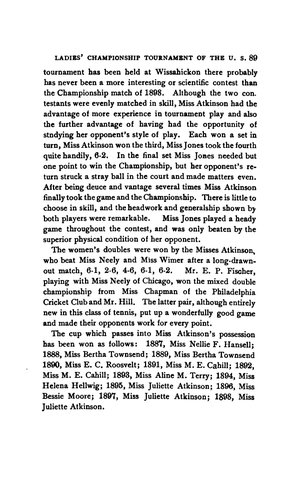
The guide's account of the tournament, on page 88, says that Atkinson had already won the cup two successive years and needed but this one more victory to give her the ownership. The roll of honour it prints two pages later, on page 89, lists 1895 to her, 1896 to Bessie Moore, and 1897 and 1898 to her. Those two statements cannot both be read straight: the wire and the roll agree that this was her third championship, and the roll shows that the three were not consecutive. Both are printed here and neither is corrected, because the volume is the association's own and the error is its own.
**What the annual pictured, counted.**
The Wright and Ditson guide was a photographic book as well as a record book. Each volume carries a run of full-page portrait plates, each with a caption and almost no other text on the leaf, and they can be counted.
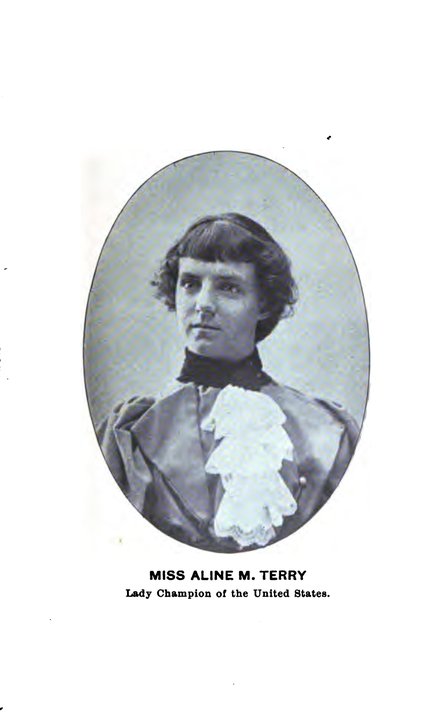
Counting them across the six volumes examined for this entry, by that test, gives this. The guide for 1893 yields only four such leaves, too few to be worth a proportion, and the one woman on them is part of a group plate of the Canadian champions. The guide for 1894, reporting the 1893 season, carries a plate captioned Miss Aline M. Terry, Lady Champion of the United States. The guide for 1895 carries eight named plates, of which the only woman is again the lady champion of Canada. The guide for 1897 carries about eighteen legible named plates and no woman at all. The guide for 1898 carries sixteen named plates and no woman at all: among them the interscholastic champion, the Bowdoin interscholastic champion, the champion of Vermont and the champion of New Mexico. The guide for 1899, reporting the season described above, carries sixteen, of which two are women: Miss Juliette P. Atkinson, Lady Champion, and Miss C. Cooper, English Lady Champion.
The volumes that pictured no American lady champion are the volumes that reported the championships won by Helena Hellwig in 1894, by Bessie Moore in 1896 and by Juliette Atkinson in 1897. The volume for the 1895 season, in which Atkinson won her first, was not located and is not counted here.
This is a count of leaves in a scan and not a transcription of a printed list, because none of these volumes carries a list of illustrations. Where a caption was too damaged to read it is excluded, which is why the 1897 figure is given as about eighteen, and why the 1893 volume is not given a figure at all. What the count will support is that the annual pictured the lady champion of the United States in 1894 and again in 1899 and not in between; what it will not support is any account of why.
**The plate that is not here.**
The 1899 volume's Atkinson plate has a further problem, and it is a problem of the scan rather than of the book. Every halftone plate in that volume failed to reproduce. Measured across the whole run, the plate leaves for Whitman, for Sheldon and Ware, for both interscholastic champions, for Atkinson and for Cooper all return an almost uniformly white page: mean brightness of about 254 out of 255. The captions are printed letterpress and survive; the photographs above them do not. Leaf 110 of that volume, counting leaves as the Internet Archive's scan numbers them rather than as the book paginates itself, is a blank page with the words Miss JULIETTE P. ATKINSON, Lady Champion set at the foot of it.
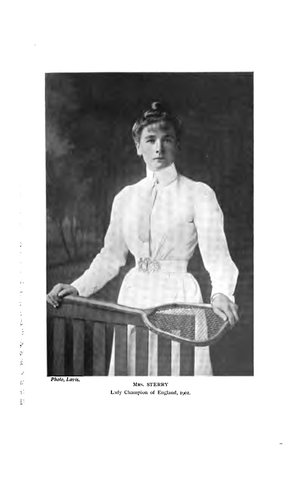
So no portrait of Juliette Atkinson was published with this entry when it was written, and the second image is the 1894 plate of Aline Terry instead, from a volume whose plates did print. It shows what the association's annual did with a lady champion of the United States when it chose to. See the amendment at the end of this entry, which closes that gap from a different book.
**Whose player she was.**
The wire enters her from the Ladies' Club of the Staten Island Athletic Club, a New York club, winning an American championship on a Philadelphia club's grass. The encyclopaedia article on her gives her and her sister Kathleen as natives of Maplewood, New Jersey. The two statements are about different things, an entry and an origin, and both are set down here.
She was born on 15 April 1873 at Rahway, New Jersey, and died on 12 January 1944 at Lawrenceville, Illinois. The same article gives her the national singles in 1895, 1897 and 1898, the doubles in 1894, 1895, 1896, 1897, 1898, 1901 and 1902, and the mixed doubles in 1894, 1895 and 1896. The guide for 1899 records that she and Kathleen won the 1898 women's doubles, beating Carrie Neely and Marie Wimer 6-1, 2-6, 4-6, 6-1, 6-2, and that the mixed doubles that week went to Neely with E. P. Fischer. Where the encyclopaedia and the contemporaneous sources differ, the contemporaneous sources are followed here.
**The name of the ground.**
This platform's entry for June 1915 at this pin uses St. Martin's; the entries for 1901 and 1904 note that the district was called Wissahickon through the earlier period and that the year the newer name took hold is not established. This entry narrows that a little without closing it. The 1899 guide's own fixture list for the season enters the tournament as Philadelphia C. C., Wissahickon Heights, Philadelphia, and its narrative calls the ground Wissahickon throughout. The guide for the 1901 season still calls it Wissahickon. The window is therefore between 1901 and 1915 on the sources read here, and it is still a window.
**Amateur-era record.**
Everything above belongs to a championship closed to anyone who had ever been paid to play, and sits on the same footing as the other pre-1968 material pinned on this platform. That is what makes the cup worth an entry of its own. The association's laws denied its players money and its trophies were the things it gave instead, and a challenge cup won three times stopped being a symbol and became a possession. Whether that was ever debated inside the association, and what the association or the club put up in the cup's place for 1899, is not established by anything read here.
**Gaps this entry declares.**
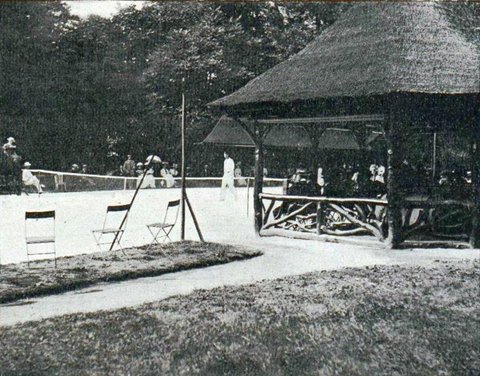
No photograph of Juliette Atkinson was published with this entry as first written: the Wikimedia Commons interface that holds the one known file returned a rate-limiting error throughout that session and was not reached, and the Library of Congress has been searched for her in earlier sessions without result. That gap is closed by the amendment below. The association's minutes are not consulted here, so nothing is established about how the three-wins rule was written or whether the 1898 outcome was foreseen. What replaced the cup is not established. No photograph of these courts is offered here either, and this entry does not need one, but this platform's 1901 entry at this pin does carry a view of the ground, which is the nearest thing to it.
**Coordinate.** 40.063473, -75.210644, precision radius 300 m. This is the Philadelphia Cricket Club pin already established on this platform for the championships of June 1915, June 1904 and June 1901, reused here deliberately and with disclosure; it was fixed from two independent sources about 38 m apart, the City of Philadelphia's property records and OpenStreetMap's building outline, and set at their midpoint. The radius covers the club's grounds rather than the clubhouse door, because nothing read here fixes which court the challenge round was played on, and the guide places the match only in the court in front of the grandstand. This pin now carries four entries, one more than Church Road in Wimbledon and two fewer than Forest Hills, and the choice is deliberate: the cup was won on this grass, and the entry is about the cup.
**Cover.** Page 89 of the Wright and Ditson Officially Adopted Lawn Tennis Guide for 1899, published by Wright and Ditson, Boston; digitised from the New York Public Library's copy and served by the Internet Archive, 2356 x 3830 px, catalogued there as not in copyright. Following the standing check on this platform the printed matter was read, and the page is legible throughout. It is a page of text headed LADIES' CHAMPIONSHIP TOURNAMENT OF THE U. S. and numbered 89. Its first paragraph is the account of the 1898 challenge round quoted and paraphrased above, ending with the judgement that Jones was only beaten by the superior physical condition of her opponent. Its second gives the women's doubles and mixed doubles results. Its third begins The cup which passes into Miss Atkinson's possession has been won as follows, and lists every winner from 1887 to 1898 by name. There is no illustration on the page.
**Second image.** Leaf 84, again by the archive's leaf count, of the Wright and Ditson Officially Adopted Lawn Tennis Guide for 1894, same publisher and same archive, 2342 x 3834 px, likewise catalogued as not in copyright. An oval halftone portrait, head and shoulders, of a young woman against a plain studio ground, her body turned slightly away from the camera and her face toward it: dark hair worn up, a high dark collar, full sleeves, and a pale frill of lace at the throat. Nothing finer than that is resolvable at the size opened. Beneath it, in letterpress, MISS ALINE M. TERRY, Lady Champion of the United States. This is not Juliette Atkinson and is not offered as her. It is included because it is what the association's annual did with a lady champion four years earlier, and because the corresponding plate of Atkinson in the 1899 volume did not survive its scan.
**Sourcing note.** Three passages are quoted above. All three are from the same wire dispatch of 17 June 1898 in two independent printers' settings, the Kansas City Journal and the Saint Paul Globe of 18 June 1898, read as machine-read page text rather than through any summarising layer, which is this platform's condition for quotation marks. Two independent settings of a championship result dispatch is the stronger of the two grounds recognised here, because the copy was set twice by two firms with no common compositor. The divergences between the settings are given in the body above rather than hidden in this note, and the quoted stretch in the second case was deliberately cut back to the five words the two settings render identically. Everything else on this page is attributed paraphrase, including every passage from the Wright and Ditson guides, the New-York Tribune's duration, the plate counts and the biographical dates. The amendment below adds no quotations.
**Sources.** Wright and Ditson Officially Adopted Lawn Tennis Guide for 1899, for the account of the 1898 championship, the roll of honour, the fixture list and the plate captions: https://archive.org/download/wrightditsonoff16unkngoog/wrightditsonoff16unkngoog_djvu.txt . The guide for 1898, for the Middle States and intercollegiate three-wins rules and its plate captions: https://archive.org/download/wrightditsonoff05unkngoog/wrightditsonoff05unkngoog_djvu.txt . The guides for 1893, 1894, 1895 and 1897, for the plate captions counted above: https://archive.org/download/wrightditsonoff20unkngoog/wrightditsonoff20unkngoog_djvu.txt , https://archive.org/download/wrightditsonoff17unkngoog/wrightditsonoff17unkngoog_djvu.txt , https://archive.org/download/wrightditsonoff02unkngoog/wrightditsonoff02unkngoog_djvu.txt and https://archive.org/download/wrightditsonoff11unkngoog/wrightditsonoff11unkngoog_djvu.txt . The guide for the 1901 season, for the ground still being called Wissahickon: https://archive.org/download/wrightditsonoff10unkngoog/wrightditsonoff10unkngoog_djvu.txt . Kansas City Journal, 18 June 1898, page 5: https://www.loc.gov/resource/sn86063615/1898-06-18/ed-1/?sp=5 . The Saint Paul Globe, 18 June 1898, page 5: https://www.loc.gov/resource/sn90059523/1898-06-18/ed-1/?sp=5 . New-York Tribune, 18 June 1898, page 5, for the fourth duration: https://www.loc.gov/resource/sn83030214/1898-06-18/ed-1/?sp=5 . Birth and death dates, the family's New Jersey origin and the list of titles from the encyclopaedia article on Juliette Atkinson: https://en.wikipedia.org/wiki/Juliette_Atkinson . The pin's coordinate and its two sources are inherited from this platform's June 1915 entry at this ground. The plate-leaf brightness measurements were taken from the Internet Archive's own page images for the 1899 volume.
**Amendment, 6 September 2026: the portrait, and what the trophy was.**
Two things this entry declared as open have since been answered out of one book, The Book of Sport, published in New York by J. F. Taylor and Company in 1904.
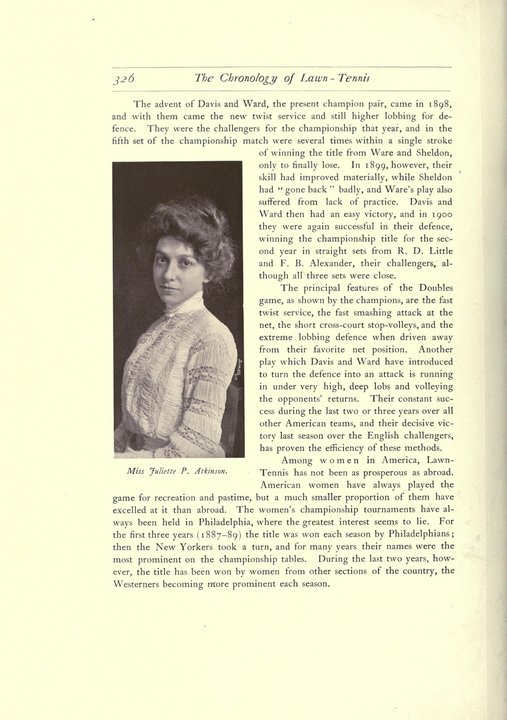
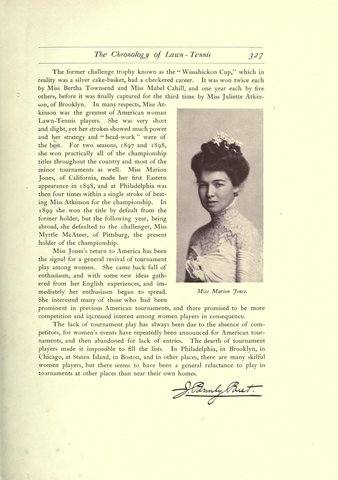
The image gap is closed. A portrait of Juliette Atkinson is now published with this entry as its third image. It is the full-page plate on page 326 of that volume, captioned Miss Juliette P. Atkinson, digitised from the University of Toronto's copy and served by the Internet Archive, which catalogues the item as not in copyright; the page image is 2748 x 3900 px and it was opened and read at full size. It is a halftone of a studio photograph, three-quarter length, of a woman turned slightly to her right with her face toward the camera: dark hair worn up and full, and a pale high-necked bodice with vertical pleating and lace at the throat, against a dark ground. Down the right edge of the photograph, scratched into the negative in white, is a studio credit reading SCHLOSS N.Y. Neither the caption nor the volume's list of illustrations names a photographer, so the negative is the only source for it. The book's copyright page states that most of its portraits were made especially for the publishers and that their reproduction is strictly forbidden; that prohibition was printed in 1904 and has long since lapsed, which is why the plate can be published here.
The route matters as much as the result. This entry recorded that the one known file on Wikimedia Commons could not be reached. It was reached in a later session and it is not usable: 218 x 500 px, below the resolution floor this platform applies. What made it worth reaching was its credit line, which named this book. The derivative was the dead end; the volume it had been cut from was not.
What the cup was. This entry establishes that the trophy became Atkinson's property and could not say what it looked like. J. Parmly Paret, writing the chronology of lawn tennis in the same 1904 volume, calls it the Wissahickon Cup and says that in reality it was a silver cake-basket. He also gives its whole career in one sentence, and that sequence agrees with the arithmetic set out above: won twice each by Bertha Townsend and Mabel Cahill, once each by five others, and then captured for the third time by Atkinson. Against the roll of champions those five are Hansell in 1887, Roosevelt in 1890, Terry in 1893, Hellwig in 1894 and Moore in 1896, which with Townsend's two, Cahill's two and Atkinson's three accounts for all twelve years from 1887 to 1898.
Paret does not say what was put up in the cup's place, so that half of the declared gap stays open. The bearing on this platform's June 1915 entry at this pin is unchanged and now firmer: a newspaper of 1915 names a Wissahickon cup, and the object described here left competition in 1898.
Two differences worth recording rather than resolving. Paret writes that Marion Jones was four times within a single stroke of beating Atkinson for the championship, where the wire quoted above says five times during the final set. Neither is adopted. And Paret enters Atkinson as of Brooklyn, where the wire enters her from a Staten Island club and the encyclopaedia gives the family a New Jersey origin; the three statements are set side by side and left there.
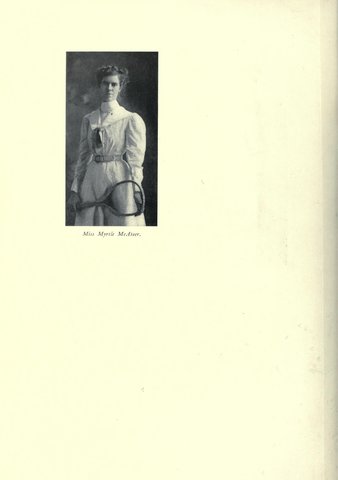
Cross-reference. This platform's entry for Myrtle McAteer, pinned at Cincinnati in September 1899, is written from the same 1904 volume and carries its roll of champions as an image. It takes up what happened to this championship in the two years after the cup was won outright, when the title passed by default in 1899 and again in 1900. Source for this amendment: https://archive.org/details/bookofsport00newyuoft , portrait at https://archive.org/download/bookofsport00newyuoft/page/n349.jpg .
changes?
delete this memory?
We detected that you have a Blox in your crypto wallet! We will import the Blox into your account.
Click on done below to complete the import.
Welcome Back!
Sign in to preserve cherished moments
Don't have an account?
Welcome!!
Sign up and start preserving cherished moments
?
?
Choose your payment method
Buy with Metablox Credit
Do you want to mint Blox with Metablox Credit?
Which Crypto would you like to use?
Purchase Confirmed!
Your Blox is being minted on-chain and will appear in your profile shortly.
Log in or sign up to claim your Blox.
How many credits do you want to buy?
$100 USD = 1 Metablox Credit = 1 Blox.
Use Metablox Credit to mint any Blox you want on the map.
 expand_more