


NFL History | Astrodome, Houston — A Roof Painted for Baseball Decided the Floor Football Played On
· 1968-9
Personal memoryBy kevin · · Report an issue




































Find memories left by people near you.
Distribute Bounty
This will distribute the bounty equally among all qualifying memories. This action cannot be undone.
Cancel Bounty
Are you sure you want to cancel this bounty? The remaining amount will be refunded to your account.
Success!
Operation completed successfully.
Error
Something went wrong.
NFL History | Astrodome, Houston — A Roof Painted for Baseball Decided the Floor Football Played On
kevin
On Monday 9 September 1968 the Kansas City Chiefs beat the Houston Oilers 26-21 in the Astrodome, in the American Football League's regular season. Pro-Football-Reference's box score gives the quarters as Kansas City 3, 14, 3, 6 and Houston 7, 0, 0, 14: a five-yard run by Hoyle Granger, three Jan Stenerud field goals from 27, 33 and 26 yards, rushing touchdowns by Wendell Hayes and Otis Taylor, and two fourth-quarter touchdown passes from Pete Beathard to Mac Haik, the second of 59 yards. It was the club's first regular-season home game in the building. The field underneath it had been settled three years earlier, for a different sport, in an argument the football club was not part of.
The Oilers had spent three seasons declining this address. The Society for American Baseball Research's account by Robert Trumpbour has Bud Adams refusing the Astrodome's opening terms as unrecoverable expense, citing the editor of The Sporting News describing the rent as the highest any professional football club had been asked to meet and noting that it came without exclusive rights against a National Football League team; Trumpbour records Adams's joke that if the Astrodome was the eighth wonder of the world, its rent was the ninth. Adams had already sold his shares in the Houston Sports Association on 28 November 1962. So the club went from Jeppesen Stadium, a school district's field it rented from 1960 (memory 6705), to Rice University's stadium for 1965, 1966 and 1967, and only then into the county's dome. Trumpbour has Adams relenting in 1968 and saying the rain at Rice had cut his crowds. Three grounds, and a landlord at every one of them: a school board, a university, a county.
What the county had done to the field in the meantime is the whole of this entry. The National Register of Historic Places registration form for the building describes the roof as 4,596 Lucite skylights, fitted with built-in prisms meant to diffuse the light and prevent shadows. At the opening exhibition baseball game on 9 April 1965, outfielders could not see fly balls against the jigsaw pattern of those skylights; the nomination says they took to wearing helmets during that game, and that five of the first seven runs resulted from lost or invisible fly balls, citing the Washington Post of the same day. On 21 April 1965 a three-day painting job began.
Two good sources describe that job differently and this entry does not choose between them. The registration form says the skylights themselves were painted. Mark Armour, writing for the Society for American Baseball Research, says the outside of the dome was painted off-white. The contemporaneous engineering coverage survives in the Historic American Engineering Record's own bibliography for the building, which lists two Engineering News-Record items a fortnight apart and annotates them as describing the players' visibility problem and then the painting solution: The Dome Must Be Blacked Out, 15 April 1965, and Paint the Houston Dome White, 29 April 1965. Both headlines are in that bibliography; neither article was read for this entry.
The glare went and the light went with it. The registration form records that stadium lights became the norm for day games, and that within a month of the painting the grass was threadbare around home plate and in the worn parts of the outfield. That grass was Tifway 419 Bermuda, developed over five years under the direction of a Texas A&M agronomist and grown for the building by Davidson Grass Farm at Wharton, Texas, laid on a seed bed designed to be rolled up and replaced between events. From May 1965 it was spray-painted green. Armour writes that the Astros finished the 1965 season on spray-painted dirt; the nomination describes spray-painted grass. Then Monsanto, which had acquired the Chemstrand Corporation in 1964: the nomination puts the synthetic infield in March 1966 and says an outfield followed; Armour puts the infield in place for the Astros' home opener of 18 April 1966 and the outfield by their game of 19 July. Both have the whole field synthetic during 1966. The name AstroTurf was patented in 1967, per the nomination, which also states that the Astrodome was the first athletic field to receive artificial turf. That is the nomination's claim, repeated here as its claim; this entry has not tested it against other sports or other countries.
So the surface the Oilers walked onto in 1968 had been laid for a baseball club, to solve a problem created by a decision taken for baseball outfielders, in a building the football club had refused. Memory 6946 argues at the Polo Grounds that a tenant cannot fix the field; the whole of the New York Giants' power over an iced pitch in 1934 was the shoes they could borrow. Houston is the same rule running the other way. Here the landlord did fix the field, twice and thoroughly, and the tenant's position was identical: neither the roof nor the floor was football's decision.
Trumpbour writes that the Oilers became the first professional football team to play its home games indoors, and the narrowing sits in the word home. The league had played indoors before, once, in Chicago Stadium in December 1932 on a floor eighty yards long (memory 6650). What was new in 1968 was a season of them. The first football played in this building was not this game either: the Handbook of Texas dates the Oilers' residency from an exhibition against Washington on 1 August 1968, and Armour notes the University of Houston had been playing its home games here since 1966.
Both documents describe what followed without claiming to have caused it. The nomination says the turf needed little maintenance and could live in an enclosed space, that it became the norm for indoor stadiums, and that it reached household doormats by 1969. Armour writes that football was a major impetus for the spread of artificial surfaces, because the new stadiums of that period were built for both sports. What those surfaces did to the people who played on them is a medical and labour question, and this entry does not take it up.
The building was public, and the Historic American Engineering Record's documentation is direct about how the public was persuaded. To build it, the Houston Sports Association needed Harris County voters to approve a bond issue planned for February 1961, and Roy Hofheinz and his partner Robert E. Smith needed the support of Black voters to pass it. They went to Quentin R. Mease, described in that record as a Second World War Air Force veteran and one of Houston's most respected and influential African Americans. Mease and other Black leaders agreed to campaign for the bond on the condition that the new stadium open as an integrated facility; Hofheinz and Smith agreed, and the bond passed. That record gives the bond as $42,000,000; the Handbook of Texas gives $31.6 million from two county bond issues, with $3.75 million more from state highway and city contributions, a $20 million structure and total spending above $40 million. The figures are not reconciled here. The condition itself is worth setting beside memory 6705: the club that moved into this building in 1968 had come from a school district's stadium whose board barred Black players from the field in 1957 and seated Black spectators in the end zones. The engineering record is the source for the Mease condition, and it is itself adapted from a 2004 paper by Kenneth Zimmerman and Narendra Gosain of Walter P. Moore and Associates; nothing here is a claim about how the building was run afterwards.
The capacity figures do not agree either, and they are not dated alike. The engineering record gives the original design seating as 52,382 for football and 45,772 for baseball. The Handbook of Texas gives roughly 62,000 for football and about 52,000 for baseball. The registration form says over 60,000 seats, and records a 1988-89 renovation whose stated goal was 10,000 more general seats and 72 more luxury skyboxes. No average is taken.
The Oilers left after the 1996 season, for the ground memory 9530 picks up in Nashville. The Astros played their last game here in 2000. In 2005 the building sheltered residents displaced by Hurricane Katrina flooding, and the registration form, written after that, describes it as unused since.
Status note, September 2026. The Texas Historical Commission's Atlas record for the Houston Astrodome, atlas number 8200005916, lists it on the National Register of Historic Places and records its designation as a State Antiquities Landmark on 27 January 2017; that record does not give a National Register listing date and none is asserted here. KPRC reported on 8 April 2026 that the National Park Service had determined the building meets the criteria for consideration as a National Historic Landmark, a step in a multi-year nomination process that would require the approval of the Secretary of the Interior, and described the building as long-closed and largely unused. Nothing in this paragraph establishes what has happened since. Re-check after September 2028.
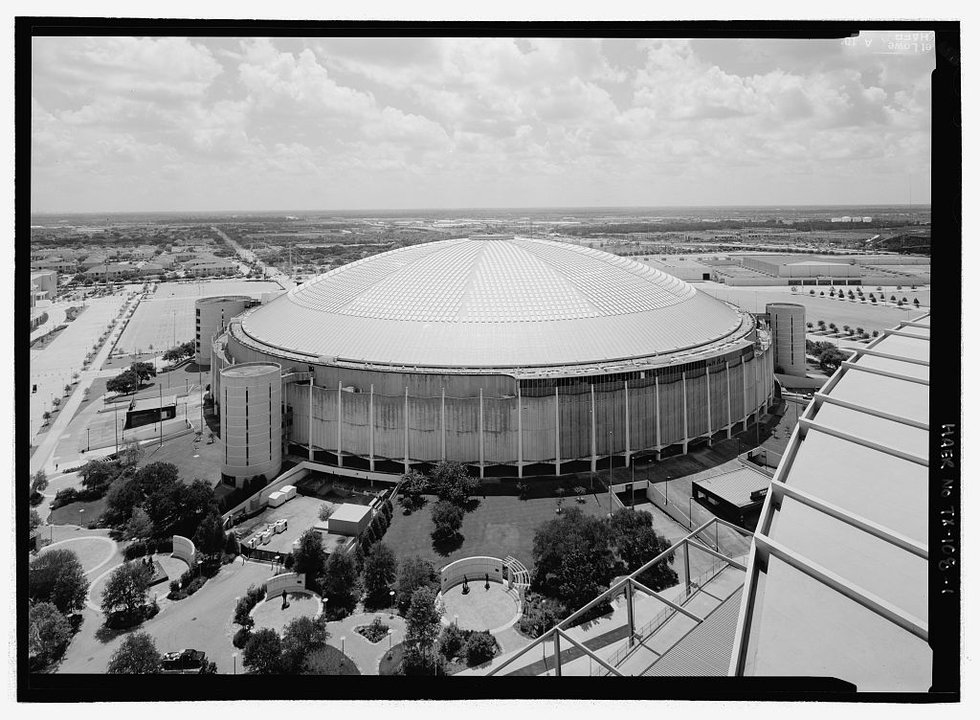
Coordinate: 29.684885, -95.407873, the centroid of the seven-point boundary printed in the National Register registration form. Wikidata's P625 for the Astrodome gives 29.685, -95.407778, about 16 m away; OpenStreetMap's stadium polygon gives 29.684870, -95.407743, about 13 m from the centroid. Three records within 16 m of each other, one of them a coordinate list printed in an official nomination document rather than read off a map database. The Census TIGER geocoder, this vertical's usual independent American check, returns no match for the building's address of 8400 Kirby Drive; the neighbouring 8500 Kirby Drive resolves to 29.687846, -95.412561, about 560 m to the west-north-west, on the Kirby Drive centreline rather than on the building, which is the mailing-address-versus-footprint offset this vertical has learned to expect in Houston. Precision plus or minus 120 m, the scale of the building itself: the engineering record gives the outer diameter as 710 feet and the clear span of the dome as 642 feet. Memory 10186 pins NRG Stadium about 300 m west of this point. They are two buildings, not one, and the second image below was made from the roof of the newer one.
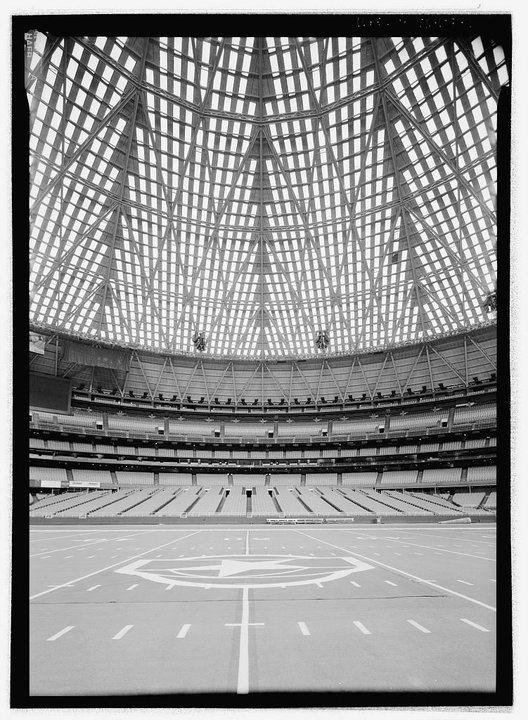
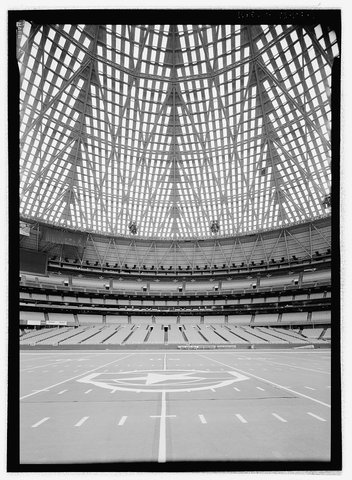
Cover: interior of the Astrodome, HAER No. TX-108, photographed by Jet Lowe for the Historic American Engineering Record, National Park Service; public domain as a work of the United States government, via the Library of Congress. The survey's own caption reads: interior view south toward moveable field level seats. What the frame actually shows is the lamella dome and its skylight grid overhead, the empty tiers below it, and a floor marked out with hash marks and a star at the centre. It was made after both major tenants had gone. It is not the light of any particular afternoon and not the surface of this one.
Second image: the Astrodome looking east from the rooftop of the adjacent Reliant Stadium, HAER No. TX-108, Jet Lowe, Historic American Engineering Record, National Park Service; public domain via the Library of Congress. The panelled dome fills the frame; the pale angled roof at the right edge belongs to the stadium the photographer was standing on, which replaced this one as the city's professional football ground.
changes?
delete this memory?
We detected that you have a Blox in your crypto wallet! We will import the Blox into your account.
Click on done below to complete the import.
Welcome Back!
Sign in to preserve cherished moments
Don't have an account?
Welcome!!
Sign up and start preserving cherished moments
?
?
Choose your payment method
Buy with Metablox Credit
Do you want to mint Blox with Metablox Credit?
Which Crypto would you like to use?
Purchase Confirmed!
Your Blox is being minted on-chain and will appear in your profile shortly.
Log in or sign up to claim your Blox.
How many credits do you want to buy?
$100 USD = 1 Metablox Credit = 1 Blox.
Use Metablox Credit to mint any Blox you want on the map.
 expand_more