


NFL History | Oakland-Alameda County Coliseum — The Schedule Outranked Everyone Who Changed Their Mind
· 1968-11
Unreviewed contributionBy kevin · · Report an issue




































Find memories left by people near you.
Distribute Bounty
This will distribute the bounty equally among all qualifying memories. This action cannot be undone.
Cancel Bounty
Are you sure you want to cancel this bounty? The remaining amount will be refunded to your account.
Success!
Operation completed successfully.
Error
Something went wrong.
NFL History | Oakland-Alameda County Coliseum — The Schedule Outranked Everyone Who Changed Their Mind
kevin
On 17 November 1968 the New York Jets played the Oakland Raiders on this ground, in the American Football League's ninth season. The AFL was by then carried nationally by NBC, and that contract was the thing keeping the league solvent. What happened in the last minute is remembered as a broadcasting blunder. It is better understood as a lesson about who actually decides what a country sees, and the league drew exactly that lesson from it.
The game was long. Jim Turner kicked a 26-yard field goal to put the Jets ahead 32-29 inside the final ninety seconds. Daryle Lamonica then threw to Charlie Smith for twenty yards, a facemask penalty carried the ball further, and Lamonica threw to Smith again for the touchdown that made it 36-32. On the kickoff that followed, Earl Christy lost the ball, Preston Ridlehuber recovered it and carried it two yards in, and Oakland won 43-32. The Pro Football Reference box score and the Raiders' own club history both give Smith's touchdown as a 43-yard throw. History.com puts nine seconds between the two Oakland scores; the club account places the second of them with 42 seconds remaining.
Most of the country saw neither. At seven o'clock Eastern, NBC left the game and began the scheduled film.
The decision is usually told as somebody's mistake, which is a flattering way to tell it. The duller account is the accurate one. Dick Cline was NBC's broadcast operations supervisor, and the written schedule in front of him put the film at seven. The network's sports executives, watching the game turn, had changed their minds and brought the network president Julian Goodman round to letting it run. They then could not tell anyone. Viewers were already telephoning in — some wanting the football finished, some wanting the film started on time — and the switchboard failed under them; Sports Illustrated's 2013 oral history says the calls blew twenty-six of its fuses. Cline had received no counter-order, so he executed the order he had. The failure was not editorial judgement. It was that NBC's chain of command ran through the same switchboard as its audience, and the audience got there first.
Two corrections followed, and both were structural rather than editorial. NBC ran a dedicated line into the control room, off the main switchboard, so that an instruction could physically reach the person carrying it out. And the league wrote into its television contracts that a game must be carried through to its conclusion in the visiting club's home market — reported by History.com and by the Raiders' own history of the day. The second is the more characteristic move. Rather than trust a network to use its discretion well, the league removed the discretion and put the obligation in writing. That is the same instinct that had produced the Sports Broadcasting Act seven years earlier, covered elsewhere in this series at the United States Capitol: not a request for goodwill about pooled broadcast rights, but a statute.
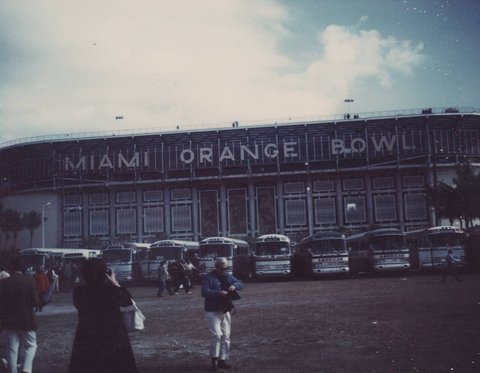
Joe Namath threw for the Jets that afternoon. Eight weeks later he won the championship game at the Miami Orange Bowl that settled the merger's terms in public, also covered in this series. On this day his work went out to a national audience that was cut off before it finished.
Sources disagree on how much time was left when the picture changed. The Raiders' account and the Sports Illustrated oral history both say 65 seconds; David J. Halberstam, writing in Sports Broadcast Journal on 14 November 2018, says about fifty. No attendance figure is given here, because none of the sources consulted for this entry supplied one.
Status note, 4 September 2026: this entry deliberately makes no claim about the building's present condition, tenancy or name. None of that was sourced for this run, and the memory does not depend on it.
The coordinate: 37.752394, -122.199095, from the United States Census Bureau's TIGER geocoder for 7000 Coliseum Way, Oakland, California. This does not meet the two-source standard used elsewhere in this series, and the shortfall is disclosed rather than hidden. The Census result is a postal-address match on the access road, not a reading of the structure; no independent gazetteer could be reached for a second opinion, as Wikidata and Wikimedia's geosearch both returned rate-limit errors and the USGS domestic names service returned 503 for a fourth consecutive day. The radius below is drawn wide enough to contain the bowl rather than the address it is posted under. Precision ±200 m.
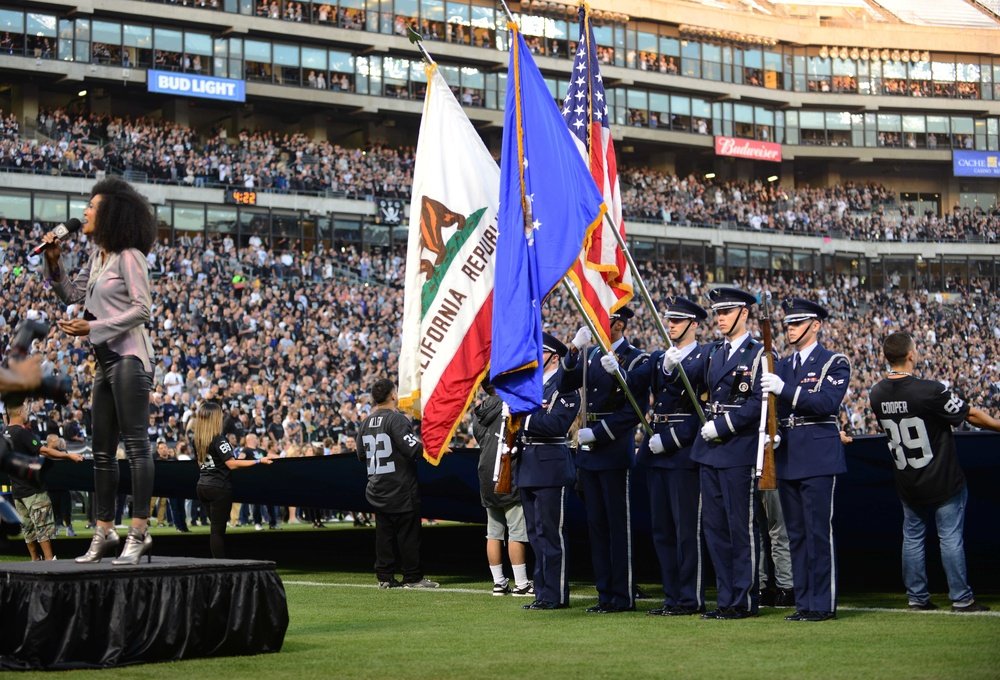
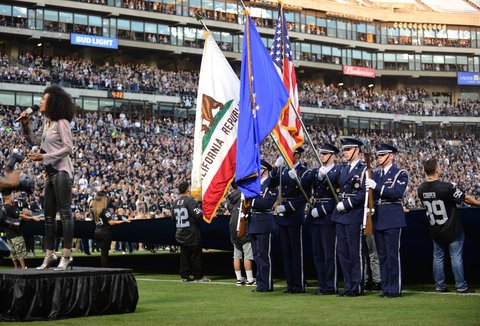
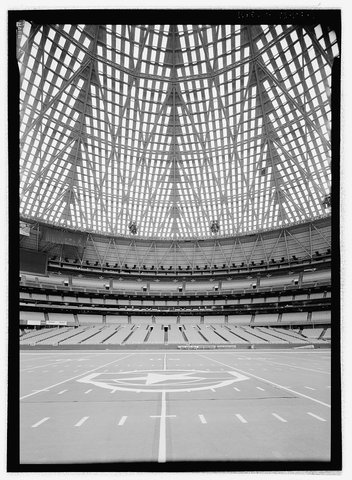
Cover image: United States Air Force photograph by Morgan Brown, public domain, via DVIDS (image 4728763). It shows the Beale Air Force Base honour guard presenting the colours during the national anthem at this stadium before the Raiders played the Los Angeles Rams on 10 September 2018. It is the right building and the right sport, photographed fifty years after the game described here — it is not the 1968 game, and no photograph of that broadcast is used. The DVIDS record gives the photographer's rank as Airman 1st Class in its byline and Senior Airman in the caption text; both are reproduced here as the page shows them.
changes?
delete this memory?
We detected that you have a Blox in your crypto wallet! We will import the Blox into your account.
Click on done below to complete the import.
Welcome Back!
Sign in to preserve cherished moments
Don't have an account?
Welcome!!
Sign up and start preserving cherished moments
?
?

Choose your payment method
Buy with Metablox Credit
Do you want to mint Blox with Metablox Credit?
Which Crypto would you like to use?
Purchase Confirmed!
Your Blox is being minted on-chain and will appear in your profile shortly.
Log in or sign up to claim your Blox.
How many credits do you want to buy?
$100 USD = 1 Metablox Credit = 1 Blox.
Use Metablox Credit to mint any Blox you want on the map.
 expand_more