
NFL History | Balboa Stadium, San Diego — The Title Game Went Where the Landlord Was
· 1964-1
Personal memoryBy kevin · · Report an issue































Find memories left by people near you.
Distribute Bounty
This will distribute the bounty equally among all qualifying memories. This action cannot be undone.
Cancel Bounty
Are you sure you want to cancel this bounty? The remaining amount will be refunded to your account.
Success!
Operation completed successfully.
Error
Something went wrong.
NFL History | Balboa Stadium, San Diego — The Title Game Went Where the Landlord Was
kevin
The American Football League never chose a host city for its championship game. There was no bid, no ballot and no neutral ground. The title game was played at the home field of one of the two finalists, which meant the league's largest occasion of the year inherited whatever building that club happened to be renting. Three times in five seasons, the building it inherited was a stadium a city had put up for a world's fair.
That is this entry's argument. Balboa Stadium was not built for professional football, was never rebuilt for it, and was not chosen for these games on any merit of its own. It hosted them because the San Diego Chargers kept reaching the final and kept holding home rights.
## What the building was
The City of San Diego's digital archives date the stadium's construction to 1914 and describe it as built for the 1915 Panama-California Exposition, with a capacity of 15,000. San Diego Past, a local history newsletter and not an institutional archive, gives the same year, the same exposition and the same figure. It stood beside San Diego High School, and for its first four and a half decades it was an exposition and schools venue that occasionally held something larger. Wikimedia Commons holds a photograph of President Woodrow Wilson addressing a crowd at the ground in September 1919, reproduced from a Library of Congress copy and filed under the name San Diego Stadium. The file title is the evidence for that earlier name; the Library of Congress record itself was not opened for this entry.
The seating figure is where the published record stops agreeing. Stadiums of Pro Football gives the original bowl 23,000 rather than 15,000, and says an upper deck was added in May 1961 that took it to 34,000. San Diego Past also gives 34,000 after the expansion but does not give a pre-expansion figure other than the 1914 one. So two sources put the fair's stadium at 15,000 and a third puts the pre-Chargers stadium at 23,000, and none of the three explains the other. They are printed here as they were found rather than averaged or reconciled, and the same page that supplies the 23,000 figure also dates the Chargers' AFL championship to 1961, which the Pro Football Hall of Fame chronology and the box scores below both contradict. Its seating numbers are therefore attributed to it rather than adopted.
What is not in dispute is the direction of travel. Every account read here has the stadium larger after 1961 than before it, and the enlargement dated to the year the club arrived.
## How the club got there
The Chargers spent the league's first season, 1960, in Los Angeles, sharing the Memorial Coliseum with an established National Football League club. The Hall of Fame's chronology then records a single line dated 10 February 1961: the Chargers were transferred to San Diego. The chronology gives no reason and none is supplied here. What it establishes is the date and the direction — one season in Los Angeles, then a move south.
Pro Football Reference's venue record for Balboa Stadium covers 1961 to 1966, forty-five games, a regular-season record of twenty-eight wins, twelve losses and two ties, and a postseason record of one win and two losses. Those three postseason games are the entire argument.
## The three championship games
**24 December 1961.** Houston 10, San Diego 3. By quarters, Houston 0, 3, 7, 0; San Diego 0, 0, 0, 3. The Hall of Fame chronology carries the same result and the same date.
**5 January 1964.** San Diego 51, Boston 10, for the 1963 championship. By quarters, San Diego 21, 10, 7, 13; Boston 7, 3, 0, 0. The box score's scoring summary has Tobin Rote running two yards, Keith Lincoln sixty-seven and Paul Lowe fifty-eight, all in the first quarter, and a George Blair field goal from eleven yards in the second. This is the game San Diego won, and the only one of the three it did.
**26 December 1965.** Buffalo 23, San Diego 0. The Hall of Fame chronology records that the Bills again defeated the Chargers, the second year running, having beaten them 20-7 at Buffalo the previous December.
**No attendance figure appears in any of the three box scores.** Pro Football Reference's early American Football League pages do not carry one, and none is claimed here. Three sources size the stadium differently and none of the three championship box scores records a crowd.
## Later the same month
The 1963 championship was played on 5 January 1964. Later the same month, on 29 January, the Hall of Fame chronology records that the American Football League signed a five-year television contract with NBC worth thirty-six million dollars, to begin with the 1965 season. Nothing here establishes that one had anything to do with the other, and the chronology does not connect them. They are set side by side because the sequence is worth seeing: the league staged its title game in a fair's stadium in the first week of the year, and by the last week of the same month had signed the contract that changed what it could afford. Another entry in this series covers the earlier pooled-rights deal and the statute that made pooled selling lawful.
## What happened to it
The club left after the 1966 season for a purpose-built stadium in Mission Valley, which another entry in this series treats on its own account. What became of Balboa Stadium afterwards is the second thing the sources do not agree about.
The City of San Diego's archives say it was demolished in the 1970s. San Diego Past says the same and adds that a smaller stadium seating 3,000 was built and opened in 1978. Stadiums of Pro Football says the structure was not demolished at all and continues to serve as a venue for high school athletics. These are not compatible statements and no source consulted here reconciles them.
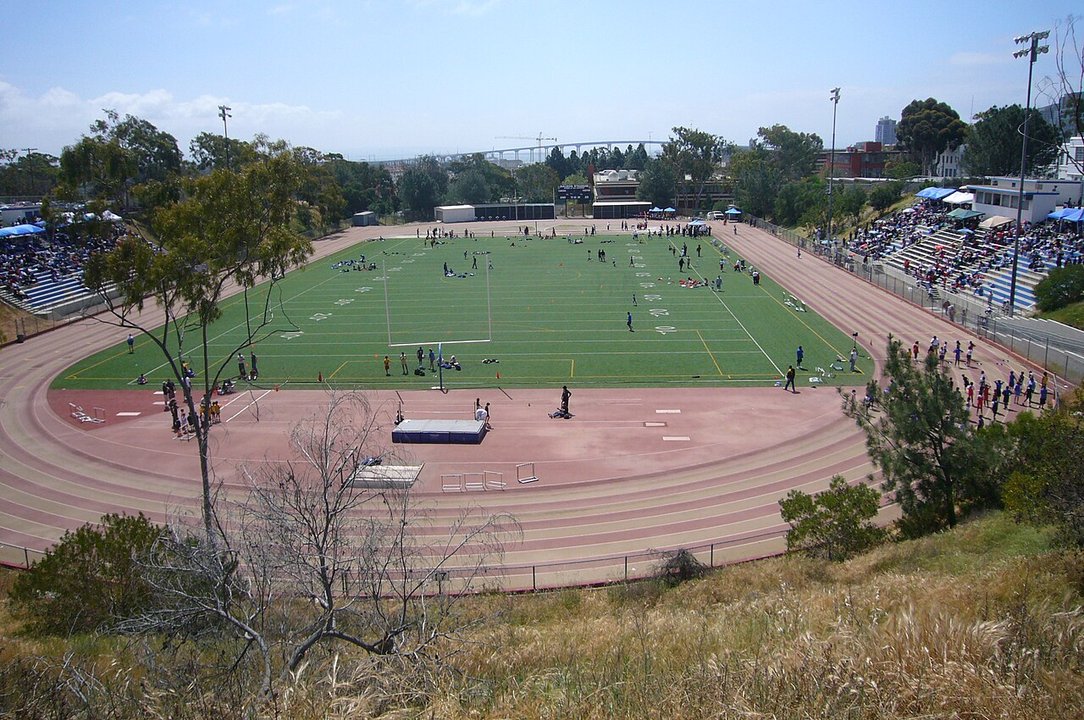
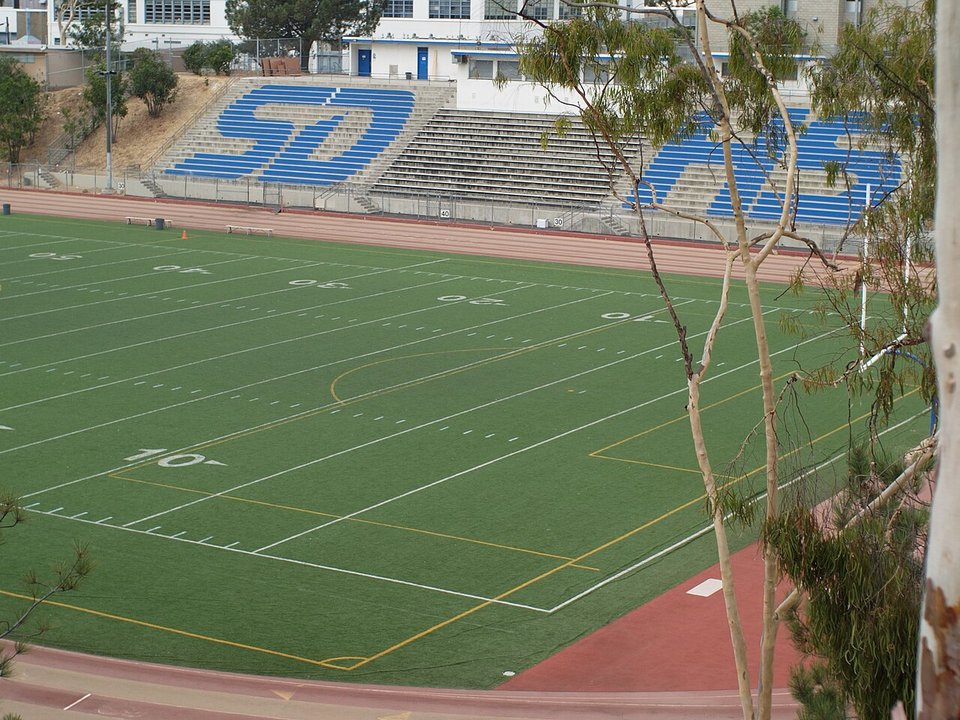
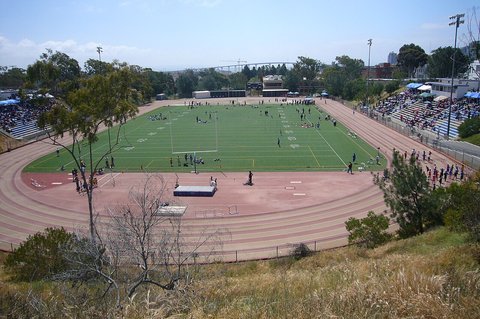
The photographs attached to this entry are the only direct evidence available, and they are evidence of one day. Both were taken in 2008. They show a bowl in use, a running track, a marked football field and a single concrete grandstand carrying school lettering — not a demolished site, and not a 34,000-seat stadium either. Whether the removal of the upper deck is what the archives mean by demolished is a reasonable guess and is not stated by anything read for this entry, so it is left as a guess.
**Status, September 2026.** This entry describes the ground as its sources describe it, the most recent of them a 2008 photograph and a city archive page with no revision date. Nothing here establishes what stands on the site today beyond the school stadium the photographs show.
## Where this sits
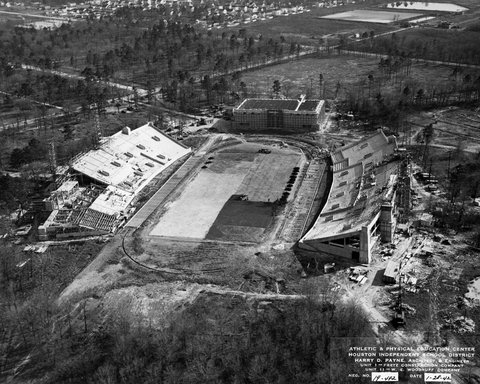
Another entry in this series is pinned at a Houston school district's field that held the league's first championship, and the pairing is worth stating because the two cases run in opposite directions. In Houston a public school system's stadium was lent to a professional club. In San Diego a professional club's enlargement was left behind for a school. Both are tenancy, and in neither case did the football club own the ground it played its biggest games on.
## The coordinate
Pinned at 32.719535, -117.153737. This is a single-method coordinate and the method is named here rather than implied.
The United States Census Bureau's TIGER geocoder returned 1405 Park Blvd, San Diego, CA, 92101 for the campus address, matching the street, city and postal code asked for. A second TIGER query on 1130 Russ Blvd returned a point about sixty-five metres west and twelve metres south, which brackets the campus corner but is the same geocoder and therefore not a second method. Both are interpolated road points on the campus boundary; the stadium bowl lies inside the campus, west of Park Boulevard.
No second independent record was reachable. The Historical Marker Database returns no entries for Balboa Stadium — a searched absence, not an untried route. A Wikimedia Commons geosearch of a 300-metre radius returned thirty files, none of them a photograph of the stadium carrying coordinates; the geotagged files in that radius are street photography. The city's parks geometry file refused with an HTTP 403.
**Precision: ±300 m.** The radius is sized from the campus and the bowl, not from the geocoder's decimal places. The oval visible in the cover image is roughly the length of a running track, and the mailing address the geocoder matched is a road point on its far side.
**Cover image:** Balboa Stadium photographed on 29 March 2008 by Eric Bekins, CC BY-SA 4.0, via Wikimedia Commons as File:Balboa Stadium.jpg. It shows the bowl from the slope above, with the Coronado Bridge on the horizon. It is a track and field meeting, not a football game, and it is included because it shows the shape of the ground rather than anything that happened on it.
**Second image:** the surviving grandstand, photographed on 20 July 2008 by mliu92 of San Mateo, CC BY-SA 2.0, via Wikimedia Commons as File:Balboa Stadium 5678 (2687990768).jpg. The seat backs spell out the initials of the high school that uses the ground, which is the clearest available statement of who the tenant is now. The photographer's own caption describes the seating as mostly removed since the Chargers era; that is the photographer's description and not a document.
changes?
delete this memory?
We detected that you have a Blox in your crypto wallet! We will import the Blox into your account.
Click on done below to complete the import.
Welcome Back!
Sign in to preserve cherished moments
Don't have an account?
Welcome!!
Sign up and start preserving cherished moments
?
?
Choose your payment method
Buy with Metablox Credit
Do you want to mint Blox with Metablox Credit?
Which Crypto would you like to use?
Purchase Confirmed!
Your Blox is being minted on-chain and will appear in your profile shortly.
Log in or sign up to claim your Blox.
How many credits do you want to buy?
$100 USD = 1 Metablox Credit = 1 Blox.
Use Metablox Credit to mint any Blox you want on the map.
 expand_more