


NFL History | Ebbets Field Site, Brooklyn — The First Television Picture Ran Out of Daylight
· 1939-10
Personal memoryBy kevin · · updated · Report an issue


















































Find memories left by people near you.
Distribute Bounty
This will distribute the bounty equally among all qualifying memories. This action cannot be undone.
Cancel Bounty
Are you sure you want to cancel this bounty? The remaining amount will be refunded to your account.
Success!
Operation completed successfully.
Error
Something went wrong.
NFL History | Ebbets Field Site, Brooklyn — The First Television Picture Ran Out of Daylight
kevin
On the afternoon of Sunday 22 October 1939 the Brooklyn Dodgers beat the Philadelphia Eagles 23-14 at Ebbets Field, and a camera watched. The National Football League's own account and the Pro Football Hall of Fame both describe the afternoon as the first telecast of a league game; the Federal Judicial Center, writing up the litigation history of football on television, uses the same description. It is worth being exact about what that claim covers. It is a claim about the National Football League, not about sport, and not about this building. The same experimental station had televised a major-league baseball game from this same ballpark in August of the same year.
The station was W2XBS. The Hall of Fame calls it the National Broadcasting Company's experimental station; the Society for American Baseball Research, writing about the same station's work at this ballpark that summer, puts its transmitter on the Empire State Building. The Hall of Fame's account puts two iconoscope cameras in the ballpark and eight people on the production staff, with one announcer, Allen Walz, working without spotters, without a colour man, without a monitor to see what was going out, and without a commercial break. It gives the running time as two hours, thirty-three minutes and ten seconds. The league's own retelling gives the same crew size, the same running time, and a kick-off at half past two.
Where the two cameras stood is not agreed. The Hall of Fame places one in the box seats at the forty-yard line and the other in the mezzanine. Frank Fitzpatrick, writing in the Philadelphia Inquirer on 4 February 2016, places one in a mezzanine box behind the announcer and the other on the sideline between the forty and the fifty. The accounts overlap and do not match, and no attempt is made here to settle them.
What every account agrees on is what happened to the picture. The game was played in the afternoon and the picture failed as the light fell. The announcer's recollection, as the Hall of Fame and the Inquirer both render it, is that the picture darkened until it was blank and the broadcast fell back to being radio. The Federal Judicial Center describes the same failure but assigns it a different cause: a cloudy day at a stadium without lights. The Hall of Fame and the Inquirer assign it to the sun dropping behind the stands. Cloud and shadow are not the same explanation and the sources are not reconciled here.
That is the mechanism, and it is a mechanism about a place. Nobody involved in the broadcast controlled the building. The football club was a tenant of a baseball ballpark. The broadcaster was a guest of the football club. The one input the picture could not do without - light on the field - belonged to neither of them. When it went, so did the broadcast, and the sources do not record at what point in the game that happened.
The audience figures are a fourth disagreement, and the accounts are not counting the same thing. The Hall of Fame says roughly five hundred New Yorkers watched on sets of their own, with more at monitors in the Radio Corporation of America's pavilion at the New York World's Fair. The Federal Judicial Center gives an estimated television audience of one thousand people. The league's retelling gives a worldwide audience of one thousand viewers. The Inquirer says fewer than a thousand New Yorkers owned a television at all, and puts a few hundred more at the World's Fair pavilion. Sets, viewers, and owners are three different quantities, and no total is computed here from them.
For the August baseball telecast from this ground, the Society for American Baseball Research carries a game account by Laura H. Peebles, published 7 February 2025, which reports about four hundred receivers inside the fifty-mile range of the transmitter on the Empire State Building. That entry also puts two stationary cameras in the park - one on the second deck behind the catcher, one near the visitors' dugout - with Red Barber announcing, and records that Barber lost his link to the director and had to guess which camera the audience was seeing.
The football itself is well recorded. Pro-Football-Reference's box score gives the quarters as Philadelphia 0, 7, 0, 7 and Brooklyn 7, 0, 10, 6. Ralph Kercheval kicked field goals of forty-four, thirty-eight and forty-five yards. Ace Parker threw forty-seven yards to Perry Schwartz. Davey O'Brien threw twenty-two yards to Bill Hewitt for the Eagles' second score. The box score and the league's retelling both print an attendance of 13,057; the Inquirer prints 13,157. The difference is a hundred people and it is left standing.
Brooklyn's professional football club was not a long-lived one. Pro-Football-Reference's franchise table runs it for fifteen seasons, 1930 to 1944, under the Dodgers name through 1943 and as the Brooklyn Tigers in 1944. Its 1939 season finished 4-6-1 under Potsy Clark, and Pro-Football-Reference lists its home ground that year as Ebbets Field. Another entry in this series describes the Chicago club that rented a baseball park on a handshake, another the Manhattan club that could not repair the field it played on, and another the two Chicago clubs whose two rented ballparks came off one architect's drawing board. Brooklyn belongs with them.
Nothing here should be read as saying this afternoon built the league's television business. The Federal Judicial Center's account has that business assembled later and by other means: clubs permitted to sell rights to local stations from 1947, regular broadcasts from 1948, blackout rules from 1951, a 1953 ruling by Judge Allan Grim that kept the home blackout and struck the rest, and a statute in 1961. Other entries in this series take those up at the places where they happened. What this ground carries is narrower and stranger: the first time the league's game was pointed at a camera, the camera could not keep up with the weather.
This paragraph is dated September 2026. It describes the site as the sources consulted describe it, the most recent of them revised in 2025, and establishes nothing about what stands on the block today beyond what the marker record below reports.
The coordinate. Two independent records were used. The Historical Marker Database's entry for the Ebbets Field marker, number 166210, carries a field reading of 40 degrees 39.861 minutes north and 73 degrees 57.462 minutes west, and places the marker at the corner of Bedford Avenue and Sullivan Place; that database records the marker as erected in 1962 and reads its text as saying only that this is the former site of Ebbets Field. The United States Census Bureau's TIGER geocoder returns 40.664548 north, 73.957353 west for 1720 Bedford Avenue, Brooklyn, and a control query at 1800 Bedford Avenue returns almost the same longitude with the latitude moved about 290 metres south, which shows the geocoder is interpolating along the avenue's centreline and is giving a point on the street rather than on a building. The two records lie about 37 metres apart. Both sit on the Bedford Avenue edge of the site, and neither of them fixes the outline of a ballpark that filled a city block, so the published radius is sized from a block and not from the decimal places of a satellite reading: plus or minus 200 metres. The pin follows the marker. The Historical Marker Database is compiled by volunteers and its reading is a single record.
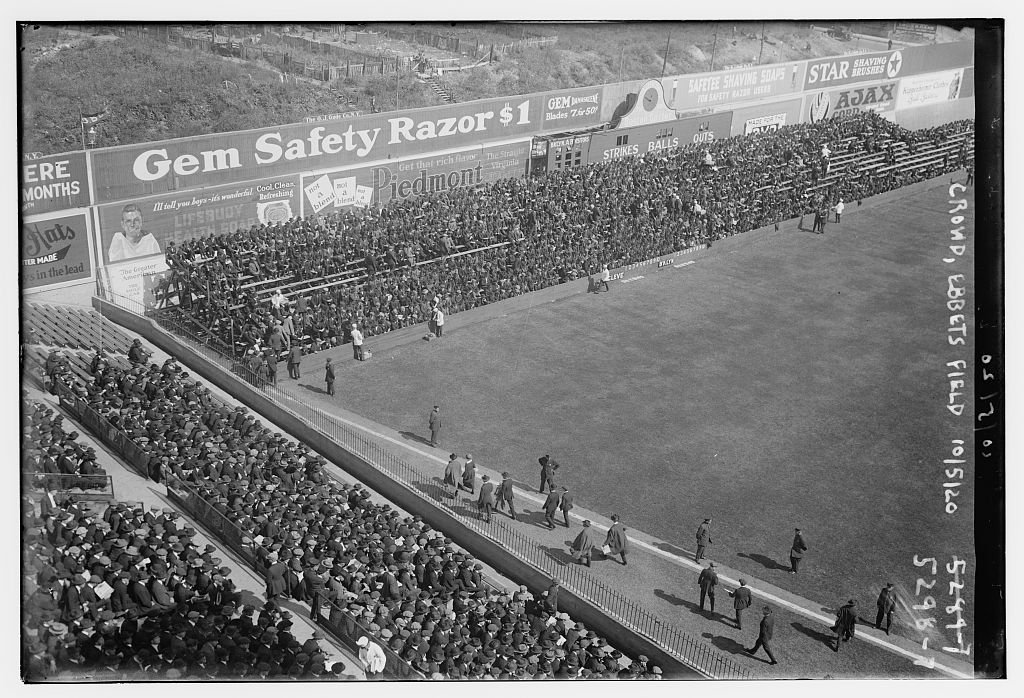
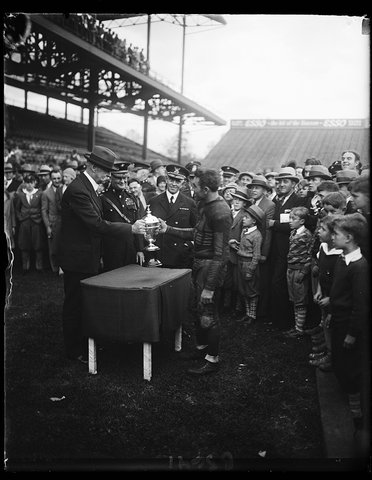
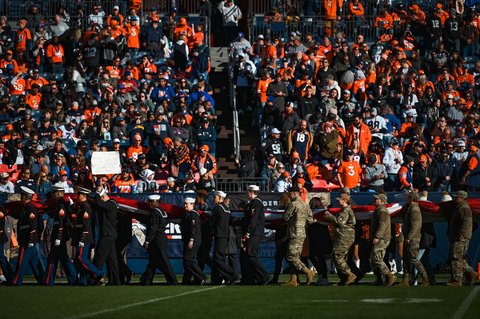
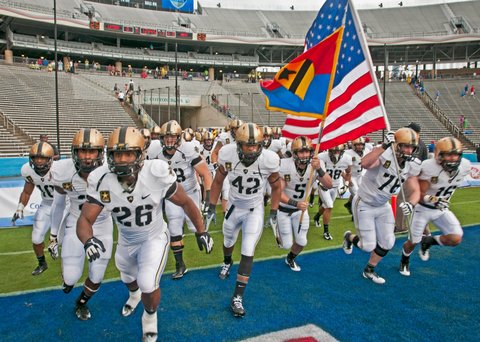
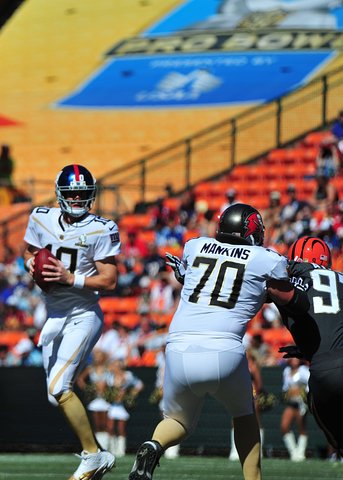
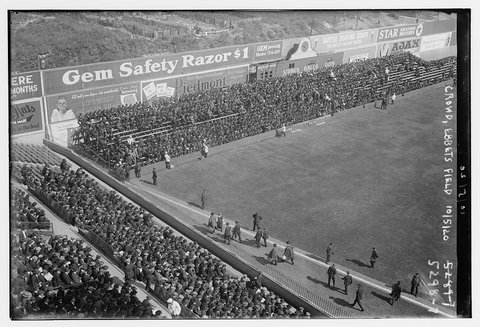
Cover image: Crowd, Ebbets Field, 10/5/20. Bain News Service, Library of Congress Prints and Photographs Division, digital identifier ggbain 31275, no known restrictions on publication. It is an elevated view across the outfield showing the advertising wall, the scoreboard, temporary stands and long shadows lying across the ground, and the negative carries the date and the words of its own caption written on the edge. It is a baseball photograph from 1920 and the game described above was played in 1939. Both years are printed and no interval is drawn between them; the picture is here because it shows the ground and the light, not because it shows the game.
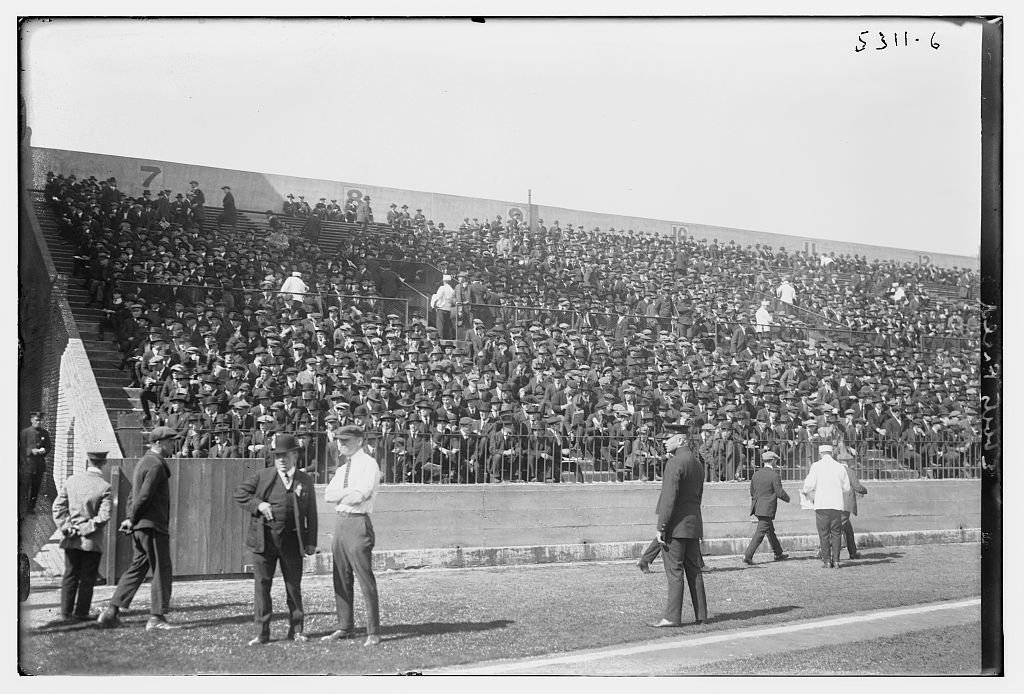
Second image: Ebbets Field. Bain News Service, Library of Congress Prints and Photographs Division, digital identifier ggbain 31451, dated 1922 by the Library, no known restrictions on publication. It shows a numbered concrete grandstand with the upper rows in sun and the lower rows in shade, and people standing on the playing surface at the foot of it. It is not a photograph of a football game and no claim is made that the light in it is the light of any particular afternoon.
changes?
delete this memory?
We detected that you have a Blox in your crypto wallet! We will import the Blox into your account.
Click on done below to complete the import.
Welcome Back!
Sign in to preserve cherished moments
Don't have an account?
Welcome!!
Sign up and start preserving cherished moments
?
?





Choose your payment method
Buy with Metablox Credit
Do you want to mint Blox with Metablox Credit?
Which Crypto would you like to use?
Purchase Confirmed!
Your Blox is being minted on-chain and will appear in your profile shortly.
Log in or sign up to claim your Blox.
How many credits do you want to buy?
$100 USD = 1 Metablox Credit = 1 Blox.
Use Metablox Credit to mint any Blox you want on the map.
 expand_more