


NFL History | Pontiac Silverdome — The Roof Covered the Field and Not the Road to It
· 1982-1
Personal memoryBy kevin · · Report an issue





































Find memories left by people near you.
Distribute Bounty
This will distribute the bounty equally among all qualifying memories. This action cannot be undone.
Cancel Bounty
Are you sure you want to cancel this bounty? The remaining amount will be refunded to your account.
Success!
Operation completed successfully.
Error
Something went wrong.
NFL History | Pontiac Silverdome — The Roof Covered the Field and Not the Road to It
kevin
The league decided where to play its sixteenth championship nearly three years before it was played. The Pro Football Hall of Fame's chronology for 1979 records that on 13 March the owners awarded three future Super Bowls in one sitting: the fifteenth to the Louisiana Superdome for 25 January 1981, the sixteenth to the Pontiac Silverdome for 24 January 1982, and the seventeenth to the Rose Bowl in Pasadena for 30 January 1983. The same institution's chronology for 1982 describes the result as the first Super Bowl held in the North. That description belongs to the Hall of Fame and is left as theirs. No source read for this entry states why the owners chose Pontiac, and no reason is inferred here. What can be said is what the building was.
It was six years old. The Detroit Historical Society's encyclopedia of Detroit gives it an opening date of 23 August 1975, a construction cost of 55.7 million dollars, a seating capacity of 82,666, which it calls the largest in the league until 2000, and a roof of 430,000 square feet of Teflon-coated fibreglass fabric held aloft by air pressure. What an air-supported roof is, and what happens to a club when one comes down, is the subject of another entry in this series and is not rehearsed again here. The point at Pontiac is narrower and it is a point about coverage. The roof was over the field. It was not over anything the crowd had to cross to reach the field.
On the day, the weather that mattered was outside the building. SFGATE, in a fortieth-anniversary account by Greg Keraghosian published on 21 January 2022 and drawing on the Detroit Free Press, the San Francisco Chronicle and the San Francisco Examiner, gives Pontiac a high of sixteen degrees Fahrenheit and a low of five, with an estimated wind chill of twenty-one below. It reports that the main car parks were full by half past eleven in the morning; that more than half the crowd arrived on an estimated 1,200 charter buses, which were stuck in the same traffic as everyone else; that the two clubs were lodged fourteen miles from the stadium and most of the press twenty-eight miles away in Dearborn; and that one spectator told the Free Press it had taken three hours to drive roughly twenty-five miles from Eight Mile Road, and complained that twenty-five intersections had been closed for the vice-president's motorcade. Vice President George H. W. Bush was not the only motorcade on the road that afternoon. SFGATE records that former President Gerald Ford had one as well.
Whether it was snowing is not settled by the sources consulted. Sports Illustrated, in an account by Robert Mays published on 27 January 2016, says snow fell on game day in Detroit and that the vice-president's motorcade savaged traffic patterns on the way to Pontiac. SFGATE says almost no snow was recorded that day, and that the damage to the roads had already been done by earlier snow and sleet, with rain and sleet on the Friday before. Those are two descriptions of one afternoon and this entry does not reconcile them. Both accounts agree about the traffic.
The mechanism is easiest to see in the bus carrying half of one of the two teams. Sports Illustrated places it on Highway 59, within sight of the dome and unable to reach it. SFGATE, following the Chronicle, supplies the arithmetic: a journey planned at twenty-five minutes took seventy, the bus stopped about three-quarters of a mile short of the stadium, and it arrived at twenty minutes to three, half an hour before warm-ups. SFGATE reports that Bill Walsh, aboard with Joe Montana, made jokes to the players during the delay. Nothing in the sources consulted says the kick-off itself was moved.
Two of the day's plainest numbers are also unsettled. Pro Football Archives prints an attendance of 81,270; SFGATE prints a crowd of 80,600. Pro-Football-Reference's box score gives a start time of four in the afternoon; SFGATE, following the Free Press, describes it as a half past four game. Neither pair is reconciled here, and no proportion of the ground's 82,666 seats is claimed to have been filled.
The football is straightforward. Pro-Football-Reference's box score has San Francisco 26, Cincinnati 21, with quarters of 7, 13, 0 and 6 against 0, 0, 7 and 14. Montana ran a yard for the first touchdown and threw eleven yards to Cooper for the second; Wersching kicked field goals of 22 and 26 yards in the second quarter and of 40 and 23 yards in the fourth. Cincinnati scored through a five-yard run by Anderson and two short touchdown passes from Anderson to Ross, of four yards and of three. The quarter figures are left as that page prints them, and no half-time score is computed from them.
The weather line on the Pro Football Archives box score reads: indoors. It is a true statement about the field. It says nothing about the afternoon.
What the league drew that day is a matter of record and it was very large. The Hall of Fame's 1982 chronology reports that the CBS telecast took a 49.1 rating with a 73.0 share, which it calls the highest of any televised sports event to that point, and a record audience of 110.2 million; CBS Radio reported a record 14 million listeners. Those figures are the Hall of Fame's. Other entries in this series deal with the sale and the regulation of football broadcasts, and none of that is repeated here.
SFGATE notes that the league did not award another Super Bowl to the snow belt for ten years, the next being at Minneapolis, and offers a reason of its own for the gap. No causal claim is made here. The interval is printed because it is checkable. Why it existed is not established by anything read for this entry.
The roof's own limit arrived three years later, and it arrived from above. United Press International's archived report, dated 4 March 1985, says that eight inches of heavy wet snow falling from the Sunday night defeated the crews trying to keep the fabric clear, and that the roof went on the Monday. It opened in three large rips and several smaller ones; seven panels needed replacing; water reached the basketball floor and the scoreboard; and a section of concrete came down into the seating. A stadium spokesman named Clayton Jones told the wire that the structure itself was undamaged and that the building might reopen within a week. The Detroit Free Press, in an account by Bill Laytner published on 27 January 2024, records that the repairs took three months and cost 8 million dollars, which the paper puts at about 24 million in 2024 money, and notes that the building's defenders insisted the fabric had deflated rather than collapsed. UPI's headline used the other word. Both words are printed here and neither is adopted.
The Detroit Historical Society records the Lions as tenants from 1975 to 2001, a second roof failure under heavy snow in 2013, the building's permanent closure that year, an auction of the property in 2009 to Andreas Apostolopoulos, and demolition between December 2017 and March 2018. The Free Press account adds that the first attempt to bring the building down failed and that it came down the following day, and that an Amazon distribution centre employing about 4,000 people was later built on the site.
Status note, September 2026: the sources above were read this month, the most recent of them dated January 2024. Nothing in this entry establishes what stands on the parcel today, who owns it, or what the ground is called now. Those are live facts and should be checked before they are relied on.
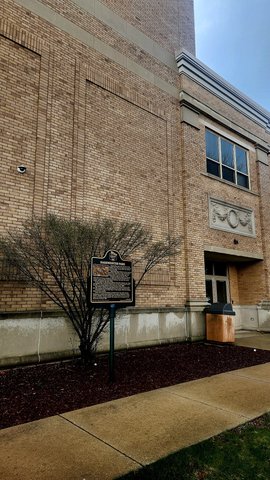
COORDINATE. 42.645833, -83.255000, precision plus or minus 250 metres. Two records were used and they do not sit on top of each other. Wikidata's entity for the Pontiac Silverdome, Q211662, carries a coordinate of 42.645833 by minus 83.255, whose decimals resolve to a whole number of arc seconds in both axes and which is therefore a published gazetteer position rather than anyone's field reading; the same entity gives the street address as 1200 Featherstone Road. The United States Census Bureau's TIGER geocoder, run on 7 September 2026, returns 42.648938 by minus 83.256242 for that address, about 345 metres to the north. A second probe on 1298 Featherstone Road returned a point with the latitude unchanged to within about five metres and the longitude 153 metres to the east, which establishes that the geocoder is interpolating along the centre line of an east-west street rather than fixing a building. The published pin is therefore the structure record, and the government record is reported as what it is, a point on the road along the site's northern edge. The radius is drawn from the footprint of a bowl that seated more than eighty thousand people, not from the decimal places in either record. The Historical Marker Database returned no entry for this stadium. A Nominatim query on the name returns the industrial park now occupying the parcel, centred about 1.2 kilometres to the south, and nothing was taken from it.
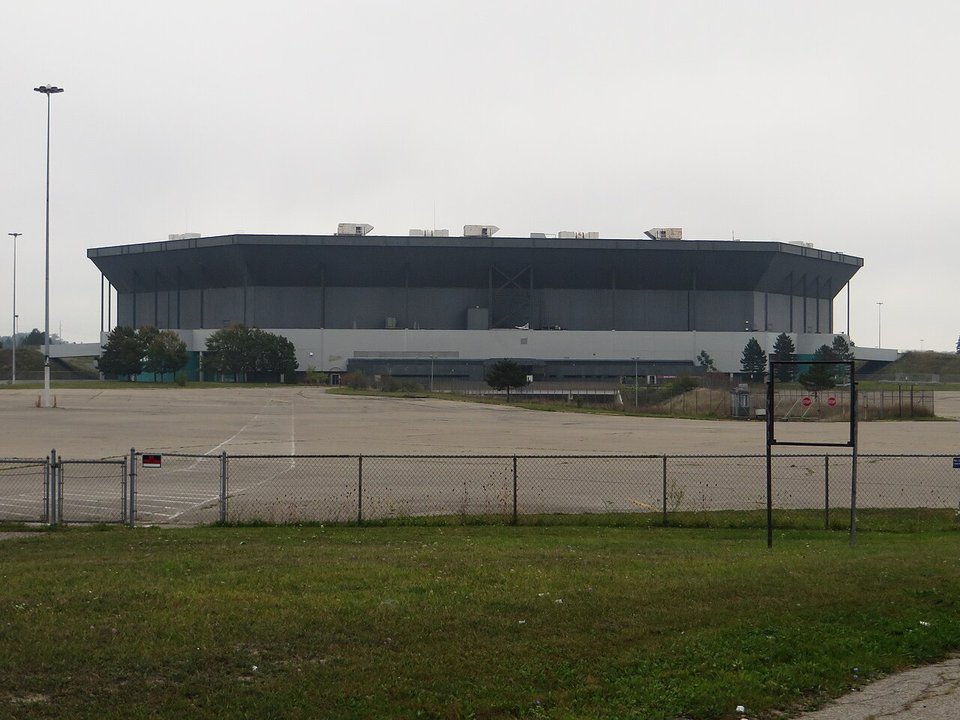
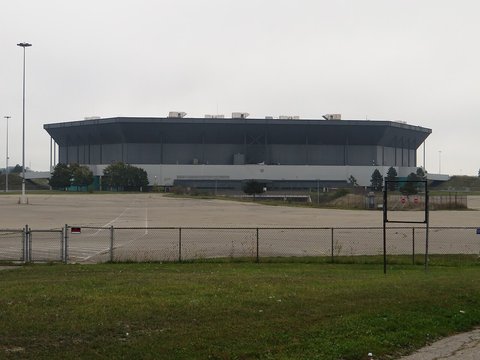
COVER IMAGE. Pontiac Silverdome, Pontiac, Michigan, photographed by Ken Lund on 25 September 2015, via Wikimedia Commons, licensed CC BY-SA 2.0. It shows the building whole in flat grey light, across an empty and cracked car park behind a chain-link fence, with the upper wall and its roof-mounted plant standing against open sky and no dome above them. It is a photograph of the stadium thirty-three years after the game this entry is about, and later than the roof failure of 2013 that the Detroit Historical Society records. No claim is made here that the frame shows the consequence of that failure; what is described is what is in the frame.
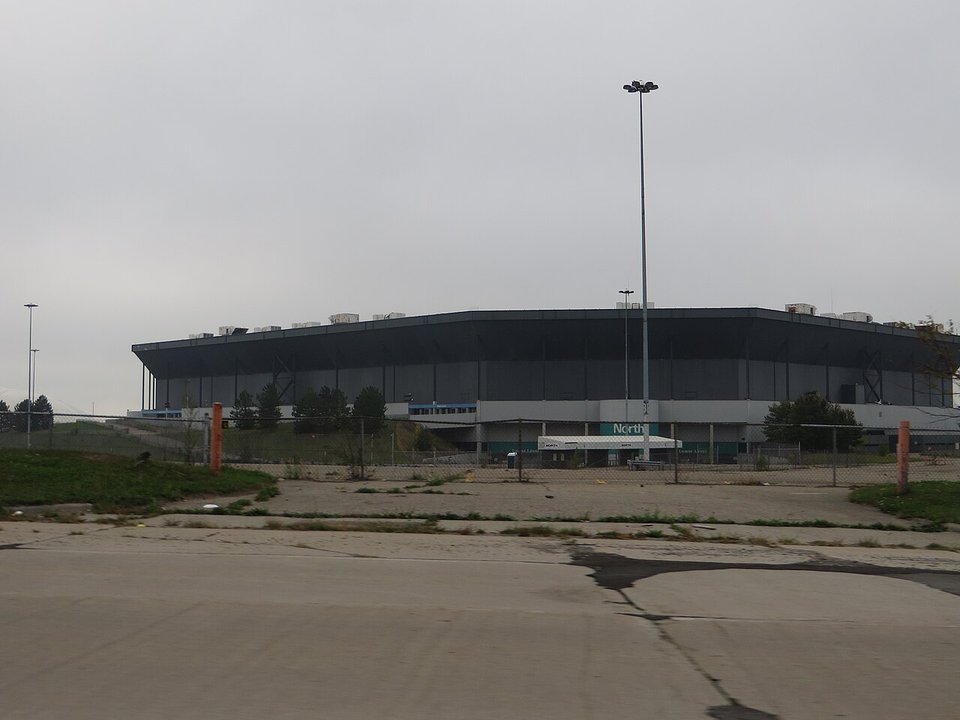
SECOND IMAGE. Pontiac Silverdome, Pontiac, Michigan, photographed by Ken Lund on 25 September 2015, via Wikimedia Commons, licensed CC BY-SA 2.0. A second view from the same visit, closer and from the north, with the ticket windows and the gate lettering legible at ground level and weeds through the paving in the foreground. It is included because it shows the approach rather than the bowl, and the approach is what this entry is about.
changes?
delete this memory?
We detected that you have a Blox in your crypto wallet! We will import the Blox into your account.
Click on done below to complete the import.
Welcome Back!
Sign in to preserve cherished moments
Don't have an account?
Welcome!!
Sign up and start preserving cherished moments
?
?
Choose your payment method
Buy with Metablox Credit
Do you want to mint Blox with Metablox Credit?
Which Crypto would you like to use?
Purchase Confirmed!
Your Blox is being minted on-chain and will appear in your profile shortly.
Log in or sign up to claim your Blox.
How many credits do you want to buy?
$100 USD = 1 Metablox Credit = 1 Blox.
Use Metablox Credit to mint any Blox you want on the map.
 expand_more