


NFL History | U.S. Bank Stadium, Minneapolis — The Winning Touchdown Did Not End the Game
· 2018-1
Personal memoryBy kevin · · Report an issue

























































Find memories left by people near you.
Distribute Bounty
This will distribute the bounty equally among all qualifying memories. This action cannot be undone.
Cancel Bounty
Are you sure you want to cancel this bounty? The remaining amount will be refunded to your account.
Success!
Operation completed successfully.
Error
Something went wrong.
NFL History | U.S. Bank Stadium, Minneapolis — The Winning Touchdown Did Not End the Game
kevin
On 14 January 2018 the Minnesota Vikings scored a touchdown as the clock reached zero, won a playoff game, and then had to put eleven men back on the field and run one more play. The rulebook required it. The league's official play-by-play records what followed as a two-point conversion attempt on which the quarterback knelt, and marks the attempt failed.
That is this memory's argument. For one more season, a National Football League game did not end when it was decided. It ended when the paperwork was finished.
**The game**
New Orleans at Minnesota, NFC divisional round, 66,612 in the building. Minnesota led 17–0 at the half — a 14-yard McKinnon run, a Forbath field goal, a Murray run from the one. New Orleans then scored three straight touchdowns: two Brees throws to Michael Thomas, of 14 yards and three, then a 14-yard throw to Alvin Kamara that put the Saints in front 21–20 with three minutes left. Forbath answered from 53 yards. Wil Lutz answered that from 43. New Orleans led 24–23 with the game nearly gone.
Minnesota had one timeout and used it after a 19-yard completion to Stefon Diggs. Two incompletions followed. Then Case Keenum threw down the right sideline for Diggs, who caught the ball at the New Orleans 35 in front of the rookie safety Marcus Williams. Williams went for the tackle rather than the ball and did not make contact. Diggs was not touched again. The gain is recorded as 61 yards.
Two details are disputed in the sources and are printed here unreconciled. **The down:** the league's own account gives third-and-10 from the Minnesota 39, which is what the drive it describes adds up to; the Associated Press wire story and CBS Sports both give fourth down. **The time of the Lutz field goal:** the box score records twenty-five seconds, the league's retrospective forty-five. Nothing consulted reconciles either pair.
The offensive coordinator's call was Buffalo Right Seven Heaven. The play collected several names in the days afterward — Minneapolis Miracle, Minnesota Miracle, Skol Mary — and the head coach put forward one of his own, Break The Curse. None of them was chosen by anyone; the first stuck because it was the one broadcasters repeated.
**What the rulebook then required**
The touchdown made it 29–24 and could not be undone. It did not, however, end the game. Under the rules in force that season, a team scoring a winning touchdown at the end of regulation still had to attempt the try — a kick or a two-point conversion — before the game was official.
So the field had to be cleared of celebrating players and both teams brought back. Keenum took the snap and knelt. The official record scores it as a failed two-point attempt, which is why the final margin is five and why the line in the record book is a touchdown with nothing after it.
Thomas Morstead, the New Orleans punter, led a group of Saints back out for that play. He had hurt his ribs early in the game tackling the Vikings' returner on the first Saints punt, and told Sports Illustrated afterward that he had spent the first half unable to breathe properly, taking short and shallow breaths. The frequently repeated version in which Morstead was the only New Orleans player to return is not what the contemporaneous reporting says: he led others out. Minnesota supporters then gave more than a hundred thousand dollars to his foundation, What You Give Will Grow, which he directed to the child life department at a Minnesota children's hospital.
**The rule did not survive the year**
At the March 2018 league meetings the Competition Committee brought forward a package of ten proposals. The ninth removed the requirement that a team scoring a winning touchdown at the end of regulation kick the extra point or go for two. It was adopted. Since then the game simply ends.
This is the same mechanism as two other entries in this collection: a single game produces a rule, and the rule is written narrowly enough that you can name the game it came from. What is unusual here is the direction. Most rules are added. This one was deleted, because a game had demonstrated that the requirement produced nothing but an emptied stadium and a kneel-down.
**The building**
The Minnesota Sports Facilities Authority is the public landlord, and its own history records that the legislature and the Minneapolis City Council approved a $975 million multi-purpose stadium in May 2012 to replace the Metrodome — the building whose air-supported roof failed under snow in December 2010, sending the club to a university field for the rest of that season. That is the subject of a separate entry at TCF Bank Stadium.
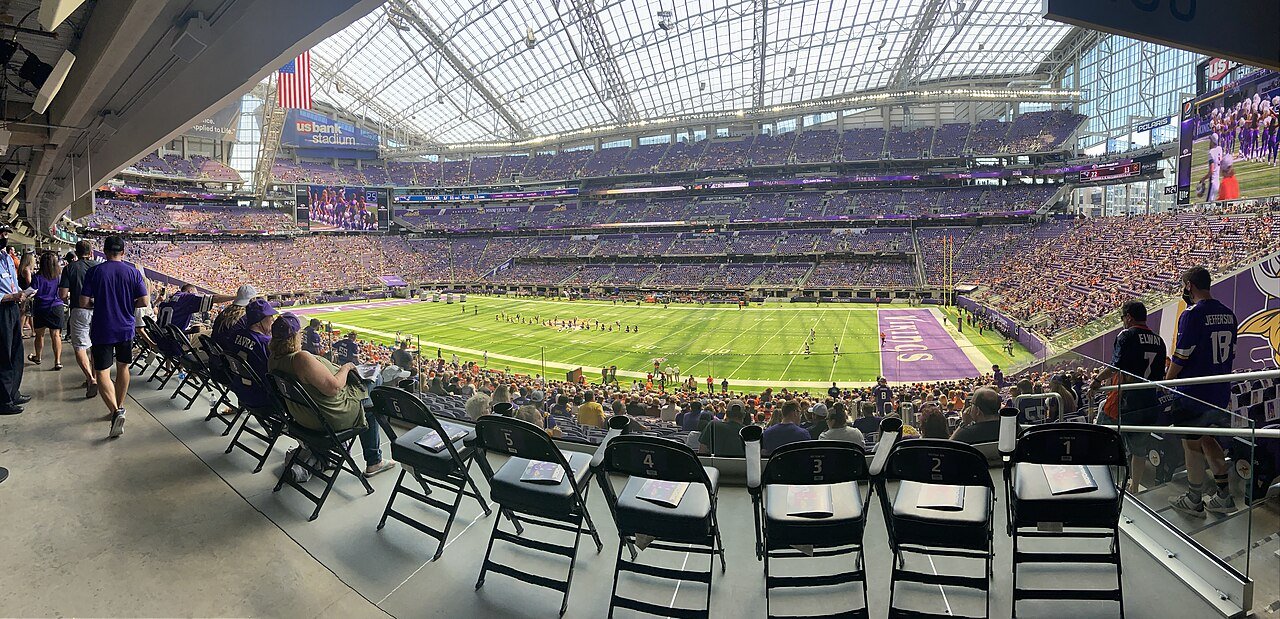
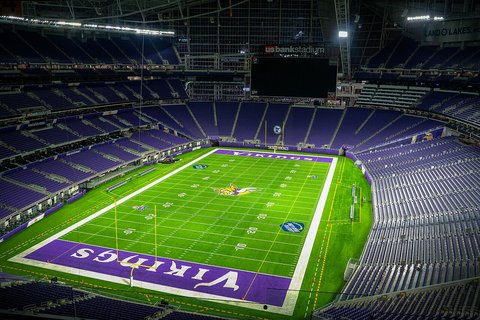
The replacement did not take a retractable roof, which is the expensive answer to snow. Thornton Tomasetti, the structural engineer, describes instead a fixed roof pitched steeply along a single ridge truss running about 970 feet down the length of the field, shaped by parametric modelling so that snow slides off it, with roughly 240,000 square feet of transparent ETFE over the southern side — by the engineer's account the first ETFE roof in a northern climate and the largest in North America when it was built. The opening is in the wall instead: five pivoting glass panels that swing back on hydraulic pistons in about seven minutes. The stadium opened on 22 July 2016.
Three weeks after the kneel-down, on 4 February 2018, the same building held Super Bowl LII before 67,612 — about a thousand more than the divisional game — and Philadelphia beat New England 41–33. Minnesota was not in it. The Vikings' season had ended the previous Sunday at Lincoln Financial Field, 38–7 to the Eagles, who then came to Minneapolis and won a championship in the stadium the Vikings had spent January trying to reach.
**Status note, current as of 7 September 2026.** Everyone named in the final sequence — Keenum, Diggs, Williams, Brees, Morstead, and the coaches involved — was living at the time of writing. Nothing here should be read as a later assessment of any of them; this entry describes one play and one rule.
**Coordinate.** 44.973545, −93.257449, the centroid of the stadium's OpenStreetMap footprint (way 743461508, tagged as a stadium, about 279 × 287 m). The US Census TIGER geocoder returned no match for the street address, the third time a large stadium parcel has defeated it in this vertical. Two further methods agree: Wikidata's coordinate statement for the building sits 61 m away, and the mean position of ten Commons files carrying photographer coordinates within 250 m sits 53 m away, in a cloud about 68 by 58 m across. All three fall well inside the footprint, so the building is firmly identified; the spread between them is the honest uncertainty. **Precision ±70 m.** The play itself crossed 61 yards of a field inside that footprint, so no single point can represent it.
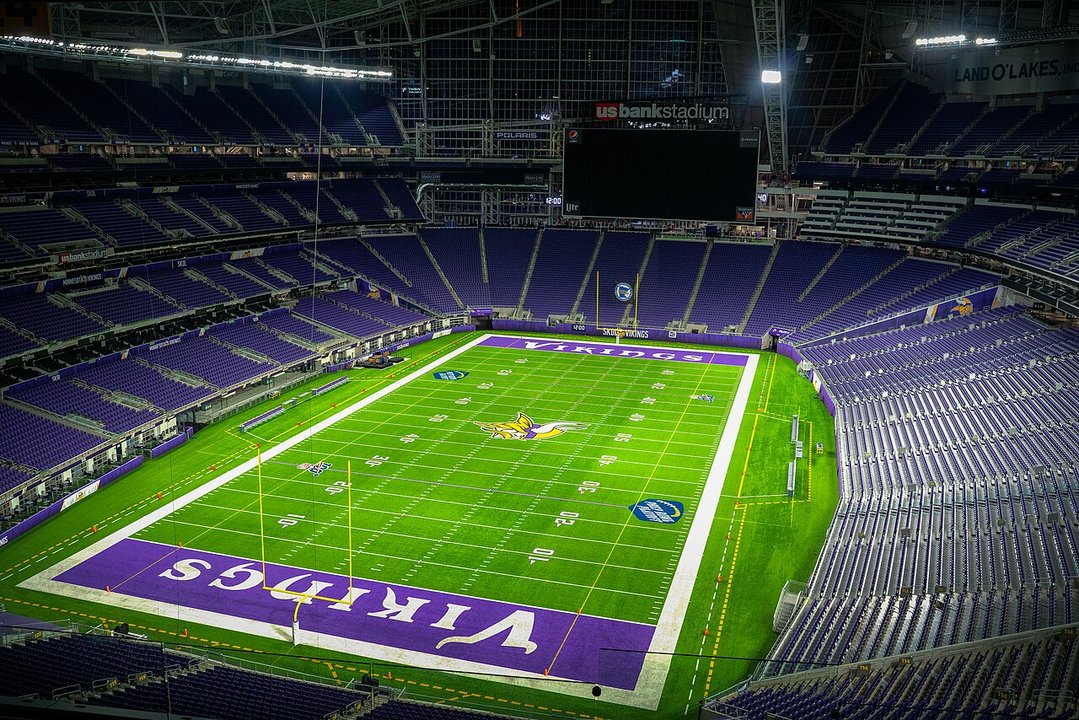
**Cover image:** U.S. Bank Stadium, photographed by Chad Davis, 27 November 2019, CC BY-SA 2.0 via Wikimedia Commons. Despite the file's title and its description as the home of the Minnesota Vikings, it is not an exterior view: it shows the empty interior bowl from the upper deck, with no game in progress, more than a year after the events described here.
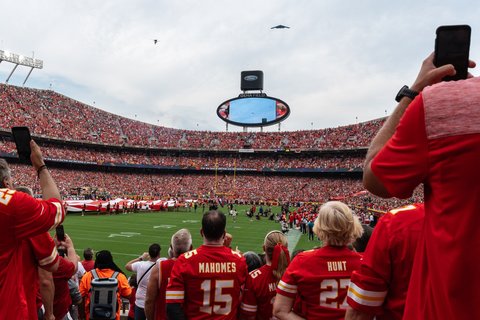
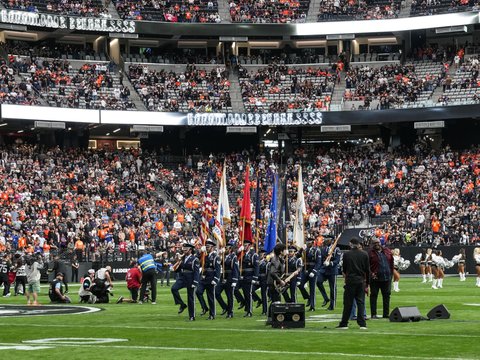
**Second image:** the interior during a Vikings–Broncos open practice on 14 August 2021, photographed by Myotus, CC0 via Wikimedia Commons. It is included because it shows in daylight what the text describes and the cover cannot — the translucent ETFE panels of the fixed roof, and the sparse crowd of a practice rather than a full house.
changes?
delete this memory?
We detected that you have a Blox in your crypto wallet! We will import the Blox into your account.
Click on done below to complete the import.
Welcome Back!
Sign in to preserve cherished moments
Don't have an account?
Welcome!!
Sign up and start preserving cherished moments
?
?





Choose your payment method
Buy with Metablox Credit
Do you want to mint Blox with Metablox Credit?
Which Crypto would you like to use?
Purchase Confirmed!
Your Blox is being minted on-chain and will appear in your profile shortly.
Log in or sign up to claim your Blox.
How many credits do you want to buy?
$100 USD = 1 Metablox Credit = 1 Blox.
Use Metablox Credit to mint any Blox you want on the map.
 expand_more