


Biography | Muriel Robb — a plaque at her club gate dates all four national titles to 1902, and a 1903 book spreads them over four years, Jesmond, Newcastle
· 1902
Personal memoryBy kevin · · Report an issue




















































Find memories left by people near you.
Distribute Bounty
This will distribute the bounty equally among all qualifying memories. This action cannot be undone.
Cancel Bounty
Are you sure you want to cancel this bounty? The remaining amount will be refunded to your account.
Success!
Operation completed successfully.
Error
Something went wrong.
Biography | Muriel Robb — a plaque at her club gate dates all four national titles to 1902, and a 1903 book spreads them over four years, Jesmond, Newcastle
kevin
A grey cast plaque hangs on the ironwork at the entrance to a tennis club on Osborne Road in Jesmond, Newcastle upon Tyne. It carries the three castles of the city arms in red, the words 102 Osborne Road around the top of the rim and City of Newcastle upon Tyne around the bottom, and in the middle, in raised white letters, the name Muriel Robb, the dates 1878 to 1907, the line Wimbledon Ladies’ Singles Champion 1902, the line Played at Jesmond Lawn Tennis Club, and then a sentence saying that she holds a unique record for winning the England, Scotland, Wales and Ireland titles in 1902.
The last three words of that sentence are wrong, and they are wrong in an interesting way. She did win all four. She did not win them in 1902. She won them across four seasons, and the order she won them in was the thing the people who watched her thought worth remarking on.
## What the four titles were, and when
A book published in London and New York in 1903, written while she was still playing, sets the sequence out at its printed page 175. Arthur Wallis Myers, in his own chapter on the players of the day, gives her first tournament season as 1896, at Newcastle, her native place, where she won the district doubles championship of Northumberland and Durham with Miss Hunter and took the singles championship the next year. Her first open singles followed at Sunderland. In 1899, he says, she won the ladies’ championship of Derbyshire and Wales, and became mixed doubles champion of England with C. H. L. Cazalet. In 1900 she won the Midland Counties singles, retained the Derbyshire cup, and took the doubles championship of England with Mrs Pickering. In 1901 she won at Dublin and, a couple of months later, became Scottish champion at Moffat. Her next national venture was the one that gave her the championship of England.
Myers then writes the sentence the plaque is a compressed version of: that she had done what none of her sex had accomplished before, in being champion of each of the four divisions of the United Kingdom, and that she had doubly honoured Wales by winning its covered court championship outright in 1901.
The modern record agrees with him on the years. The English-language encyclopaedia entry on her, read in its own source text rather than through any summarising layer, gives the Welsh singles title to 1899 and the Irish and Scottish singles titles to 1901, citing Martin Hedges’s Concise Dictionary of Tennis of 1978 for them. A local history society in the same city as the plaque gives the same three years in the same arrangement.
So: Wales 1899, Ireland 1901, Scotland 1901, England 1902. Four titles, four years, three of them won before the year the plaque assigns to all four.
What the compression costs is the shape. On Myers’s account the interesting thing about her is that she arrived from a district club in the north-east, won the small national championships first and the large one last, and did it inside seven seasons. A plaque that puts everything in 1902 turns a progression into a single miraculous summer, which is both less true and less impressive.
The plaque was erected by the city council in 2011. Its wording was read for this entry from a photograph of the object at 1024 pixels square, in which every line is legible; the photograph itself is not reproduced below, for the reason given under images.
## The 1902 title, and the match that was not the final
Here the platform’s own recurring trap appears again, in its third distinct form, and this time it runs the other way from the last one.
Under the challenge round, which was how the championship worked from 1877 until 1921, the holder did not play through the draw. Everyone else played a competition called the All Comers, and whoever won that then played the holder in a separate match for the title.
In 1902 Muriel Robb played five matches. The tournament record, as carried in the encyclopaedia entry on that year’s ladies’ singles and sourced there to Lance Tingay’s history of 1977 and John Barrett’s of 2014, gives her a second-round win over Edith Bromfield at 6–3, 4–6, 6–4, a quarter-final over Hilda Lane at 6–1, 7–5, a semi-final over Dorothea Douglass at 6–4, 2–6, 9–7, and then the All Comers’ final against Agnes Morton, won 6–2, 6–4. Only after that did she meet the holder, Charlotte Sterry, in the challenge round.
The encyclopaedia’s own biographical entry on Robb prints a table headed Grand Slam finals — using that phrase in its four-tournaments sense, not its four-in-one-calendar-year sense — with a single row: 1902, Wimbledon, opponent Charlotte Cooper Sterry, score 7–5, 6–1. That is the challenge round, labelled as the final. The All Comers’ final she actually won, against Morton, appears nowhere in it.
The local history society’s account of the same fortnight makes a different mistake in the same place. It runs her matches through to the semi-final, jumps straight to Sterry, calls that the final, omits Morton altogether, and describes Douglass as the then current champion — which she was not, since Sterry held the title from 1901 and Douglass won her first in 1903. It also names her quarter-final opponent Elsie Lane where the draw gives Hilda Lane.
This platform has now recorded three shapes of the same collapse: an entry that dropped an All Comers win, an infobox that invented a final that was never played, and here a table that renames a challenge round as a final and loses a real All Comers’ final in the process. The distinction is not pedantry. It is the difference between five matches and four, and between a title match and a title match preceded by one.
## Fifty-three games, thirty-four of which were struck out
The other thing the record carries about 1902 is a number.
The tournament record says the first meeting with Sterry was abandoned at 4–6, 13–11 because of rain, and replayed the following day, when Robb won 7–5, 6–1. The local history society gives the same account with more detail: that Sterry took the first set 6–4, that Robb took the second 13–11 after saving a match point at 5–4 and 40–30 against her, that the rain then stopped play, and that the following day the match was not resumed but begun again from nothing. It adds, fairly, that nobody has ever explained why, and that matches of that period were normally resumed rather than restarted.
The figure that gets quoted is fifty-three games, described as a record for a women’s singles final at Wimbledon. The arithmetic was recomputed for this entry. The abandoned match contained thirty-four games: ten in the first set and twenty-four in the second. The replay contained nineteen: twelve and seven. Thirty-four and nineteen is fifty-three.
Which means the record is the sum of a match that was expunged and the match that replaced it. Nothing that happened on the first day counted for anything: not the set she won, not the match point she saved. The match that actually decided the 1902 championship was nineteen games long, which is short.
Both statements are true and they point in opposite directions, and an account that gives only the fifty-three is telling the reader something that did not happen in the form the number implies. The local history society also states that the 13–11 set remains the second longest set played in a women’s singles final at Wimbledon, two games shorter than the 14–12 first set of the 1970 final between Margaret Court and Billie Jean King. That claim was not independently checked here and is reported as theirs; the two-game difference is arithmetically right on the scores given.
## The chapter on ladies’ play was written by the woman she beat
The 1903 book has a fact in its table of contents that changes how two of its plates should be read, and this platform had not noticed it until now.
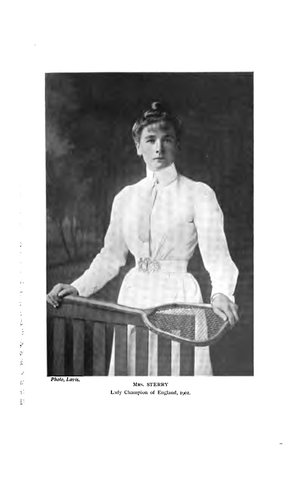
Chapter IV, printed from page 117, is titled Lawn Tennis for Ladies. Its author line reads By Mrs. Sterry. It is written by Charlotte Sterry, four times champion of England, who was the holder Robb took the title from in the challenge round described above, and who is named as the losing player on every modern table of that match.
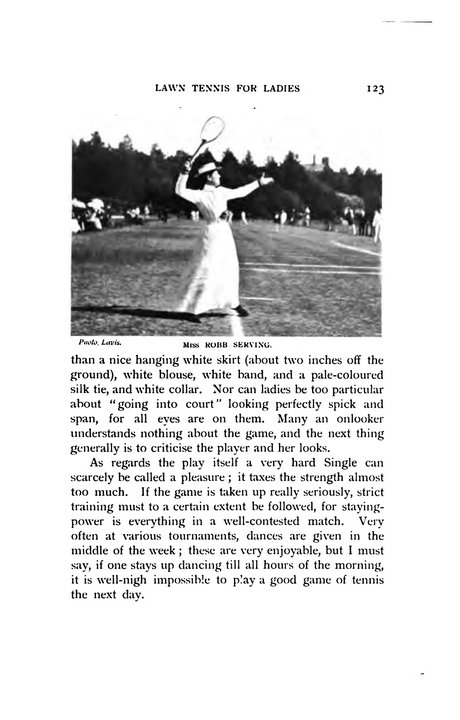
Two of the book’s plates of Robb sit inside that chapter. The photograph of Robb and Mrs Pickering as ladies’ doubles champions of England is at page 119. The photograph of Robb serving, which is this entry’s second image, is at page 123. Sterry’s chapter is where the book chose to put its pictures of the woman who had just beaten her, and Sterry’s text runs around them without mentioning it.
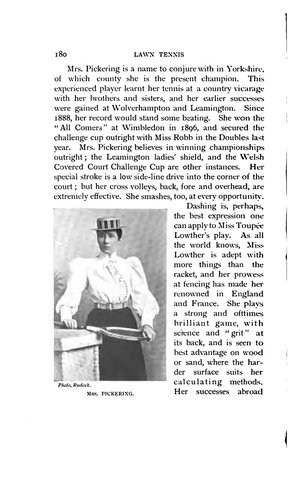
This also corrects an attribution on this platform. The entry on Alice Pickering quotes the passage at page 119 about tournament play involving a great deal of travelling and a good deal of expense, and attributes it to a woman contributor whom it does not name. That contributor is Charlotte Sterry. The observation about the cost of playing as an amateur is being made by a woman who won the championship of England four times, which is worth knowing when reading it.
## Where she learnt, and who says so
Myers, at page 175, says she learnt the rudiments of the game playing at home with her father, mother and governess, and that she strengthened her hold on it at Cheltenham College, where she carried all before her.
The local history society’s profile says she learnt the rudiments of tennis while attending Cheltenham Ladies’ College. The home half is gone.
This is the second time in successive entries on this platform that the 1903 book has preserved a domestic origin for a woman player that later accounts drop. The entry on Alice Pickering rests on the same book saying she learnt her tennis at a country vicarage with her brothers and sisters, which no modern account of her repeats. Two women, two households, one book, and in both cases the household is the part that falls out. Whether that is a pattern in the sources or an accident of two cases is not something two cases can establish, and this entry does not claim it is more than two cases.
## The club the plaque is fixed to
The Tyne and Wear Historic Environment Record, maintained for Newcastle City Council, holds an entry for this site under number 13433. It says the club was founded in 1883 at Fern Avenue, that it is the oldest club in Newcastle and among the oldest in the world, that its badge is a fern leaf, and that in 1890 it moved to this site on Osborne Road with five grass courts and a pavilion.
It gives a membership of 102 and an annual subscription of one pound ten shillings for men and one guinea for ladies. It attaches no year to either figure, so neither is dated here, and neither is converted into modern money. A guinea was twenty-one shillings; thirty shillings was half as much again. What the record does not say is why the two rates differed, and this entry does not supply a reason it does not have.
It says the land was rented from Mr Burdon-Sanderson for thirty pounds a year and bought outright in 1920. It says two courts were changed to red shale in 1973, and that several years later the courts nearest Osborne Road were sold for a residential development called The Lawns. The club’s name and foundation date are inscribed on an arch over the iron gate on Osborne Road, which is the gate the plaque hangs on.
So the ground the plaque commemorates her on is smaller than the ground she played on. Five grass courts became three all-weather courts and a pavilion, and part of the enclosure is now houses. That is the ordinary fate of an urban club with valuable frontage, and it is the reason this entry’s radius is set wider than the mapped outline.
The record also contains an error of its own: it says she died in 1906 aged 28. She died in 1907, and 28 is right.
## The Welsh cup, and a contradiction inside one book
Myers writes at page 176 that she doubly honoured Wales by winning its covered court championship outright in 1901.
The same volume, at page 180, writes of Mrs Pickering that she believes in winning championships outright, and gives the Leamington ladies’ shield and the Welsh Covered Court Challenge Cup as instances. And at page 80, in H. S. Scrivener’s chapter, it says the Welsh Covered Court Championship was instituted after his time, that the first cup was won in 1893 by J. H. Crispe, that W. S. X. Heard won at Craigside in 1894, that Reginald Doherty then won three in succession, and that Mrs Pickering was the first holder of the ladies’ cup, instituted in 1896.
One book therefore credits two different women with winning the same Welsh ladies’ trophy outright, a hundred pages apart, in chapters by two different authors, with no cross-reference between them.
They need not be contradictory. Winning a challenge cup outright meant winning it a set number of times, after which the trophy became the winner’s property and the competition provided a new one. Two women can each win a cup outright if there were two cups. Nothing read for this entry establishes that there were, or how many wins the Welsh ladies’ event required, or in which years Pickering’s wins fell. The mechanism is offered as the reason the two statements may both stand; it is not offered as the answer.
This platform pins the Welsh Covered Court Championship at Craigside in Llandudno, and that entry already records a published roll of the women’s event that appears to begin before 1896, against Scrivener’s date for the cup. This entry adds a third strand to that knot rather than untying it.
## The doubles, and a correction to a correction
Myers at page 175 says she took the doubles championship of England with Mrs Pickering in 1900 and subsequently won it outright; page 180 says Mrs Pickering secured the challenge cup outright with Miss Robb in the doubles the previous year, meaning 1902; and the plate at page 119 is captioned Ladies’ Doubles Champions of England, 1900-1902. Three years running, and the cup kept.
The entry on Alice Pickering records that a media repository describes a copy of that same photograph as showing the Wimbledon doubles champions of 1900 to 1902, where the printed caption says champions of England and names no venue. That finding stands. But it needs a refinement, which this entry supplies against itself.
Myers, at page 185, writing about Agnes Morton, says she won the doubles at Wimbledon the previous year with Mrs Sterry. So a ladies’ doubles event of some kind was being played at Wimbledon in 1902, and by a different pair. The repository’s caption is therefore not wrong because no such event existed; it is wrong because it names the wrong one. Where the championship of England ladies’ doubles was actually played in those years is not established here, and finding out is logged below as a gap.
## Her death
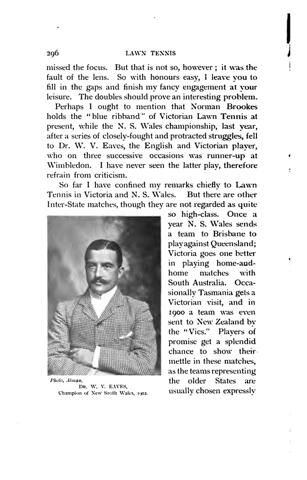
She died on 12 February 1907, aged 28, in Jesmond, less than five years after the 1902 championship. The date and the age are given consistently by the encyclopaedia entry, by the local history society, and by the dates cast on the plaque.
Accounts of why she died at that age trace to a local newspaper report of 2011, published around the making of the plaque, which states that it drew on a death certificate. That certificate has not been seen for this entry, and this series does not assert a person’s medical history on a secondary retelling, so nothing further about her health is stated here. The local history society adds that no other winner of a singles title at Wimbledon has died younger. That is its claim, not this entry’s, and it was not checked.
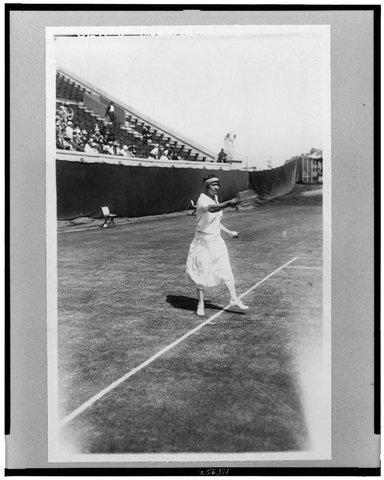
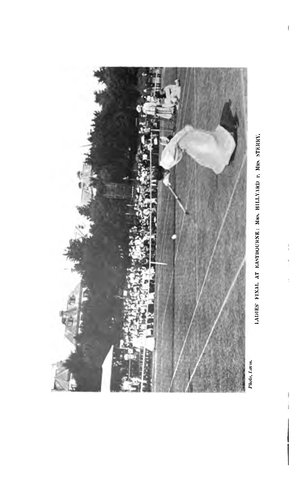
It also credits her with popularising the overhead service in the women’s game, and reproduces a remark attributed to Blanche Hillyard about the power she got on the ball. No source text for that remark was found this session, so it is not quoted here and is reported only as something that page attributes to Hillyard. What can be said is what the second image below shows, which is a woman serving overhead in a photograph printed in 1903, with the racket above and behind her head.
## Naming, and the rules she played under
The event is The Championships, Wimbledon. It has never had Open in its name. It was not open in 1902 in the other sense either: entry was confined to amateurs, and amateurism at this date was a rule about who could afford to travel and compete for a season without being paid before it was a rule about sport. Nothing in this entry is set against any figure from after 1968, when that restriction ended at the four major championships.
The phrase Grand Slam is used twice above and is disambiguated in place. Neither of its two ordinary senses — the four major tournaments taken as a set, and all four won inside one calendar year — was available in 1902; this platform’s own entries record that the four were designated as majors only from the middle of the 1920s.
Nationality: she is described in the sources as English and as British, and she won the championships of all four divisions of the United Kingdom as those competitions then existed, with Ireland undivided. She is described here as she was described at the time.
## Coordinate
The pin is Jesmond Lawn Tennis Club, 102 Osborne Road, Jesmond, Newcastle upon Tyne, and it is 54.993245, -1.602508, with a precision radius of 150 m.
Two independent readings were taken, from producers maintained separately from one another.
1. The Tyne and Wear Historic Environment Record entry 13433 gives an Ordnance Survey easting of 425530 and a northing of 566590 for the club. Converted from OSGB36, which is EPSG:27700, to WGS84, which is EPSG:4326, that is 54.993245, -1.602508. It is the pin.
2. The OpenStreetMap object for the club, way 30153055, tagged with the name Jesmond Lawn Tennis Club, the sport tennis and the address 102 Osborne Road, returns 54.9933144, -1.6021334 from the gazetteer.
The two fall 25.1 m apart.
Two further readings were taken and are reported as corroboration rather than averaged in. The Office for National Statistics centroid for postcode NE2 2TD gives 54.99301, -1.602822, which is 32.9 m from the pin and is a postcode centroid rather than a building. A crowd-maintained plaque database gives the plaque itself as 54.99335, -1.603, which is 34.7 m from the pin.
The grid conversion was checked rather than trusted to one library, by running the same transformation on the statistics office’s own published easting and northing for this postcode and comparing the result against its own published latitude and longitude. They agreed to 1.21 m. The converted position was also checked against the known rough position of Newcastle before anything was built on it, because a grid reference converted against the wrong square origin lands in a different country and looks plausible while doing it.
The mapped outline of the club encloses about 2,120 square metres, or 0.52 acres, and its furthest node lies 60.6 m from the pin. The radius is not set by that. It is set at 150 m because the record above says the club had five grass courts here in 1890 and has three all-weather courts now, with the frontage nearest Osborne Road sold for housing, so the enclosure she played on was larger than the enclosure mapped today and this entry cannot say by how much. No dwelling is pinned and no present occupier is named or implied.
Newcastle upon Tyne has carried no tennis entry on this platform before this one. The nearest entry of any kind is 1.93 km away and belongs to no vertical at all; the nearest belonging to a history vertical is 4.52 km east, at the Roman fort at Wallsend. The nearest tennis entry is 30.6 km south, and it is the entry on Alice Pickering at Tow Law in County Durham — which is to say that the two women who held the ladies’ doubles championship of England together from 1900 to 1902, and kept the cup, are now pinned thirty kilometres apart, one at the church of her father’s parish and one at the gate of her club. Both were pinned within two days of each other and neither was pinned because of the other. Every distance in this paragraph was computed against the platform’s own stored coordinates this session rather than recalled.
The 1902 matches described above were not played here. They were played at the All England Club’s ground on Worple Road in Wimbledon, which this platform pins separately. The year on this entry is 1902 because that is the year the memorial on this ground names, and this entry says so plainly rather than implying a championship was played in Jesmond.
## Cover image
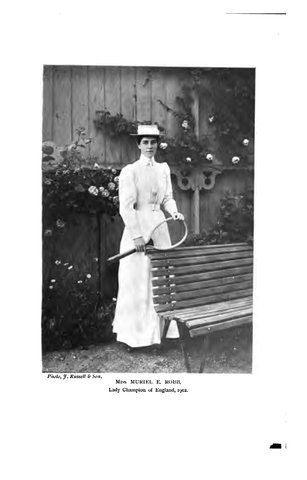
Printed page 173 of Arthur Wallis Myers, Lawn Tennis at Home and Abroad, published in London and New York in 1903, from the Internet Archive scan of the volume, public domain by age. The leaf is numbered n194 by the archive, which is the printed page plus twenty-one, the offset this series has established across this scan. The leaf is 3250 by 5084 pixels and was opened at full size and examined, and the racket count made on a crop enlarged to more than twice page scale.
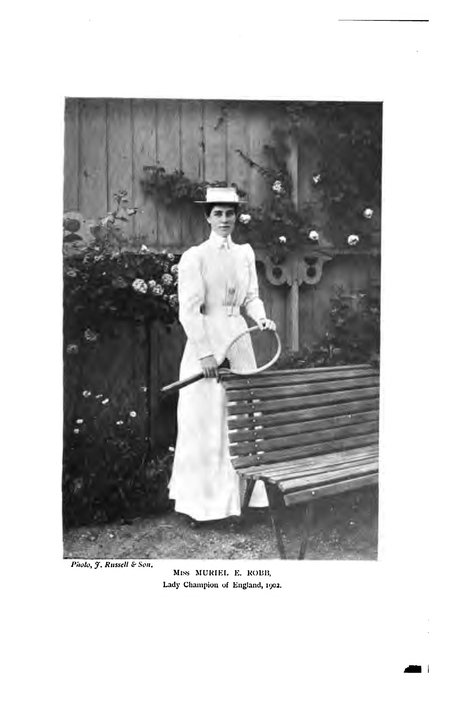
It is a full-page plate. A woman stands outdoors beside a slatted wooden garden bench that runs across the lower right of the frame. Behind her is a tall boarded fence or screen with a decorative pierced panel at the right, and climbing roses in flower over it and over the shrubs at the left. She wears a straw boater with a pale band, a high-collared long-sleeved white dress buttoned down the bodice, and a dark ornament or badge at the breast. Her expression is level and she looks at the camera.
One strung racket is legible. Its head is an open oval below and right of her waist, the stringing visible as a fine mesh, and its handle runs up to her right hand, which grips it at the throat. A second straight dark shaft crosses the frame horizontally at her left hand, which is closed around it with the fingers distinctly visible; the far end of that shaft passes out of the frame at the left and behind the bench at the right, and nothing about it can be resolved. It is not counted as a racket and this entry does not say what it is.
Set in letterpress below the frame, in italic at the left, Photo, J. Russell & Son; and below the centre, in two lines, Miss Muriel E. Robb, Lady Champion of England, 1902.
## Second image
Printed page 123 of the same volume, the leaf the archive numbers n144, same dimensions, opened at full size and enlarged.
A photograph set into the text page, roughly square, at the head of Charlotte Sterry’s chapter on ladies’ play. A woman is caught at the top of a service action on grass, seen from behind and slightly to her right. Her right arm is raised and bent so that the racket head stands clear above and behind her head; her left arm is extended out and slightly up, the tossing arm, and no ball is resolvable anywhere in the frame. She wears a straw boater with a dark band, a white blouse with full sleeves gathered at the wrist, and a white skirt to the ground; her shadow falls hard to her left across the turf, so the sun is high and to the right. Court lines run across the middle distance and a tramline crosses the right of the frame.
Beyond the court a line of onlookers stands and sits along the far side, in pale clothes and hats, one at the far left under a parasol. Behind them a dense belt of trees, and on the skyline at the right, on rising ground above the trees, a substantial building with a tower and a tall chimney.
Set in letterpress below, in italic at the left, Photo, Lavis; and in the centre, Miss Robb Serving.
The caption names no place, and no place is claimed for it here. The building on the skyline is the kind of fixed structure that could identify the ground, and it is left as a lead. What the plate is used for in this entry is narrower and safe: it shows the overhead service, played by this player, in a photograph printed in 1903.
## Images considered and not used
The photograph of the plaque from which its wording was read is held on a photo-sharing site and credited by the plaque database to a named photographer under a Creative Commons attribution licence. The licence could not be confirmed at source this session — the photographer’s page returned HTTP 404 to a constructed URL and no other route to the file page was found — so the photograph is not reproduced here. Reading a page in order to check a fact and republishing it are different acts, and only the first was done. The unblocking condition is precise: locate the file page for photo id 9778189772 on that site and confirm the licence there.
Two copies of the plate at page 119 exist on a media repository at 240 by 365 and 437 by 322 pixels. Both are crops of this same book and both fall below this series’ quality floor, which the 3250 by 5084 archive leaves clear by an order of magnitude. The archive is the source used here.
## Gaps this entry declares
Nothing above is inside quotation marks. The condition this series applies is that machine-read text earns quotation marks only where the same wording was set by two independent printers, and nothing used here satisfies it: one book of 1903 in a single typesetting, one heritage record, one plaque, one encyclopaedia and one local history page. Where a caption, a rim inscription or a credit line is set out in the words cast or printed on the object, that is a description of the object rather than a quotation of a text, and it follows the convention this series uses for the plates in this same book.
No newspaper was read. She was a national champion in four countries and died young in a large newspaper city, and neither the Newcastle press of 1902 nor the London press of the same July was searched this session. That is the route to a quotation, to the identity of the ground in the second image, and to whatever was said in Newcastle when she came home with the championship of England.
Where the ladies’ doubles championship of England was played in 1900, 1901 and 1902 is not established. Nor is how many wins the Welsh covered court ladies’ cup required for an outright win, nor the years of Alice Pickering’s wins in it.
Nothing was read from the club’s own records, from the Lawn Tennis Association, or from the All England Club. The 1902 draw, the scores and the abandonment all reach this entry through one encyclopaedia article and the two published histories it cites, neither of which was consulted at source.
The plaque’s unveiling date is given by the plaque database as 2011 without a month. Two newspaper articles from that year are cited in the encyclopaedia entry, dated 1 February and 11 June 2011, and neither was reachable at the URLs given.
## Status, dated
Read on 7 September 2026. The club is an operating tennis club at this address, with a website and a mapped outline; the plaque database records the plaque as still in place, last updated in 2017. Nothing above should be read as describing any arrangement at the club later than the date of this reading.
## Sources
Arthur Wallis Myers, Lawn Tennis at Home and Abroad, 1903, read as page images and as the archive’s machine-read text rather than through any summarising layer, for the career sequence and the four divisions sentence at printed pages 175 and 176, the Pickering note at 180, Scrivener on the Welsh cup at 80, the Morton note at 185, the chapter authorship in the table of contents and chapter heads, the list of illustrations, and the two plates used: https://archive.org/details/lawntennisathom00myergoog , with the cover leaf at https://archive.org/download/lawntennisathom00myergoog/page/n194.jpg and the second image at https://archive.org/download/lawntennisathom00myergoog/page/n144.jpg .
Encyclopaedia article on Muriel Robb, read as raw wikitext at https://en.wikipedia.org/w/index.php?title=Muriel_Robb&action=raw , for the dates of birth and death, the Welsh, Irish and Scottish years and their citation to Hedges 1978, the club membership and its citation to a 2011 newspaper article, and the single-row finals table. Encyclopaedia article on the 1902 ladies’ singles, read as raw wikitext, for the draw, the round-by-round scores, the All Comers’ final against Agnes Morton, the challenge round against Charlotte Sterry, and the abandonment at 4–6, 13–11: https://en.wikipedia.org/wiki/1902_Wimbledon_Championships_%E2%80%93_Women%27s_singles .
Tyne and Wear Historic Environment Record entry 13433, Osborne Road, Jesmond Lawn Tennis Club, maintained for Newcastle City Council, for the club’s foundation at Fern Avenue in 1883, the move in 1890, the five grass courts, the pavilion, the membership and subscriptions, the rent and the 1920 purchase, the 1973 resurfacing, The Lawns development, the inscribed arch, and the grid reference: https://sitelines.newcastle.gov.uk/SMR/13433 .
Plaque record 7323 in the OpenPlaques database, for the plaque’s address, its erection in 2011 by Newcastle City Council, its colour, its coordinate and the photographs listed against it: https://openplaques.org/plaques/7323 . The inscription itself was read from one of those photographs.
Friends of Jesmond Old Cemetery, profile of Muriel Evelyn Robb, for the parents’ names and occupation, the Wesleyan Methodist foundation of the club, the round-by-round account of 1902, the fifty-three games claim, the comparison with the 1970 final, the overhead service, the remark attributed to Blanche Hillyard, and the claim about age at death: https://jesmondoldcemetery.co.uk/profiles/sports/muriel-evelyn-robb-1878-1907/ . It is a local history society’s page and is characterised as such throughout rather than treated as establishing anything.
Coordinates from the Historic Environment Record grid reference converted with pyproj, from the OpenStreetMap gazetteer and the OpenStreetMap API for way 30153055, and from Office for National Statistics postcode data served through https://api.postcodes.io/ . A Historic England list entry was not sought for this site; that host has returned HTTP 403 to this series in a previous session and is logged as unreachable rather than unchecked.
Every cross-reference to this platform’s own entries and every distance and arithmetic figure above was queried or recomputed this session.
All online material was checked on 7 September 2026.
changes?
delete this memory?
We detected that you have a Blox in your crypto wallet! We will import the Blox into your account.
Click on done below to complete the import.
Welcome Back!
Sign in to preserve cherished moments
Don't have an account?
Welcome!!
Sign up and start preserving cherished moments
?
?

Choose your payment method
Buy with Metablox Credit
Do you want to mint Blox with Metablox Credit?
Which Crypto would you like to use?
Purchase Confirmed!
Your Blox is being minted on-chain and will appear in your profile shortly.
Log in or sign up to claim your Blox.
How many credits do you want to buy?
$100 USD = 1 Metablox Credit = 1 Blox.
Use Metablox Credit to mint any Blox you want on the map.
 expand_more