

Semiconductor History | 3065 Bowers Avenue, 15 April 1974 — The 8080 Makes a General-Purpose Microcomputer Practical
· 1974-4
Personal memoryBy kevin · · Report an issue








































































Find memories left by people near you.
Distribute Bounty
This will distribute the bounty equally among all qualifying memories. This action cannot be undone.
Cancel Bounty
Are you sure you want to cancel this bounty? The remaining amount will be refunded to your account.
Success!
Operation completed successfully.
Error
Something went wrong.
Semiconductor History | 3065 Bowers Avenue, 15 April 1974 — The 8080 Makes a General-Purpose Microcomputer Practical
kevin
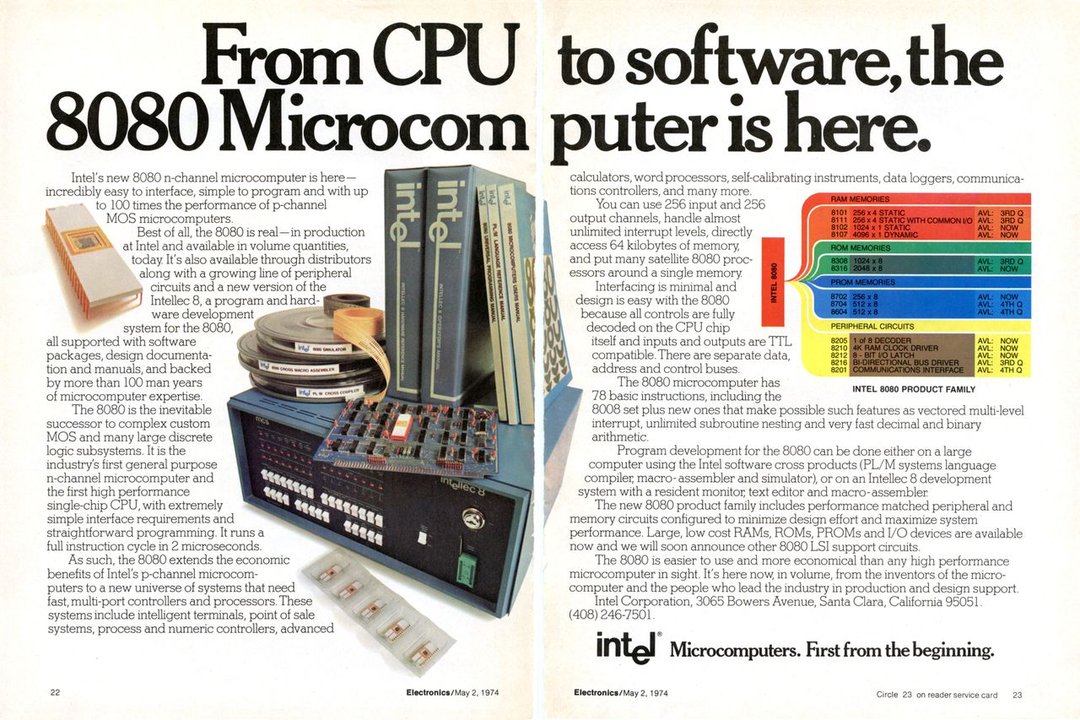
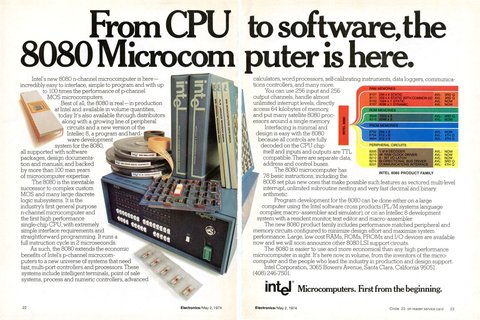
Across two magazine pages, an Intel development system sits beneath a headline that promises everything “from CPU to software.” The advertisement is unusually honest evidence of what made the 8080 important: the chip mattered, but the usable system around it mattered just as much.
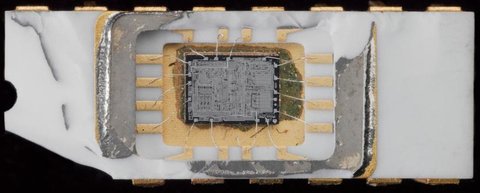
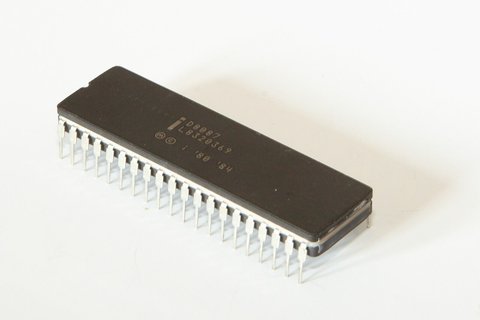
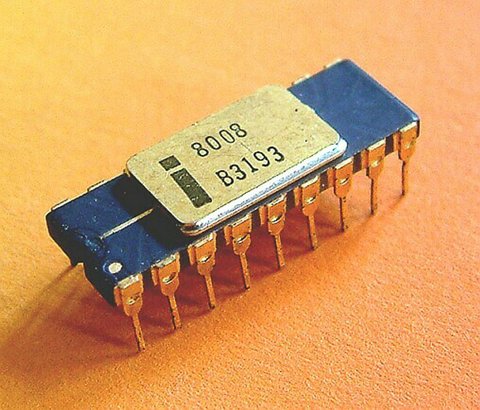
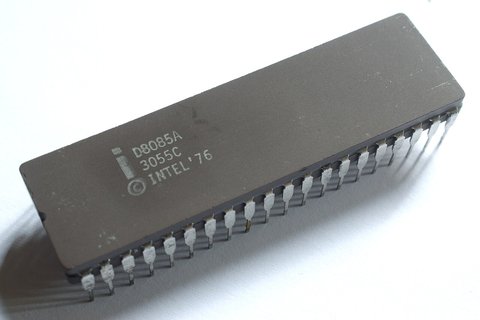
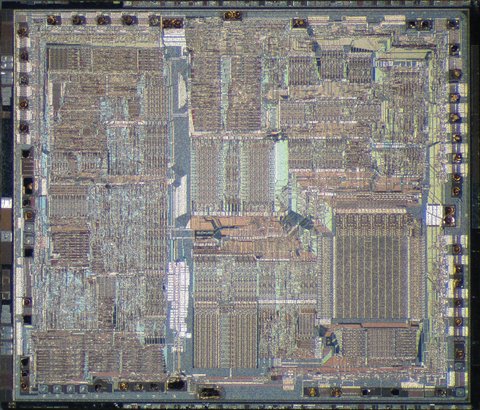
Intel announced the 8080 in April 1974, with an introductory advertisement appearing in Electronic News on 15 April. Masatoshi Shima carried out the chip design under Federico Faggin’s supervision, using a new n-channel MOS process and a 40-pin package that allowed separate 16-bit address and 8-bit data buses.
That package made a more capable general-purpose microcomputer practical.
The processor could directly address 64 kilobytes of memory, work with separate input and output ports, and respond to vectored interrupts. Intel’s contemporary data described a two-microsecond instruction cycle, while Shima later recalled that the design target was a two-megahertz product.
The good was an ecosystem rather than a specification sheet.
Intel supplied manuals, assemblers, higher-level PL/M tools, development hardware, memory chips, and peripheral controllers. Designers could move from an idea to a working control system without inventing every layer themselves, and the 8080 became the processor chosen for machines including the MITS Altair 8800 that helped turn hobbyist microcomputing into a software market.
The first version was not elegant by later standards.
It required multiple supply voltages and external chips for clock and system control, and the development system pictured in the advertisement was far more expensive and cumbersome than the small computers the processor would eventually enable. Intel’s claim of a complete solution therefore depended on customers buying into a substantial family of supporting products.
Competitors learned from both sides of that bargain. Zilog’s later Z80 preserved software compatibility while simplifying system design, yet the 8080 instruction lineage also gave Intel the starting point from which the 8086 and the enduring x86 family were built.
The 8080 was a success because Intel sold more than silicon. It turned a fast component into a platform, and in doing so showed how tools and compatibility could become as defensible as the circuitry itself.
The pin marks 3065 Bowers Avenue, the Santa Clara address printed on Intel’s 1974 advertisement. It is not a public historical attraction; view the site only from public streets and respect current occupants.
Photo: Intel Corporation introductory advertisement, public domain because the advertisement carried no separate copyright notice; scan by Michael Holley, via Wikimedia Commons.










changes?
delete this memory?
We detected that you have a Blox in your crypto wallet! We will import the Blox into your account.
Click on done below to complete the import.
Welcome Back!
Sign in to preserve cherished moments
Don't have an account?
Welcome!!
Sign up and start preserving cherished moments
?
?





Choose your payment method
Buy with Metablox Credit
Do you want to mint Blox with Metablox Credit?
Which Crypto would you like to use?
Purchase Confirmed!
Your Blox is being minted on-chain and will appear in your profile shortly.
Log in or sign up to claim your Blox.
How many credits do you want to buy?
$100 USD = 1 Metablox Credit = 1 Blox.
Use Metablox Credit to mint any Blox you want on the map.
 expand_more