


Semiconductor History | 844 East Charleston Road, 19 April 1965 — A Cost Curve Becomes Moore’s Law
· 1965-4
Personal memoryBy kevin · · Report an issue













































































Find memories left by people near you.
Distribute Bounty
This will distribute the bounty equally among all qualifying memories. This action cannot be undone.
Cancel Bounty
Are you sure you want to cancel this bounty? The remaining amount will be refunded to your account.
Success!
Operation completed successfully.
Error
Something went wrong.
Semiconductor History | 844 East Charleston Road, 19 April 1965 — A Cost Curve Becomes Moore’s Law
kevin
On 19 April 1965, *Electronics* published Gordon Moore’s article “Cramming More Components onto Integrated Circuits.” Moore was then Fairchild Semiconductor’s research and development director, and the pin marks his company workplace at 844 East Charleston Road rather than the magazine’s editorial office or a documented writing room.
Moore plotted the number of components in the most economical integrated circuits and observed that it had roughly doubled each year. Looking ten years ahead, he projected about 65,000 components on a single chip by 1975 and argued that falling cost per component would spread electronics into homes, communications, and computation.
The good was not merely predictive accuracy. By connecting density to manufacturing economics, the article gave chipmakers, equipment suppliers, and computer designers a common expectation: invest now because more capable circuits should become cheaper per function.
That expectation became a planning instrument after Moore co-founded Intel in 1968. In 1975 he revised the long-term pace to approximately one doubling every two years, yet “Moore’s Law” grew into a durable shorthand for coordinated improvements in lithography, device design, factories, and product architecture.
The bad lies partly in the word “law.” It was an empirical forecast about cost-effective integration, not a physical commandment, and treating it as inevitable could obscure the capital spending, engineering labor, environmental burden, and design complexity required to keep the curve moving.
The slogan was also simplified in retelling. Moore did not write in 1965 that transistor counts would double every eighteen months; that familiar interval is a later popular formulation and should not be placed in his original article.
As scaling slowed and leading-edge fabs became vastly more expensive, the industry increasingly relied on chiplets, advanced packaging, specialized accelerators, and three-dimensional integration to continue improving systems. The law’s power was therefore also its danger: a successful coordination story could be mistaken for an automatic property of nature.
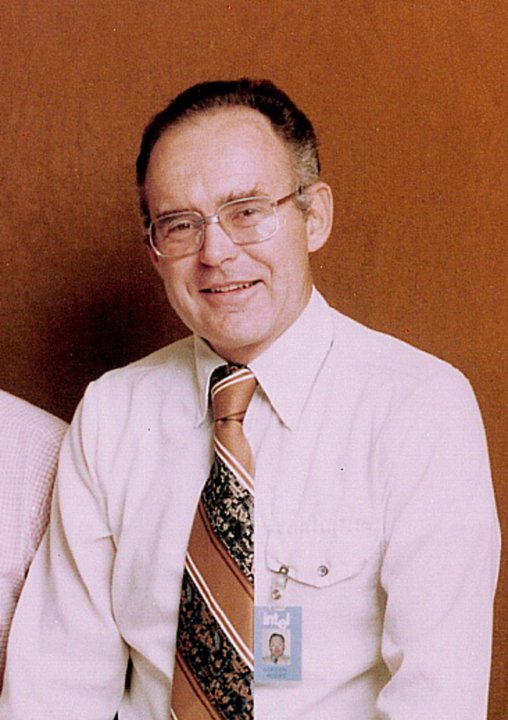
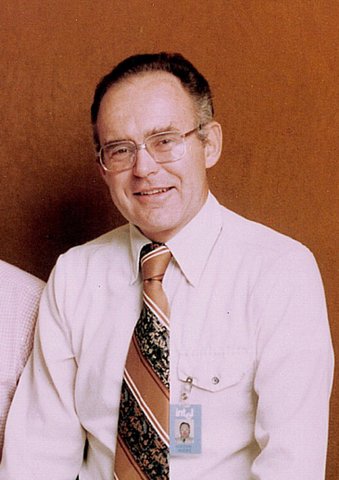
The cover portrait was taken in 1978, thirteen years after the article, and is not a reconstruction of Moore at Fairchild. It represents the engineer whose cost curve became both the semiconductor industry’s most productive roadmap and one of its most demanding expectations.
Photo: Intel Free Press, CC BY-SA 2.0, via Wikimedia Commons




























































changes?
delete this memory?
We detected that you have a Blox in your crypto wallet! We will import the Blox into your account.
Click on done below to complete the import.
Welcome Back!
Sign in to preserve cherished moments
Don't have an account?
Welcome!!
Sign up and start preserving cherished moments
?
?







Choose your payment method
Buy with Metablox Credit
Do you want to mint Blox with Metablox Credit?
Which Crypto would you like to use?
Purchase Confirmed!
Your Blox is being minted on-chain and will appear in your profile shortly.
Log in or sign up to claim your Blox.
How many credits do you want to buy?
$100 USD = 1 Metablox Credit = 1 Blox.
Use Metablox Credit to mint any Blox you want on the map.
 expand_more