


Semiconductor History | Intel Headquarters, 1979 — The Million-Bit Memory Made from Moving Bubbles
· 1979
Personal memoryBy kevin · · updated · Report an issue














































































Find memories left by people near you.
Distribute Bounty
This will distribute the bounty equally among all qualifying memories. This action cannot be undone.
Cancel Bounty
Are you sure you want to cancel this bounty? The remaining amount will be refunded to your account.
Success!
Operation completed successfully.
Error
Something went wrong.
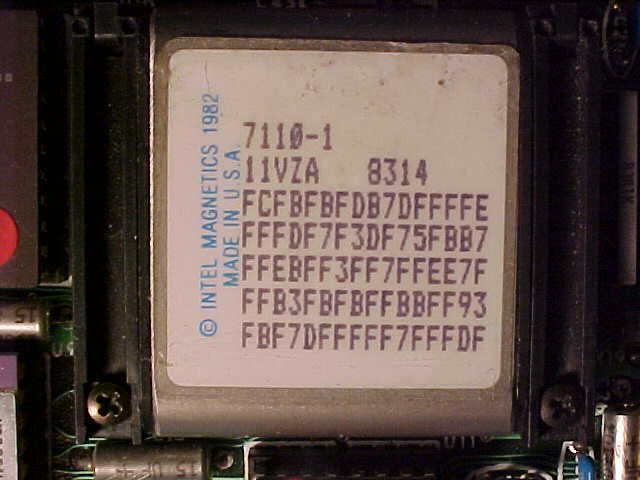
Semiconductor History | Intel Headquarters, 1979 — The Million-Bit Memory Made from Moving Bubbles
kevin
In 1979, Intel Magnetics introduced the 7110, a one-million-bit magnetic-bubble memory system. Intel’s annual report called its megabit chip the first product using the company’s bubble technology and said it offered four times the capacity of competing devices then available.
Bubble memory stored information as tiny magnetized domains moved through a thin magnetic film. It was nonvolatile, retained data without power, required no rotating disk, and promised compact, rugged storage for equipment that could not tolerate a conventional drive.
The good was genuine engineering range. Intel brought a megabit-class solid-state storage system to market before flash memory existed, with error correction and support electronics designed to make an unfamiliar physical effect usable by system builders.
There were real customers, not merely laboratory demonstrations. Intel reported that Mitel’s SX2000 telephone switching system could use as many as eight 7110 modules, providing eight million bits of program storage in a demanding communications application.
The bad was that an ingenious memory technology still had to beat every alternative on cost, speed, density, and simplicity. Bubble systems needed magnetic control structures and supporting circuitry, while semiconductor memory and disk storage followed stronger improvement curves and larger markets.
Intel kept working on the technology, but it never became the universal solid-state replacement its advocates imagined. In 1986, amid heavy losses and restructuring, Intel decided to sell its bubble-memory business rather than continue funding a specialized storage line.
The 7110 was therefore neither a fraud nor a forgotten triumph. It solved real problems and reached production, yet its commercial ceiling illustrates how a technically sound platform can lose when competing technologies improve faster and attract broader ecosystems.
This pin marks Intel’s public corporate headquarters, the institutional anchor for a product developed by the Intel Magnetics organization; it is not presented as the precise fabrication location of every 7110 module.
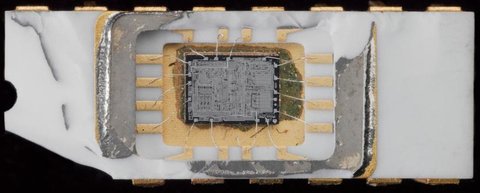
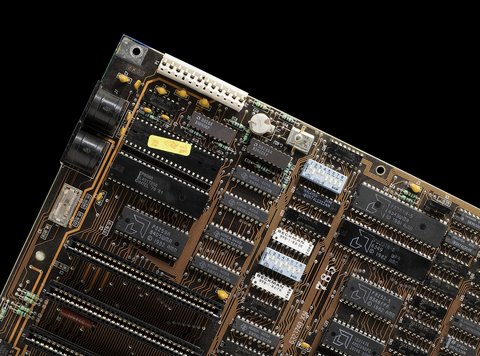
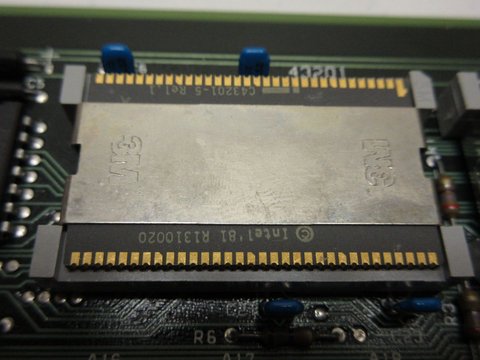
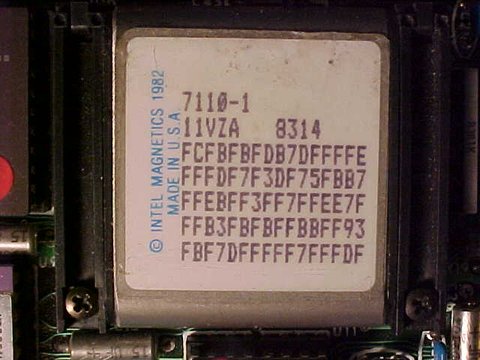
Photo: Michael L. Umbricht, CC BY-SA 3.0, via Wikimedia Commons. The photograph shows an Intel Magnetics 7110-1 bubble-memory module.





















changes?
delete this memory?
We detected that you have a Blox in your crypto wallet! We will import the Blox into your account.
Click on done below to complete the import.
Welcome Back!
Sign in to preserve cherished moments
Don't have an account?
Welcome!!
Sign up and start preserving cherished moments
?
?







Choose your payment method
Buy with Metablox Credit
Do you want to mint Blox with Metablox Credit?
Which Crypto would you like to use?
Purchase Confirmed!
Your Blox is being minted on-chain and will appear in your profile shortly.
Log in or sign up to claim your Blox.
How many credits do you want to buy?
$100 USD = 1 Metablox Credit = 1 Blox.
Use Metablox Credit to mint any Blox you want on the map.
 expand_more